June 2025

A short one from the U.S. Court of Appeals for the Sixth Circuit.

In Wenzel v. Federspiel, No. 24-1278 (June 20, 2025), the Sheriff was accused of keeping “fourteen firearms seized in a criminal investigation that ended years ago.” Slip op. at 1. Eventually, the claimed owners of those guns sued, inter alia, for a taking. You got no proof that these guns belong to you, replied the Sheriff. 

The plaintiffs “do not have any documents proving their ownership,” slip op. at 2, so in support of their motion for summary judgment, they submitted declarations that they owned the guns. We’re not sure whether the Sheriff responded with any evidence of his own. But in the end, the district court granted the Sheriff summary judgment because the plaintiffs “had not established constitutional violations.” Slip op. at 3. 

After first concluding that the Sheriff in his personal capacity was

Continue Reading CA6: A Wrongful Keeping Is A Taking, If Plaintiff Proves He Owns The Kept Property

Take a look at the New Jersey Appellate Division’s opinion in Johnson v. City of East Orange, No. A-2586-23 (June 27, 2025). 

The court vacated the dismissal of a property owner’s takings claim, holding that it was timely. We aren’t going into too much detail because this one is out of our shop. As the opinion notes:

Pacific Legal Foundation, plaintiff’s counsel in the instant matter, represented the plaintiff in Tyler, and appeared as amicus curiae in both the appellate, 257-261 20th Avenue Realty, LLC v. Roberto (Roberto I), 477 N.J. Super. 339 (App. Div. 2023), and state Supreme Court, 257-261 20th Avenue Realty, LLC v. Roberto (Roberto II), 259 N.J. 417 (2025), proceedings in what became the first published authority applying the holding in Tyler in this state.”

Slip op. at 2.  

But here are some of the highlights:

  • A takings claim does not accrue, and


Continue Reading NJ App: Takings Claim Accrues When Govt Keeps Property It Should Return To The Owner

DSCF3117
If you know, you know.

Sad birthday wishes to what just might be our most un-favorite decision ever, Penn Central Transp. Co. v. New York City, 438 U.S. 104 (1978), which turns 46 today. This in addition to the unhappy Kelo-versary earlier this week. A takings and regulatory takings one-two punch! 

Time has not treated the opinion well. Practitioners, judges, and legal scholars across the spectrum have called the three-factor Penn Central test for an ad hoc regulatory taking “demanding,” “fuzzy,” a four-part test, “neither defensible as a matter of theory nor mandated as a matter of precedent,” and “problematic” and “mysterious.”

No one but the Supreme Court professes to understand what that case means. Courts mess up the basic meaning of the factors, treat what is supposed to be a fact-centric “ad hoc

Continue Reading Not A Great Week For Property Rights Anniversaries: Penn Central Turns 46 Today

Check out this story from the Frontier Centre for Public Policy

Most pundits missed it, but Alberta’s revised Bill of Rights just strengthened property rights in a big way. Senior research fellow Joseph Quesnel breaks down how new amendments could protect landowners from regulatory takings—government actions that restrict property use without compensation. He examines key Supreme Court of Canada rulings and explains why every Canadian jurisdiction should take note. Could this be a game-changer for property rights?

As you may know, property rights are not a national constitutional right north of the border as they are here in the U.S. We’re no experts on Canadian law, but in our view it looks like Alberta is heading in our direction, at least as a province. 

Premier Danielle Smith faced controversy last year for amending Alberta’s Bill of Rights. While most commentators focused on the amendments protecting the right to refuse

Continue Reading O, Canada! “Alberta Trailblazing on Property Rights Protections”

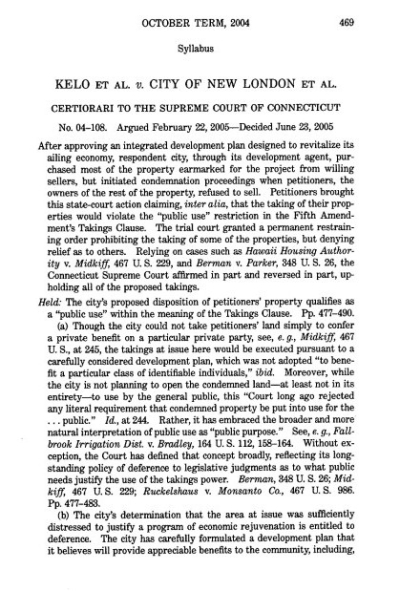
Kelo page - Copy

It hardly seems like two decades have passed. After all, it was a mere 10 years ago we were lamenting “Kelo At 10: Still Stinks, And A Decade Has Not Lessened The Odor.” 

But yes, it was twenty years ago today … the U.S. Supreme Court, by the thinnest of margins, held in Kelo v. City of New London, 545 U.S. 469 (June 23, 2005) that there’s nothing inherently suspect about “economic development” takings to justify a higher level of judicial scrutiny than the judges-as-poodles standard of review applied in Public Use challenges to takings for every other reason.   

Susette Kelo’s home was taken on the claim that it was needed as part of the package of incentives to lure a pharmaceutical company to set up shop in New London, which would in turn, raise the overall economic climate in the city. That butterfly-effect theory was

Continue Reading Unhappy 20th Anniversary, Kelo v. City of New London

It seems very appropriate that we’re posting the Texas Court of Appeals’ decision in Burgess v. City of Wentworth Village, No. 02-24-00252 (June 19, 2025) today, the twentieth anniversary of Kelo v. New London.

Because on the Kelo-versary, we start as the Burgess opinion did: an epigram wherein the court quoted a concurring opinion recognizing the inherent unfairness of eminent domain and how just compensation is very often inadequate:

On occasion, to serve a public purpose, a citizen’s private property must be taken without his consent. We tolerate such intrusions because society cannot function without roads, schools, military facilities, and other vital infrastructure. Eminent domain also requires “just” or “adequate” compensation, to be sure. U.S. Const. amend. V; Tex. Const. art. I, § 17(a). But the condemnation process is complicated, time-consuming, and sometimes confusing. And no compensation can accurately value the sweat, tears, pride, love, beauty, and

Continue Reading Texas App: No, A Taking For A “Short-Game Practice Area” Isn’t Entitled To Judicial Deference Under Post-Kelo Changes

Please add this one to your podcast listening queue: the latest episode of Bound by Oath, produced by John Ross at the Institute for Justice. BBO isn’t a typical podcast, but more of an audio documentary as we have noted before. If you aren’t a subscriber, you really should be. 

This episode focuses on regulatory takings, and the sleight-of-law that governments frequently employ to avoid the merits of takings claims, or perhaps worse yet to avoid paying compensation even after ordered to. Cases detailed include DeVillier, Agins, First English, Violet Dock Port, Ariyan. This episode is a great companion piece to BBO‘s episodes on Euclid (zoning), Pennsylvania Coal (reg takings), and Berman (Public Use). 

Put on your “self-executing” hat and take a listen! 

Here’s the description of the episode:

The Fifth Amendment says that the government must pay just compensation when it takes

Continue Reading Must-Listen Podcast: “Neat Takings Tricks” (Bound by Oath, S3, E3)

Today is a good day to remember that legal emancipation had its roots in the “contraband” property theory. Here’s a post from a few years ago where we visited what we called “The Birthplace of a More Perfect Union” (Fort Monroe, Virginia).

The contraband property theory was itself very imperfect, and a compromise theory driven by practicality and politics. But it was a legal theory that laid the foundation for a general acceptance of emancipation, and led inexorably to the Emancipation Proclamation, and the Thirteenth, Fourteenth, and Fifteenth Amendments. 

A good reminder that property law and property rights are not primarily about land, or dirt, or “development,” but about freedom and human rights.

Continue Reading A Juneteenth Reminder: Emancipation Had Its Roots In The Property-Based “Contraband” Legal Theory

In 2021, the Iowa Supreme Court held that a police search of garbage left at curbside for pickup was unconstitutional under the Iowa Constitution’s search and seizure clause. A local ordinance made scavenging through someone’s garbage illegal, which to the court meant that the garbage owner possessed a government-recognized property right in the trash, and the police search was similarly illegal.  

In Iowa v. Amble, No. 23-2114 (June 13, 2025), the Iowa Supreme Court concluded that that was then, this is now. In the aftermath of the 2021 case, the Iowa Legislature adopted a statute which deemed curbside garbage to be abandoned property. The statute also forbade municipalities from enacting ordinances or adopting regulations which would create a “reasonable expectation of privacy in garbage placed outside of the person’s residence for waste collection in a publicly accessible area.”

Flash forward to today: Des Moines police searched garbage bags which

Continue Reading Iowa: Govt-Granted Property Rights Can Be Altered By The Legislature

The bottom-line holding in the U.S. Court of Appeals’ recent opinion in Appalachian Voices v. Fed. Energy Reg. Comm’n, No. 24-1094 (June 6, 2025), that FERC was ok when it allowed a pipeline company an extension of time to complete the project isn’t all that surprising. And indeed, it isn’t all that interesting except to you FERC nerds. And were the court to have stopped there, we likely would not have posted this one.

But do yourself a favor and skip the majority opinion (unless, of course, you are a FERC nerd, then by all means don’t skip it), and check out the concurring opinion. Scroll all the way to page 24 of the pdf, where Judge Henderson sums up well the vibe in this case and other similar challenges to not just pipelines, but to pretty much everything.

We have labels for these type of objections, from NIMBY

Continue Reading Death By A Thousand Days: The Courts “have enabled interest groups to transform the bench into a tool to stymie any new development. It is long past time to correct our mistake.”