May 2025

Daunting

You know the claim: even after the federal courts opened back up to regulatory takings claims, winning a case is still pretty difficult. 

Yes, that may be by design: maybe it’s not supposed to be easy to get in the way of the regulatory state and prevail on a claim that a government action has “gone too far” by having similar effects on the owner’s property rights as an exercise of eminent domain. Or maybe it is. But either way, those of you who have been at this long enough can sense that something isn’t quite right. That our property owners are not getting a fair shake from the courts. That there’s an imbalance in The Force. 
Whether it is surviving a motion to dismiss where the court applies stricter pleadings standards than in other civil cases, or getting to the merits by escaping summary judgment, or even having

Continue Reading New Article: “Daunting Odds: Regulatory Takings Claims in The United States Circuit Courts of Appeals,” 94 Miss. L. J. 637 (2025)

In 1996 (you remember 1996, don’t you?), Corey purchased a vacant parcel, adjacent to a busy crossroads, and thus an ideal location for a truck stop. Problem was that the zoning was C-2, which didn’t permit truck stops (although it did allow gas stations and convenience stores).

So began a 25+ year odyssey, which in Corey v. Rockdale County, No. 23-13097 (May 7, 2025), the U.S. Court of Appeals held that Corey’s takings claim was not ripe because the County amended the challenged zoning ordinance around his earlier claim, and he had not received the County’s confirmation under the most recent version of its zoning that the truck stop Corey had been trying to build was a definite no-go. 

Let’s start at the beginning. To us, it seems like the takings claim was ripe back in 1999:

In 1999, Corey asked the County if its zoning regulations

Continue Reading CA11: 25-Year-Old Takings Case Isn’t Ripe

1000002646

It was on this day in 1928 when the U.S. Supreme Court issued its second most famous decision about zoning, Nectow v. City of Cambridge., 277 U.S. 183 (1928). 

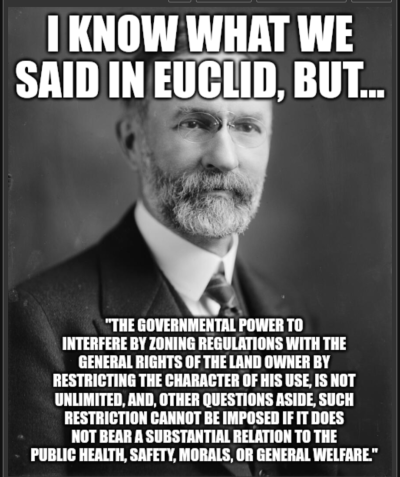
We say “second” because everyone knows that the first is the Court’s decision issued just two years earlier which generally upheld comprehensive use, height, and density regulations as a valid exercise of the government’s police power to regulate property uses to further the public health, safety, welfare, or morals. See Village of Euclid v. Ambler Realty Co., 272 U S. 365 (1926). 

Partly because of the hype surrounding Euclid and the broad governmental embrace of exclusionary land use policies that Euclid unleashed, we think that Nectow has not received the attention it is due. After all, it should be seen as the companion case to Euclid: it was authored by same Justice who wrote Euclid (Justice Sutherland)

Continue Reading Happy 97th Birthday, Nectow v. City of Cambridge!

Naturalpropertyrights

The long-awaited book from lawprof Eric Claeys, “Natural Property Rights” (Cambridge Press 2025) has dropped.

More, after we’ve had a chance to read it.

Now mind you, in the hardcover edition the thing ain’t exactly cheap (£100 GBP from Cambridge, or $130 from Amazon). But frankly, for an academic book the price isn’t bad.

And if the table of contents and the sampler sections posted here, it looks like it will be well worth it.

Here’s a summary of what you’ll get:

Natural Property Rights presents a novel theory of property based on individual, pre-political rights. The book argues that a just system of property protects people’s rights to use resources and also orders those rights consistent with natural law and the public welfare. Drawing on influential property theorists such as Grotius, Locke, Blackstone, and early American statesmen and judges, as well as

Continue Reading New Book: “Natural Property Rights” (Eric Claeys)

A brief, but important, decision from the U.S. Court of Appeals for the Second Circuit.

In Sikorsky v. City of Newbergh, No. 23-1171 (May 2, 2025), the court held that the plaintiff adequately pleaded a regulatory takings claim which was based on Tyler v. Hennepin County, where the U.S. Supreme Court held that a government violates the Fifth Amendment if it seizes and liquidates property in order to satisfy the owner’s tax debt, but “keeps the change” and retains any proceeds in excess of the tax debt.

Here, Sikorsky purchased a home but failed to pay $92,786 in taxes, and the city eventually foreclosed. The city sold the home for $250,000 more than Sikorsky owed in taxes, “but refuses to give him the surplus.” Slip op. at 3. He sued, and the district court dismissed:

Two months after Tyler was decided—and seemingly without reference to it—the District Court

Continue Reading CA2: The Harm In Home Equity Theft Takings Is Government’s Retention Of Surplus Equity

Screenshot 2025-05-04 at 11-03-11 1033 Exchanges Advanced Strategies for Optimal Tax Deferral ALI CLE

Want to learn of some of the options available to property owners whose land is taken by eminent domain (or, even more sadly, destroyed by a disaster)?

Then you should sign up for next week’s ALI-CLE webinar, “1033 Exchanges: Advanced Strategies for Optimal Tax Deferral.”

Here’s a description of the program:

When property is lost due to an involuntary conversion such as a taking by eminent domain, destruction by natural disaster, or theft, many clients assume they must immediately face a significant tax burden from compensation received. However, IRS §1033 provides a powerful alternative—tax-deferral through strategic reinvestment. Understanding the nuances of 1033 exchanges allows attorneys to guide clients through the process, ensuring they maximize tax benefits and rebuild wealth effectively.

Join us for this comprehensive CLE course designed to equip legal professionals with the knowledge and tools needed to navigate 1033 transactions with confidence.

With our colleagues Alan Continue Reading ALI-CLE Webinar: Tax Consequences Of Eminent Domain (May 13, 2025)

We had to read the facts of the Tennessee Court of Appeals’ opinion in City of Pigeon Forge v. RLR Investments, LLC, No. E2023-01802-COA-R3-DV (Apr. 20, 2025) a couple of times over, just to make sure we were understanding what was going on. But the effort was worth it, just because of the unusual arguments presented. Check it out.

RLR owned two adjacent properties, the first used for a hotel, the second for a duplex, parking area, and open green space. So far so good. The city took portions of each for a greenway. It also took temporary construction easements on each parcel. Check. The city sought immediate possession. Got it. The owner objected to public use and the quick take, but the trial court agreed with the city, and entered an order of possession. Understood.

Here’s where it gets squirrelly. RLR, the property owner, sought to enforce the order

Continue Reading It’s The Vibe: Taking Of Condemnee’s Property To Replace Property Taken From Condemnee Is A Public Use

Partial taking for highway project. You know what that means: severance damages. And you also know that often means a “general or special” benefits fight over how the remainder parcel may have been improved by the project, and whether these benefits can reduce the severance owed.

Before-the-project condition: undeveloped land on a frontage road with no nearby connection to the freeway. After-the-project condition: remainder property has direct freeway access, an increase in traffic to the site and easier ability to enter/exit, and curb and sidewalk improvements. The trial court concluded these specially benefited the remainder property, and could be offset against compensation.

In Utah Dep’t of Transportation v. Boggess-Draper Co., LLC, No. 20220875 (May 1, 2025), the Utah Court of Appeals disagreed. In accordance with a Utah Supreme Court decision, benefits that may be used to offset compensation must be those which “affect the land itself,” and increase “the

Continue Reading Friends Without Special Benefits: Direct Access To Interstate Is General Benefit

Here’s the latest in a case we’ve been following.

This is Fane Lozman. You know his name. Yes, the guy who has taken on the City of Riviera Beach, Florida twice at the Supreme Court, and is now coming back for a third shot on goal. Houseboat guy. Public hearing gadfly guy. And now, maybe the ripeness guy.

Lozman has filed a cert petition asking the Court to review the Eleventh Circuit’s opinion which dismissed his regulatory takings claim as unripe.

Here’s the Questions Presented:

Fane Lozman has a contentious relationship with the City of Riviera Beach, Florida. The City’s mistreatment of Mr. Lozman has twice required this Court’s intervention. See Lozman v. City of Riviera Beach, 568 U.S. 115 (2013); Lozman v. City of Riviera Beach, 585 U.S. 87 (2018).

In this third chapter, Mr. Lozman was forced to sue the City

Continue Reading SCOTUS Hat Trick? Houseboat Guy Returns For Shot At Lucas Ripeness

Here’s more on an issue we recently covered involving Texas’s “depopulation” of captive white-tailed deer in order to curb Chronic Wasting Disease. In the earlier opinion, the court held that the owner of a deer-breeding facility did not have a property interest in the deer, and thus could not assert a due process or takings claim.

The court in Young v. Texas Parks & Wildlife Dep’t, No. 15-24-00052-CV (Apr. 24, 2025) reached the same conclusion. We’re posting the latest opinion because it elaborates on the “ferae naturae” issue, and every law student and lawyer’s old (very old) friend, the rule of capture

The court rejected the owner’s arguments:

Comparing the facts in Tyler to those here, Young argues that the common law doctrines of ferae naturae and the rule of capture existed long before the Texas Legislature stepped in and began regulating white-tailed deer. In

Continue Reading More On That White-Tailed Deer Takings Case: Law Of Capture Subject To Public Trust