Recently, we read Professor Sara C. Bronin‘s recent book, “Key to the City: How Zoning Shapes Our World.”Continue Reading Book Review: “Key to the City: How Zoning Shapes Our World,” Sara C. Bronin
January 2025
One Last Chance To Join Us For The 42d ALI-CLE Eminent Domain & Land Valuation Litigation Conference (San Diego & Webcast)
With our tongues firmly planted in cheeks, the Planning Chairs for the upcoming 42d edition of this popular and venerable Conference bring you this “breaking news” report from San Diego!
As you know, in addition to being the best nationally-focused conference on the subjects that we love and a venue that is nearly certain to have some of the warmest winter weather in the continental United States, and we went on-location from some of the local highlights: the beaches, Torrey Pines, the Zoo, Balboa Park, the Gaslamp Quarter, and Coronado to name but a few.
More about the Conference here, including registration information.
Here are some of the highlights:
- Property Rights at the Supreme Court: DeVillier and Sheetz and What’s Next
- Slow Take: Possession, Rent, Relocation, and Offset
- The Jury’s View: How Jurors See Your Case
- From Penn Coal to Penn Central: How to
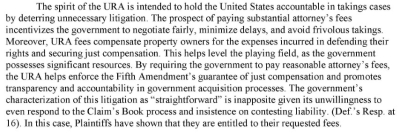
CFC: Attorneys Fee Shifting “incentivizes the government to negotiate fairly, minimize delays, and avoid frivolous takings”
One from the U.S. Court of Federal Claims that is worth your time at least to skim. And the opinion is worth reading if only for the court’s conclusion which we’ve reproduced above.
Hyatt v. United States, No. 23-399 (Jan. 16, 2025) is, as the court described it, “a typical rails-to-trails action[.]” The issue resolved here was how much the property owners were entitled to recover in attorneys fees and expenses, now that they prevailed on the merits.
Under the Uniform Relocation Act, a property owner who obtains compensation for a regulatory taking may recover reasonable attorneys fees and costs. The opinion noted:
Specifically, in actions brought under the Tucker Act or the Little Tucker Act in which a plaintiff is compensated for the taking of property, the URA provides for the recovery of “such sum as will in the opinion of the court or the Attorney General reimburse…
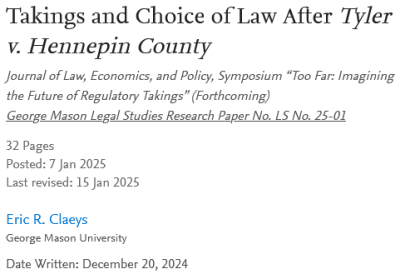
New Article (Eric Claeys): “Takings and Choice of Law After Tyler v. Hennepin County”

Check out this article, forthcoming in the George Mason Journal of Law, Economics, and Policy from lawprof Eric Claeys, “Takings and Choice of Law After Tyler v. Hennepin County.”
This is one of the pieces coming out of the recent symposium “Imaging the Future of Regulatory Takings” at George Mason Law School.
Here’s the Abstract:
This Essay contributes to a symposium on the future of regulatory takings. It focuses on choice of law in eminent domain disputes. When claimants bring eminent domain claims in federal courts, the courts must determine whether the claimants have constitutional “private property” in the entitlements allegedly taken. Should that determination be made with federal law, with the law of the state allegedly taking property, or law from some other source?
The 2023 Supreme Court decision Tyler v. Hennepin County addressed that issue. Under Tyler, it is a federal question whether an eminent domain claimant has constitutional private property. To answer the question, federal courts usually consult the law of the state where the alleged taking took place. But that presumption applies only if state law seems to secure and not to circumvent the federal right. And if that reservation is not satisfied, federal courts may consult a wider pattern of legal sources—Anglo-American history, the general law of the several United States, federal court precedents, and a broader cross-section of law from the state allegedly taking property. That approach resembles the approach taken generally for federal constitutional rights—especially in Indiana ex rel. Anderson v. Brand (1938)—but varies from the general approach in the sources it makes relevant to settle what counts as private property under the Fifth Amendment. This Essay interprets Tyler, and it offers a normative justification for Tyler’s approach to choice of law in eminent domain.
Don’t miss this one.Continue Reading New Article (Eric Claeys): “Takings and Choice of Law After Tyler v. Hennepin County”
Bees May Be Fish In California, But Here In Colorado, Elephants Ain’t Persons
What to say about the Colorado Supreme Court’s recent decision in Nonhuman Rights Project v. Cheyenne Mountain Zoo, No. 24SA21 (Jan. 21, 2025), wherein the court resolved the momentous and highly controversial question of whether an elephant is a person?
Our first temptation is to see this through the takings lens (surprise), and snark that courts seem be very willing to consider ridiculous cases like this one, determine whether a monkey owns a “selfie” that he snapped, and rule that bees qualify as “fish” in a statute because the legislature didn’t think to modify the term “invertebrate” in a list of marine invertebrates with the term “marine” — yet it is beneath the dignity of judges to consider cases where — oh, the humanity! — they may be called on to be Super Zoning Boards of Appeals.
Our other snarky thought was the outcome of this case…
Continue Reading Bees May Be Fish In California, But Here In Colorado, Elephants Ain’t Persons
Friday Dirt Law Round-Up
Here’s what we’re reading this day:
- Christian Britschgi (Reason), “18 Months After Wildfires Destroyed Some 2,000 Homes on Maui, Only 3 Have Been Rebuilt“
- Christy DeSmith (Harvard Gazette), “Study says tighter land-use controls hurt productivity, innovation among builders, fuel housing crisis“
- Steven Greenhut, “If California Can Suspend Permitting Rules After Wildfires, It Can Abolish Them“
- Carol N. Brown (Medium), “A Civil Rights Defense of Gentrification“
- Michael J. Crosbie (Common Edge), “Unlocking the Mysteries of Zoning” (a review of Key to the City: How Zoning Shapes Our World (Sara Bronin)
Good weekend reading as well. Continue Reading Friday Dirt Law Round-Up
Mass SJC: State Requiring Municipalities To Adopt Multi-Family Zoning Is Enforceable By AG…But

The only courthouse we know where the Supreme Court
is below the Court of Appeals (SJC on the second floor,
appellate court on the third)
A brief one from the Supreme Judicial Court of Massachusetts.
In Attorney General v. Town of Milton, No. SJC-13580 (Jan. 8, 2025), the court rejected a challenge to a state statue which allowed the Massachusetts Bay Transportation Authority, the public transit authority in the Boston area, to require municipalities which access the T loosen their zoning regimes to “provide for at least one district of multifamily housing ‘as of right’ near their local MTBA facilities.” Slip op. at 3. One town declined to do so, and the state AG sued to enforce the statute.
The town responded by challenging the statute’s validity and the AG’s authority to sue to enforce it. Yes on both counts held the SJC. But (and there’s a…
Hawaii Supreme Court Arguments: Is Just Compensation For Even A Small Slice Of A Primo Hawaii Beach Zero?

Here’s the latest in a case we’ve been following for a long time.
As we previously noted, the Hawaii court of appeals affirmed a trial verdict that the just compensation owed to littoral property owners for the State’s regulatory taking of small portions of accreted beach is zero.
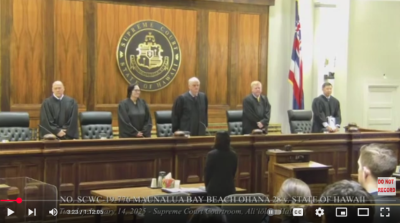
Last week, the Hawaii Supreme Court heard oral arguments. Here’s the video (sorry, can’t embed it here). Worth watching, if only because questions of just compensation and how it is calculated rarely are presented to this court (which is a frequent flyer in regulatory takings cases).
Here’s a description of the case and issues from the Hawaii Judiciary:
Petitioners Maunalua Bay Beach Ohana 28, Maunalua Bay Beach Ohana 29, and Maunalua Bay Beach Ohana 38 brought an inverse condemnation action against the State of Hawai‘i in 2005. At that time, they argued that the State effected a taking of accreted lands via Act 73 of 2005. In 2009, the Intermediate Court of Appeals (ICA) held that Act 73 “effectuated a permanent taking of littoral owners’ ownership rights to existing accretions to the owners’ oceanfront properties that had not been registered or recorded or made the subject of a then-pending quiet-title lawsuit or petition to register the accretions.” Maunalua Bay Beach Ohana 28 v. State, 122 Hawai‘i 34, 57, 222 P.3d 441, 464 (Ct. App. 2009).
On remand from the ICA, Petitioners sought just compensation for the alleged temporary taking of their accreted lands between 2005 and 2012. At trial, the circuit court concluded that $0 was just compensation for the alleged temporary taking of the accreted land and no nominal damages should be awarded to the petitioners. It also determined that the petitioners were not entitled to attorney’s fees.
The ICA affirmed the circuit court’s decision. With regard to attorney’s fees, the ICA held that the petitioners’ “claim for attorneys fees against the State for obtaining declaratory relief is barred by sovereign immunity.” The ICA further held that the Ohanas were not entitled to attorney’s fees under the private attorney general doctrine.
In their application for certiorari, the petitioners argue that the ICA erred in affirming the circuit court’s award of $0 in just compensation with no nominal or severance damages. Petitioners also contend that the ICA erred by concluding that sovereign immunity bars an award of attorney’s fees, and that they would not be entitled to fees under private attorney general doctrine. The State contends that the ICA did not err in affirming the circuit court’s award of $0 in just compensation or declining to award nominal damages to petitioners. It also argues that the ICA correctly held that sovereign immunity bars petitioners’ claim for attorney’s fees, and that even if it did not, petitioners would not be entitled to attorney’s fees under the private attorney general doctrine.
We watched live, and have a couple of thoughts:
- Justice McKenna’s questions indicate she recalls that in an earlier regulatory takings case, the court concluded that even “speculation value” was enough to place a regulatory takings claim outside a Lucas wipeout analysis, an indicator that in this court’s view, property always has value, even if it has no use. Is that enough to say the owners here were entitled to, at the very least, nominal just compensation?
- Does obtaining a decision holding the State to its constitutional obligation (after which the State repeals the unconstitutional statute) qualify the plaintiff for fee recovery from the State under the private attorney general doctrine, even where the adjudicated compensation is zero? We think so, because suing to keep the State in line when it has acted beyond its authority is exactly the kind of thing that the Attorney General should do (but didn’t here, because it has been too busy defending the State’s action). What about the advocate for the State who argued that there was no constitutional wrong here, because of the zero compensation verdict (the notion that the Takings Clause does not prohibit takings, only uncompensated takings)? The fact that the State withdrew the offending statute after the plaintiffs won the takings claim seems to contradict that argument because at the heart of it, the court ruled that the State should have used its eminent domain power to take future accreted land, and not the police power.
Stay tuned. We’ll continue to follow along and will post the court’s opinion when issued.Continue Reading Hawaii Supreme Court Arguments: Is Just Compensation For Even A Small Slice Of A Primo Hawaii Beach Zero?
New Cert Petition: SWAT Takings, Part X
Here’s the latest in a case (and issue) we’ve been following.
In this latest iteration of what we call the “SWAT takings” issue, the Sixth Circuit, like every other federal appellate court, denied the owner of property severely damaged in the course of a police dislodging of a criminal suspect. But the court applied a different analysis. Instead of (incorrectly, we think) looking and whether the police were acting with the scope of their (ha!) police power, the court concluded that the police had a “privilege” to enter, so thus could destroy in the course of that entry, the petitioner’s property.
In short, your bundle of sticks never included the right to exclude the po-po.
Here’s the Question Presented:
A few weeks ago, this Court denied certiorari in Baker v. City of McKinney, 23-1363, a case about whether the Fifth Amendment’s Takings Clause re-quires compensation when a…
Cal SCt Petition: Does “Existing Structures” Protected By The California Coastal Act Mean Only Those Existing In 1977?
You remember 1977, don’t you? No? Well surely you must know the soundtrack. Sublime and deeply resonant music, accompanied by complex-yet-meaningful lyrics like these:
I’m your boogie man, that’s what I am.
I’m here to do whatever I can.
Be it early morning, late afternoon.
Or at midnight, it’s never too soon.
To wanna please you, to wanna keep you.
To wanna do it all, all for you.
I wanna be your, be your rubber ball.
I wanna be the one you love most of all, oh, yeah.
I’m your boogie man
I’m your boogie man, turn me on.
We dig it. After all, we there, tuning in on AM radio at a time when disco dominated, before it fell from grace and then became hip again.
Well dust off your 1977 vibes. The year Elvis left the building for good, when Star Wars was just “Star Wars” and…