September 2024

BK banner

Here’s the full report from David Morrill about the 21st Brigham-Kanner Property Rights Conference earlier this month. Pictured above: Professor James Stern (responsible for the overall planning of the B-K Conference), this year’s Prizewinner Professor Lee Fennell (U. Chicago Law School), and Andrew Brigham, St. Augustine, Florida – property rights lawyer extraordinaire).

Here are what Prof. Fennell had to say:
Upon accepting the Property Rights Prize, Fennell said that spending time in myriad places through the years piqued her interest in how property can work better for complex systems like large and interconnected cities and ecosystems. In the process, she tried to learn more about what sorts of interconnectedness matter most for humans and other animals, and what forms of adaptability and property forms can best serve needs going forward.

“We can’t make any headway on property as an institutional response to interdependent systems without practicing interdependence ourselves, getting together

Continue Reading 21st Brigham-Kanner Property Rights Conference Report

Here’s a recently-filed cert petition which raises two questions about the constitutional calculation of just compensation.

Here are the Questions Presented:

A county unquestionably used real property that denied access to private property and allowed the private property owner to restore the denied access at the owner’s own expense, without county reimburse- ment. Although at trial a jury awarded substantial damages, the appellate court would eventually reduce damage to zero. The questions presented are:

1. When the government undisputedly takes a real property right, does a court have an independent duty to ensure that just compensation is more than $0?

2. Where there is a temporary taking of property rights, is it required under the Fifth Amendment to measure just compensation using the rental value of the property for the time it is taken?

Follow along on the Court’s docket here.

Petition for a Writ of Certiorari, CBS MN

Continue Reading New Just Comp Cert Petition: Is $0 Just Compensation Constitutional?

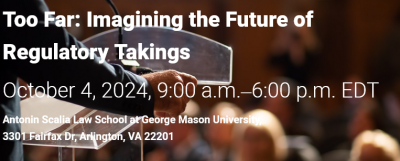
Screenshot 2024-09-26 at 09-41-29 Too Far Imagining the Future of Regulatory Takings

There’s still time to join us next Friday, October 4, 2024, at the Antonin Scalia Law School (George Mason University) for the symposium “Too Far: Imagining the Future of Regulatory Takings.”

Co-produced by our outfit (Pacific Legal Foundation) and the Journal of Law, Economics & Policy, the symposium will feature the most cutting-edge legal academics and courtroom practitioners discussing what is on the horizon in regulatory takings. Here’s the description of the program (full agenda and presenter list below):

A century ago, Supreme Court Justice Oliver Wendell Holmes cautioned government that if property regulations went “too far,” they would be “recognized as a taking.” Flash forward to today, where governments are constantly trying to push the limits while the courts struggle to define what exactly “too far” means.   

Join Pacific Legal Foundation and George Mason University’s Journal of Law, Economics, and Policy for a day-long symposium

Continue Reading Too Far: Imagining the Future of Regulatory Takings (Friday, Oct. 4, 2024)

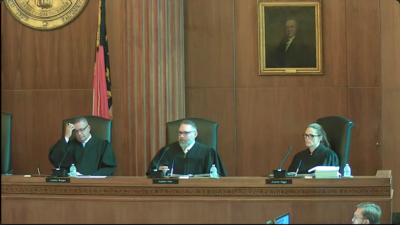
Screenshot 2024-09-25 at 09-31-31 206PA21 and 410PA18-2 Town of Apex v Rubin - YouTube

Here’s the latest in a case we’ve been following (and in which we filed an amicus brief in favor of the property owner).

Yesterday, the North Carolina Supreme Court heard oral arguments in Town of Apex v. Rubin. Here’s a link to the recording (YouTube prevents us from embedding it, sorry).

This is a somewhat unusual case. The Town of Apex sought to take an easement across Rubin’s land. She objected, asserting the taking was not for a public use or purpose, but rather to benefit a private party: a developer who needed the easement to connect two of his non-contiguous parcels to the municipal sewer system, a precondition of the Town’s development approvals for his proposed residential subdivisions.

While Rubin’s public use objection was pending, the Town went ahead at installed the sewer line, purportedly under its quick-take power. That was not the best of moves, however, because

Continue Reading Unringing The Bell: NC Supreme Court Arguments – What Happens If A Taking Lacks A Public Use, But They Take It Anyway?

Heads up: the second episode of the rebooted Eminent Domain Podcast is live, with host Bobby Debelak and guest law professor Ilya Somin. Here’s the description of this ep:

Professor Ilya Somin of George Mason University and the Cato Institute discusses his work in drafting amicus papers in the Kelo case, working with Jane Jacobs, writing a book on Kelo (The Grasping Hand) a decade after the decision, and his current work on the costs of exclusionary zoning. Throughout, Bobby and Prof. Somin discuss the common ground that otherwise-differing philosophies find in property law.

We’re not going to post up every new episode (you really should subscribe and get notifications yourself), but we figured while the podcast was getting its sea legs back it couldn’t hurt to remind you. Check it out. Continue Reading New Ep, Eminent Domain Podcast: Lawprof Ilya Somin

In Turner v. Jordan, No. 22-13159 (Sep. 17, 2024), the U.S. Court of Appeals for the Eleventh Circuit held that even though the federal courts have jurisdiction over Turner’s takings claim, the court nonetheless has the discretion to choose to wash its hands of the case in order to protect a state’s administrative procedures.

This is one of those home equity takings cases, with the twist here being that Turner claims that because Florida officials failed to account for his homestead exemption, his property sold for half of what it should have at a property tax foreclosure sale. He alleged that with the exemption, the sale would have netted him some equity to which he was entitled. The district court dismissed for comity reasons, and the Eleventh Circuit affirmed.

Of course, the opinion pays lip service to the more-often-in-the-breach-than-in-the-observance principle that “federal courts have a ‘virtually unflagging obligation …

Continue Reading Comity Of Errors: CA11 Chooses Nondisruption Of State’s Administrative Process Over Constitutional Right To Compensation

On the surface, the Virginia Court of Appeals’ opinion in Town of Iron Gate v. Simpson, No. 1588-23-3 (Sep. 17, 2024) deals with a straightforward issue in a straightforward way: the property owner’s inverse complaint adequately alleged that the Town’s flooding of her property was for a public use, and thus properly survived the Town’s demurrer.

As the Virginia Supreme Court has held, one of the elements of pleading a legally-adequate inverse condemnation complaint for flooding is an allegation that the flooding was for some public use. The court of appeals rejected the Town’s argument that Simpson failed to allege public use, holding that the complaint’s allegation that the Town “used her ‘property as a ‘makeshift storage site for excess stormwater,’ which was accomoplished for the public use of maintaining and operating the Town’s stormwater system[,]'” was certainly good enough:

She alleged that the Town “purposefully uses, operates

Continue Reading Va App: It Doesn’t Take Much To Allege Public Use In Inverse Condemnation

On the day we celebrate Constitution Day (or should we say Khaaaaan-stitution Day?) we have to admit that pretty much nothing beats One Named Kirk’s reading of the Preamble

KIRK: This was not written for chiefs.Hear me! Hear this! Among my people, we carry many such words as this from many lands, many worlds. Many are equally good and are as well respected, but wherever we have gone, no words have said this thing of importance in quite this way. Look at these three words written larger than the rest, with a special pride never written before or since. Tall words proudly saying We the People.

That which you call “Ee’d Plebnista” was not written for the chiefs or the kings or the warriors or the rich and powerful, but for all the people! Down the centuries, you have slurred the meaning of the

Continue Reading The Real “Prime Directive” – Happy Constitution Day 2024

The gunfight at the OK Corral is about all we know
about bearing arms in public places.

There’s a lot going on in the U.S. Court of Appeals for the Ninth Circuit’s opinion in Wolford v. Lopez, No. 23-4356 (Sep. 6, 2024), and none of it is about takings, at least directly. And the case involves a Second Amendment challenge to Hawaii and California’s restrictions on where a bearer of arms can bear those arms, a topic that is beyond our full understanding as mere mortals.

So why are we covering it? Well, glad you asked. This one is peripherally about property rights and because of the posture of the case avoids what we think is the biggest issue from a property rights viewpoint. The bulk of the case analyzes the state’s ability to restrict carrying weapons in public places like beaches, parks, and other public venues. But one

Continue Reading Guns N’ Encloses: While Figuring Out Gun “Sensitive Places,” CA9 Backhandedly Upholds The Right To Exclude

Friday, Sep 13 2024

My love: I am writing this just in case. For the past several days since I’ve been in Williamsburg, I’ve had a low-grade fever, which was one of the symptoms Dr. Lee said would indicate something to not let slide. When it wouldn’t go away for a few days, I went to the emergency room at the Williamsburg hospital this morning just to be sure. After a number of tests and scans they say it is an abscess, a collection of pus underneath the ileostomy reversal area. So this afternoon I will be undergoing a relatively minor surgery to drain the abscess. Even though it is relatively minor, it still will require general anesthesia and all the risks that that entails. 

Because of that and because I can’t even inform you (damn him), I am writing this note just in case things do not go as

Continue Reading READ THIS