
Skip to content

October 2023

We were all set to write up our in-depth analysis and post our deep thoughts on the California Court of Appeal’s opinion in Pacific Gas and Electric Co. v. Superior Court, No. C097529 (Sep. 21, 2023), a case involving the question of “necessity,” the burden of proof, and whether a legislature’s assertion that a taking is needed to accomplish the stated public use is virtually un-challengeable in court.

But before we could get to it, our colleagues Brad Kuhn and Steve Silva beat us to it, and posted “Public Agency’s Resolution of Necessity Not Entitled to Conclusive Presumption When Using Eminent Domain for Takeover of Public Utility” at Nossaman’s California Eminent Domain Report.

If you do this kind of stuff, you understand that challenges to necessity in eminent domain by property owners are generally very (very) difficult to mount. But as Brad and Steve write:

In

Continue Reading Cal App: Hang On, Maybe You Can Challenge Eminent Domain Necessity In Some Cases

If you happen to be in the Hampton Roads neighborhood later this week, you may want to consider paying a visit to Hampton University for what looks like an intriguing program:

The Virginia Center for Investigative Journalism at WHRO and ProPublica Present “Erasing the Black Spot” – How Virginia Universities have Disrupted Black Neighborhoods

October 19, 6 p.m.
Robert P. Scripps Auditorium
Scripps Howard School of Journalism and Communications, Hampton University
200 William R. Harvey Way
Hampton, VA 23669
Register to attend

Virginia’s public universities have a long history of expanding campuses in the name of progress and economic growth. But often, these expansions used eminent domain and property seizures to disrupt and diminish thriving Black communities across the state.

An investigative series by The Virginia Center for Investigative Journalism at WHRO and ProPublica uncovers the damaging social and economic


Continue Reading Wed Oct 19 6pm ET – “‘Erasing the Black Spot’ – How Virginia Universities Have Disrupted Black Neighborhoods” (Hampton University)

In Van Sant & Co. v. Town of Calhan, No. 22-1190 (Oct. 13, 2023), the U.S. Court of Appeals for the Tenth Circuit considered the claim of the operator of a mobile home park who asserted a due process property right to instead use its property as a RV park. Here’s why the court said no.

Van Sant was using its property as a mobile home park. It decided to use its land instead as a RV park. Turns out that the local municipality doesn’t much care for RV parks — or at least the way that Van Sant was going to use its property — so the Town shifted from a regime that didn’t regulate RV parks to a regime that prohibited or tightly controlled RV parks on certain lands (lands that looked an awful lot like Van Sant’s). And to cap it off, the Town’s new regulations

Continue Reading CA10: Absence Of Restrictions On Land Uses Isn’t A Due Process Property Right

Here’s the latest in a case and an issue we’ve been following.

Recall that the U.S. District Court for the Eastern District of Texas concluded that the City of McKinney, Texas was liable for the taking of Vicki Baker’s home, after city police officers destroyed a large part of it while apprehending a suspect who had taken refuge therein. The court awarded just compensation and the city appealed.

Now, the other shoe drops: in Baker v. City of McKinney, No. 22-40644 (Oct. 11, 2023), the U.S. Court of Appeals for the Fifth Circuit reversed, concluding that because the invasion was necessary and a justified use of the city’s police powers, it does not owe compensation.

We’ve been down this path before, so we won’t go over it in detail (recall that the Tenth Circuit reached the same conclusion and the subsequent cert petition was denied by the Supreme

Continue Reading Fifth Circuit Kicks Down The SWAT Takings Door (And Boots The Issue Upstairs)

A really quick one from the U.S. Court of Appeals for the Seventh Circuit.

In Willow Way, LLC v. Village of Lyons, No. 22-1775 (Oct. 5, 2023), the panel held that the plaintiff/property owner did not sufficiently plead federal diversity of citizenship jurisdiction over his state law takings claim.

After providing notice, the Village demolished Willow’s dilapidated house, which the Village deemed a nuisance. Willow instituted a federal court lawsuit, alleging violation of the U.S. Constitution’s Due Process Clause, and an Illinois law inverse condemnation claim. Federal subject matter jurisdiction was based on a federal question (due process) and supplemental (Illinois takings claim). The district court dismissed the due process claim, and declined to continue to exercise supplemental jurisdiction over the state law takings claim.

What about diversity of citizenship jurisdiction?, Willow argued at the Seventh Circuit oral argument. Sure, why not, responded the panel. The court “invited Willow

Continue Reading CA7: When Pleading A Diversity-of-Citizenship State Takings Claim In Federal Court, It Helps To Allege The Plaintiff’s Citizenship

A short one from the U.S. Court of Appeals for the Ninth Circuit.

In Jevon v. Inslee, No. 22-35050 (Aug. 8, 2023), the panel summarily concluded that a takings challenge to the Washington governor’s eviction moratorium — imposed in response to the Co-19 emergency — is moot.

The plaintiffs limited the relief sought to a declaratory judgment (understandable, because as a federal court lawsuit, they likely wanted to avoid the usual Eleventh Amendment fight if suing a state in federal court for retrospective monetary relief), and the court thus concluded that a declaratory judgment today, now that the moratorium has expired, would not do much of anything:

[A] declaratory judgment merely adjudicating past violations of federal law — as opposed to continuing or future violations of federal law — is not an appropriate exercise of federal jurisdiction.” Thus, this case is moot because the challenged activity — the eviction

Continue Reading No “Brooding Presence” – Takings Challenge To Co-19 Eviction Moratorium Seeking Declaratory Relief Is Moot

The Sixth Circuit these days. Lots of property and takings-related stuff being decided in that court. See here, here, here, here, here, and here for some examples.

The latest is O’Connor v. Eubanks, No. 22-1780 (Oct. 6, 2023), in which an unsigned panel opinion (with concurrence of Judge Thapar in the result, but not in the reasoning), held that state officials sued in their individual capacities have qualified immunity from takings claims which seek just compensation. But are not similarly immune from procedural due process claims.

Short story: O’Connor was the payee on two checks that were delivered to his property. Apparently he got neither, so the payors turned the checks over to the State of Michigan, which treated them as unclaimed property.

Michigan’s unclaimed property statute moves fast. It requires that the State, after first publishing notice, to sell or liquidate the property

Continue Reading Backing Into Williamson County Again – CA6: We Already Said That State Officials Sued Individually For Compensation Have Qualified Immunity

PXL_20231006_123245007
The Mothership

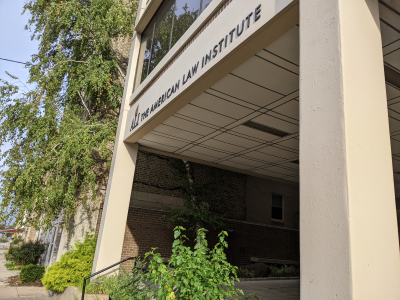
We’re spending a couple of days in Philadelphia at the American Law Institute mothership [insert angelic music soundbyte here], as ALI members meet to continue the work on the Restatement (Fourth) of Property.

Very interesting stuff for us Dirt Lawyers. Partition, leases, holdover tenants, statute of frauds, and the like. You know the drill.

With some of the leading legal scholars, jurists, and practitioners in our field, it can be a little bit intimidating for this back-of-the-room guy to be in a room full of law school “gunners.”

But so far, we’re holding our own.

PXL_20231006_131755605
The room where it happens.

PXL_20231006_142910937
How the Property Law sausage gets made.Continue Reading Restating Dirt Law At The American Law Institute
In MB Financial Bank N.A. v. Brophy, No. 128252 (Sep. 21, 2023), the Illinois Supreme Court clarified that in non-quick take actions (aka straight takings), the date on which title transfers — which is the date on which the owner actually is deprived of the property — is when the owner is relieved of the obligation to pay property taxes. Until then, the owner is on the hook, even though the owner is under the cloud of condemnation. .

In 2005, the City of Joliet filed a condemnation action to take an apartment building owned by MB Financial Bank. This was not a quick take action, but rather a straight taking. Which meant that neither title nor possession transferred from the owner to the condemnor. These would have to wait until ascertainment of the amount of compensation, the agreement of the City that it wanted to pay that amount

Continue Reading Illinois: In Straight Takings, Title Transfers Only After Compensation Is Paid, So Property Owner Is Responsible For Property Taxes During The Litigation

Here’s what we’re reading about the Supreme Court’s property rights docket — some good, some disappointing — this day.

  • Niina Farah, “Supreme Court flooding case could ripple across the energy sector (E & E News / Energywire) – About the Devillier case (which we summarized here), in which we were quoted: “The Supreme Court decision to hear the Devillier case comes after a concerted effort in recent years to convince the court to address procedural maneuvers that have made it challenging for property owners to bring their claims to court, said Robert Thomas, director of property rights litigation at the Pacific Legal Foundation. The nonprofit is among the groups that has asked the court to address takings cases and has lent its support for the property owners in Devillier in a ‘friend of the court‘ brief. ‘There’s a lot of gamesmanship going on


Continue Reading Supreme Court Property Rights Round-Up