
October 2023

A quick one from the Alabama Supreme Court. In Dixon v. City of Auburn, No SC-2022-0741 (Oct. 27, 2023), the court rejected a property owner’s claim that the city outlawing short term rentals of residential properties — when the plaintiff had been renting his basement for a while — was not a violation of the Alabama Constitution.

The court rejected the argument that Dixon’s use was a nonconforming use or vested right, and concluded that his right to do so was not so because he had no legal right to rent out his property before the STR ordinance. The court rejected his claim that in the absence of regulations limiting that right, he could rent short term, because the zoning code prohibits any uses not expressly allowed. Slip op. at 10.

And here’s the interesting bit. Although Dixon styled one of his claims as “an ‘unlawful taking without just

Continue Reading Alabama: Banning Short-Term Rentals Is Constitutional (PS – “the Alabama Constitution does not recognize regulatory-takings claims”)

Penn Coal

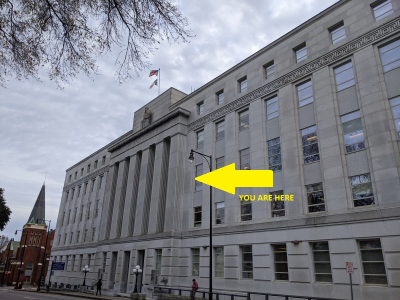
Our thanks to Professor/Dean/Provost Patricia Salkin and Lawprof Simone Freeman for inviting me to drop in on their Touro Law School Land Use class last evening to talk about regulatory takings and some of the interesting details of the Pennsylvania Coal Co. v. Mahon case from 1922.

We discussed the case, using some photos we took during our site visit to the former Mahon property and environs last year on the 100th anniversary of the date the Court issued the landmark opinion. We also emphasized the importance in dirt law cases generally to get yourself on the ground and see the property in question. Even though we have an amazing set of technical tools by which we can remotely get a sense of the land (Google Maps, Street View, for example), there is no substitute for getting yourself to the site to feel the ground, touch the dirt, understand the

Continue Reading We Want A Lump Of Coal For Christmas (As Long As It Is Pennsylvania [Anthracite] Coal)

PXL_20231024_221802638
Professor Gregory Alexander: the newest inductee in
the Property Rights Hall of Fame

PXL_20231027_140416239Jim Burling, discussing Prof Alexander’s
property work.

Our panel at today’s Brigham-Kanner Property Rights Conference at William and Mary Law School in Williamsburg, Virginia, which was focused on the work of this year’s Brigham-Kanner Property Rights Prize, Prof. Greg Alexander, was tasked with addressing this topic:

“Equity has long had an influence on the delineation and development of property rights. In addition to defining the extent of property rights and influencing a court’s choice of remedies, equity has played a role in governing or managing the impact of property rights on other interests. This panel will discuss these and other topics related to the role of equity in property law, including the relationship of that role with constitutional protection of property rights.”

Speakers on this topic included Profs Henry Smith (Harvard) and Samuel Bray (Notre

Continue Reading 20th Brigham-Kanner Property Rights Conference: Property Rights As A Means Of Human Flourishing

A short one from the Ninth Circuit on a topic that we keep revisiting, whether the various eviction moratoria adopted and enforced by the feds and many states and local governments during Co-19.

We keep revisiting the topic because the courts keep getting it wrong.

And before we go on, a disclosure: this is one of ours, and our law firm and our colleague Jon Houghton rep the property owners.

This moratorium is from the State of Washington (yes, the same State of Washington whose moratorium was recently challenged unsuccessfully in the state courts). But this challenge is to the City of Seattle’s moratorium, and is in federal court.

Thus, it was the Ninth Circuit considering the question of whether, by commandeering rental property as pandemic public housing, Washington was on the hook for just compensation. Requiring to house residents — whatever the reason — is a physical

Continue Reading CA9: No Physical Commandeering In Eviction Moratorium Because Yee Says “You Let The Tenants In, So You Can’t Complain About Keeping Them (For Free)”

NCSCT

Here’s the latest on a kind of strange case we’ve been following.

Our case starts off as a somewhat typical public use challenge. After a developer failed to negotiate purchase from Rubin an easement for a sewer line to serve a nearby housing project, the developer enlisted the Town of Apex to lend a hand.

Next, whaddaya know, the Town is taking the easement for the developer’s sewer line from Rubin by eminent domain, with the developer paying the compensation and the costs of the lawsuit. If this sets off your private benefit radar, you’d be right. The North Carolina courts sure thought so. No public use. 

You might think that this would signal the end of the matter. We know what would happen if the Town had affirmatively abandoned the taking. In that case, it wouldn’t be off the hook if it walked away, and although it would

Continue Reading Midnight Quick Take: NC Supreme Court To Consider Remedies For Failed Takings – What Happens When A Taking Lacks A Public Use, But They’ve Already Seized The Property?
BK Program 2023 cover

This week is what we call Brigham-Kanner week here at William and Mary Law School. The week culminates in the Thursday presentation of the Brigham-Kanner Property Rights Prize to lawprof Greg Alexander, followed on Friday by the Conference presentations (see below).

And earlier in the week, we’re having a series of law student-oriented programs, featuring sessions on “Careers in Dirt Law,” “Comparative Property Rights” (feat. Toronto expropriation lawyer Shane Rayman), and “Property Rights Practice Perspective” (feat. several young lawyers — including W&M Law alums — who are now practicing eminent domain and takings law).

Here’s the full B-K Conference program.

The Friday program includes some very intriguing topics:

  • Property and Propriety (or the Well-Ordered Society): A Tribute to Gregory S. Alexander
  • Equity’s Role in Defining Property Rights*
  • Emerging Issues Roundtable
  • The Restatement’s Impact on Property Rights
  • The Scalability of Property Rights – the Extent to Which Interests


Continue Reading 2023 Brigham-Kanner Property Rights Conference (Oct. 26-27, 2023)

The topic of the “self-executing” nature of Just Compensation is in the news these days, with the Supreme Court’s agreeing to review Devillier v. Texas.

But we’ve been on that issue for quite a while, and in a recent episode of Clint Schumacher’s Eminent Domain Podcast (if you are not already subscribed, why not?), our Pacific Legal Foundation colleague Deborah La Fetra joins Clint to discuss the issue, including a recent case we did together involving the intersection of property rights and the federal government’s bankruptcy power.

As the program notes note:

Deborah La Fetra of the Pacific Legal Foundation joins us to talk about the case of Financial Oversight and Management Board for Puerto Rico v. Cooperativa de Ahorro y Credito Abraham Rosa, a unique case where the boundaries of just compensation and governmental restructuring collide. Deborah and PLF served as counsel for several of the unpaid

Continue Reading Deb La Fetra Guests On Clint Schumacher’s Eminent Domain Podcast On Self-Executing Just Compensation

HSBA 10-2023

Yesterday, during the Annual Meeting of the Hawaii State Bar Association, we participated in a program sponsored by the Real Property and Financial Services Section, “Inverse Condemnation & Paying for Disasters.”

As you can see above, we joined lawprofs Shelley Saxer and David Callies to share thoughts about inverse claims, and the difference between these property arguments and tort negligence claims.

Here are some of the key cases and materials which we mentioned (or should have):


Continue Reading Links And Materials From “Inverse Condemnation & Paying for Disasters”

The U.S. Court of Appeals for the Federal Circuit’s opinion in Stimson Lumber Co. v. United States, No. 22-1201 (Oct. 2, 2023) does not add a lot to the overall regulatory takings canon, but the court and the caption might give you a hint that this one is a Trails Act takings claim.

As is often the case in these type of cases, the dispositive issue is a question of state property law; here, whether railbanking is within the scope of the easement for a “right of way” which Stimson’s predecessor-in-title granted. The court concluded that under Oregon law, this was a “general terms” easement, which allows “unlimited reasonable use,” and was not limited to a right of way for railroad purposes. In short, the terms of the easement itself contemplated virtually any use.

We’ve been down this (rail)road before, as we noted in this amicus brief in a similar

Continue Reading CAFED: Terms Of Granted Easement Allowed “Unlimited Reasonable Use,” So No Taking For Railbanking

We don’t regularly cover unpublished opinions, but the U.S. Court of Appeals for the Fourth Circuit’s Columbia Gas Transmission, LLC v. 0.12 Acres of Land, No. 23-1069 (Oct. 11, 2023) got our attention because it involves a slight twist on the the Supreme Court’s ruling a couple of years ago in PennEast Pipeline Co. v. New Jersey, 131 S.Ct. 2244 (2021).

There, the Court held that a private actor exercising the delegated federal power of eminent domain may take property from a state in a federal court action, notwithstanding the state’s usual Eleventh Amendment immunity. Employing a historical analysis, the Court held that when the states entered the Union they consented to the federal government’s eminent domain power. And the later-adopted Eleventh Amendment didn’t change that.

The caption of the latest case should tell you a couple of things. First, this is also a federal taking (plaintiff vs.

Continue Reading CA4 (unpub): We’re Not Going To Adopt Justice Gorsuch’s Dissent In PennEast And Prohibit A State From Having Its Property Taken In Federal Court