March 2022

Here’s an issue that we’ve been following for a while. What will a court do when a condemnor is ordered to pay (the property owner has a judgment in hand), but the condemnor says “no thanks”?

The latest incarnation is the U.S. Court of Appeals’ opinion in Ariyan, Inc. v. Sewerage & Water Board of New Orleans, No. 21-30335 (Mar. 21, 2022). There, a group of property owners successfully brought Louisiana law takings claims against the Board after its flood control project caused “property damage and economic loss.” In the various cases, verdicts were rendered, and judgments were issued from 2018 through 2020.

Well, you know what is supposed to happen next. Judgment debtors are supposed to pay up, or else the judgment creditor may satisfy the judgment by other means.

But when the government is the judgment debtor, the creditor can’t just put a lien on City

Continue Reading What Can A Property Owner Do When A Condemnor Doesn’t Pay? (Fifth Circuit: Nothing)

JayMassey

From the “too modest” department: when you find out that a fellow you knew only as an appraiser/MAI (who once mentioned offhand that he was “in the Army for a bit before I became an appraiser”) was so much more than what you knew him as.

Yes, he was the one who taught you about appraisal science and art, and helped you pick apart the other side’s valuation. But only in his obituary do you learn that Jay Massey MAI was one of the legendary MAC-V/SOG operators; indeed a “One-Zero” (team leader), and spent years at the front lines and behind the lines. Master Blaster. One STRAC individual. One of the old school Green Berets, who answered JFK’s call to do for his country, and lived up to the label “the Quiet Professionals.”

Jay, I wish you had been less modest, a bit less quiet. You and I would

Continue Reading Adieu To A Quiet Professional – Jay Massey

Check out the U.S. Court of Appeals for the Eighth Circuit’s opinion in 301, 712, 2103 and 3141 LLC v. City of Minneapolis, No. 20-3493 (Mar. 14, 2022), in which the court held that a Minneapolis ordinance prohibiting property owners from rejecting a prospective tenant because of the applicant’s criminal, credit, or rental history isn’t a taking.

The challenged ordinance “requires landlords to evaluate applicants for rental housing by either (1) ‘inclusive screening criteria’ or (2) ‘individualized assessment.'” Slip op. at 2. That’s a roundabout way of saying that a property owner cannot reject an applicant for their criminal or credit background, unless the owner first considers other “supplemental evidence” to justify why the applicant should become a tenant in spite of these problems, and notifies the tenant why this evidence isn’t enough to outweigh the problems. 

The court first rejected the owners’ claim that the ordinance allows third

Continue Reading CA8: Ordinance Making It Really Really Hard To Reject Tenants Isn’t A Physical Taking

CEQAflowchartSee if you can navigate this maze.

Even if you are not in California, this thing called “CEQA” (the California Environmental Quality Act) is something you might have heard of. An environmental reporting statute on steroids, CEQA is, according to this new report from the Pacific Research Institute, the main reason why California is home to the unbeatable combination of sky-high home prices and nation-leading poverty rate, and has become as famous for its homeless problem as its beaches

In “The CEQA Gauntlet,” the authors report that the above problems are products of the fact that it is “very, very hard to build homes in California.” And the reason it is hard to build homes in California? That’s right, CEQA.

What started off as a data-gathering and informational requirement (so that the decision makers could incorporate environmental considerations) has become the tail that wags the dog

Continue Reading Death By A Thousand Days: Presenting “The CEQA Gauntlet” Report

When you are building a sewer, grading is important. Otherwise, the stuff might not “flow” correctly, if you get our drift. Okay Public Works Authority built a sewer, and guess what? “The work performed by OPWA caused extensive damage” to private property, and the “lines installed by OPWA had not been properly graded.”

Not good. The jury in the inverse condemnation lawsuit that followed awarded $73k in compensation. The court of appeals, however, tossed the verdict because OPWA did not possess the power of eminent domain to take property for sewage lines. And to be liable for inverse in Oklahoma, the defendant must possess the eminent domain power.

In Barnett v. Okay Public Works Authority, No. 117792 (Mar. 8, 2022), the Oklahoma Supreme Court concluded that the utility possesses the eminent domain power to take property for sewer lines. The decision turned on the language in the statute delegating

Continue Reading OK: Inverse Is A Two-Way Street – Utility Has Eminent Domain Power, So Is On The Hook For Inverse

Here’s a really short one from the U.S. Court of Appeals for the Fourth Circuit. Not published, so even shorter than you might expect.

In Virginia Hospital & Healthcare Ass’n v. Kimsey, No. 20-2176 (Mar. 1, 2022), the court rejected the Commonwealth’s argument that the sole remedy for a takings claim is just compensation.

The plaintiff challenged a statute which limited their ability to obtain reimbursement for medical services rendered to Medicaid patients, which instead keys reimbursement to the patients’ diagnoses. According to the plaintiffs, this scheme leaves them holding the financial bag in situations were they render services that the statute deems avoidable because of the final diagnosis. 

The complaint alleges a regulatory taking, because the statute “denies just compensation for federally-mandated emergency services by predicating reimbursements on the final diagnosis only – and not on the services actually provided,” and for reimbursing at only 1/2 the usual

Continue Reading CA4: Just Comp Isn’t The Only Remedy For A Taking

Well, that was quick. Last month, as we reported here, the a Ninth Circuit panel held that the City of Oakland, California, could require property owners to pay thousands of dollars in what is branded “relocation fee” to their tenants as a precondition of the owner moving into their own property. This isn’t an “exaction” subject to the nexus and rough proportionality requirements applicable to such demands when they are in land use permits. This was merely a regulation of the landlord-tenant relationship.

Now, our colleagues Dave Breemer and Brian Hodges (the team responsible for Knick v. Township of Scott) have produced this cert petition.

As this is a case in which our firm has an active part, we won’t be doing much more here than posting the petition, and the Question Presented. You can read the petition yourself and get the idea of what the issues

Continue Reading New Cert Petition: Are Generally-Applicable Requirements Subject To Nollan-Dollan Analysis?

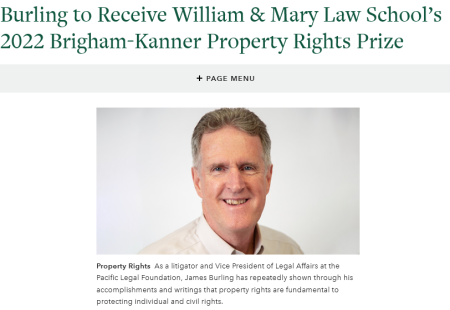
Screenshot 2022-03-07 at 14-43-08 Burling to Receive William Mary Law School’s 2022 Brigham-Kanner Property Rights Prize

Some good news: our Pacific Legal Foundation colleague Jim Burling is slated to receive the 2022 Brigham-Kanner Property Rights Prize in September.

Check out the media release, with more details:

James Burling, Vice President of Legal Affairs at Pacific Legal Foundation, will receive the 2022 Brigham-Kanner Property Rights Prize at William & Mary Law School’s 19th annual Brigham-Kanner Property Rights Conference on September 29-30 sponsored by the William & Mary Property Rights Project.

The Property Rights Project presents the award each year to an individual whose scholarly work and accomplishments affirm that property rights are fundamental to protecting individual and civil rights.

“James Burling is among the foremost students of the relationship between citizens and their government in contemporary America,” said Steven J. Eagle, Professor Emeritus of Law at George Mason University’s Antonin Scalia Law School and the 2019 Brigham-Kanner Prize winner.

Congratulations, Mr. Burling.

Please mark your calendars

Continue Reading Burling to Receive William & Mary Law School’s 2022 Brigham-Kanner Property Rights Prize

We gotta be honest here: when the substantive portion of an opinion (even an opinion about takings and exactions) begins with, “Congress created the Enterprises to, inter alia, provide liquidity to the mortgage market…” our eyes kind of glaze over. It’s going to be one of those opinions.

But we soldiered on, and slogged through the Federal Circuit’s opinion in Washington Federal v. United States, No. 20-2190 (Feb. 22, 2022). The case is about the 2008 federal takeover of Freddie Mac and Fannie Mae. We won’t go into the details, but the basic allegations in the complaint are that the fed takeover of the entities was an exaction, and a taking.

The Federal Circuit affirmed the Court of Federal Claims’ dismissal, although for other reasons. The CFC thought the plaintiffs missed the 30-day statute of repose applicable to challenging the appointment of a conservator. The Federal Circuit disagreed

Continue Reading CAFED: Fed Takeover Of Fannie Mae & Freddie Mac Not An “Exaction,” Not A Taking

Lately, we’ve been zeroing in on one of the lesser known parts of the Supreme Court’s takings canon, Yee v. City of Escondido, 503 U.S. 519 (1992), where the Court concluded that a city ordinance that limited the amount a property owner could charge a tenant for rent was not a physical invasion taking.

In Yee, the Court held that the ordinance did not intrude on the owner’s right to exclude because the owners had invited their tenants to intrude on their property when they let them become tenants. Yeah, that invitation and resulting intrusion was conditioned on the tenant paying each month a specific amount of rent and the ordinance effectively rewrote that agreement, but the plaintiff raised only a facial categorical takings claim (and thus the question of whether the city-mandated lower rent prohibited a fair return to the owner was an issue that the owners could

Continue Reading Wash App: No Taking Of Right To Exclude Because Eviction Moratorium Merely Lets Tenants Remain