
May 2020

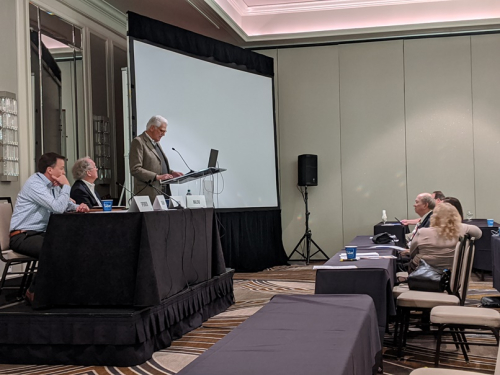
MVIMG_20200125_115411_1

This is a post I wish I didn’t have to write. But I’ve just been informed that our friend and colleague, William W. Wade, Ph.D., died earlier this week.

I know many of you, like me, have known Bill for a long time. He was an economist, and not a lawyer, but he spoke our language (often in more clear terms than we do). A frequent speaker (that’s Bill above, speaking recently to the ALI-CLE Eminent Domain Conference in Nashville in January), thinker, author (here’s a recent guest post by Bill), and expert witness in takings cases, Bill knew his stuff.

IMG_20200522_091928

But to me, Bill was more than just a colleague and frequent correspondent, but also a friend and kindred spirit. Of course I treasured our conversations about our work in the law and economics, but more importantly, he always struck me as a kind soul.

Continue Reading Aloha, Bill Wade Ph.D.

Last Friday, we had the good fortune to moderate a debate between two scholars — F.E. Guerra-Pujol and Ilya Somin — on the question of takings and emergencies (“COVID-19 & Property Rights: Do Government Actions in Response to the Coronavirus Pandemic Create Compensable Takings?“). This issue has resulted in a flurry of claims nationwide. See here, here, here, here, here, here, here, here, here and here, for example)

Note: the recording of that session will be available and when ready, we’ll post it here. 

Professor Guerra-Pujol has also written up some post-session thoughts on his blog, prior probablity. In “Property rights panel: a recap,” he summarizes his thoughts and those of Professor Somin. 

Rather than summarize his summary, we simply suggest you visit his blog and read it (it’s a quick read).

The entire discussion

Continue Reading A Good Time To Make Bad Law?

The hits keep on coming. Here’s the latest complaint alleging that a coronavirus-related shut-down order is a taking (among other things).

This joins a long list (see here, here, here, here, here, here, here, here and here, for example) of complaints alleging takings. We’re guessing there’s no horizon on such claims in sight yet.

Here’s a summary of the takings claim:

The Orders and Emergency Directives effectively amount to an impermissible “partial” or “complete” taking in violation of the Takings Clause of the Fifth Amendment to the U.S. Constitution in that the prohibition of Plaintiffs’ operation of their “Non-Essential Business” constitutes a regulatory taking of private property, for public purpose, without providing just compensation therefore. Furthermore, the Orders and Emergency Directives violate the Takings Clause of the Fifth Amendment in that the complete prohibition of the business operations of “Non-Essential Businesses&rdquo

Continue Reading One More Coronavirus Takings Complaint (Nevada, pt. II)

WMdoor2

This fall, we’ll be back at the William and Mary Law School (hopefully in-person, depending on the circumstances and the yet-to-be-announced approach to be taken by the College of William and Mary), teaching two of our favorite subjects.

Not only will this be the third time leading Eminent Domain and Property Rights (Law 608), but we’ll also be undertaking another subject, Land Use Control (Law 425). This semester, we’re stepping into the (big, figuratively speaking) shoes of Professor Lynda Butler who recently retired after a stellar and trailblazing career. Thankfully, Lynda is continuing to lead the Brigham-Kanner Property Rights Project and is underway with planning October’s Brigham-Kanner Conference, honoring Harvard lawprof Henry Smith.

Land Use is, of course, related to Eminent Domain and Property Rights, but the law school understands that they are each worthy of separate study, and they should not be folded into a single course (or

Continue Reading Land Use Also On The Fall Semester Agenda At William And Mary Law

In Allard v. Big Rivers Elec. Corp., No. 2019-CA-000486 (May 15, 2020), the Kentucky Court of Appeals made short work of each of the property owner’s arguments objecting to a taking of land for a electric-transmission corridor, and we won’t go through each contention here.

But that one that we will mention briefly is the necessity argument. You know, the one you often hear from your property owner clients: “they shouldn’t put the [road, fire station, whatever the condemnor claims is the public use] on my property, it makes much more sense to put the [public use/purpose thing] somewhere else.” Makes intuitive sense doesn’t it? After all, how can a taking be “necessary” to accomplish the stated public use or purpose if it is not the best place for the thing, or even a rational place to locate it?

But despite this, you also know that in all

Continue Reading Ky App: Condemnor Can Choose Between Cemetery And Oak Tree, Same As It Ever Was (and there’s no necessity to tie a yellow ribbon round the old oak tree)

Texas Court of Appeals in Texas Central RR & Infrastructure, Inc. v. Miles, No. 13-19-000297 (May 7, 2020): sounds good.

We were going to write up this case, when Tiffany Dowell Lashmet (author of the fabulous Texas Agricultural Law Blog) posted her analysis: “Appellate Court Finds High-Speed Rail Meets Required Definitions for Eminent Domain Authority.”

We can’t add much to her excellent write-up, so we will simply recommend you read it.

More from the Dallas Morning News: “Texas bullet train inches another step closer to reality.” And from Engineering News-Record: “Court Ruling Elevates Eminent Domain Battle on $20B Texas Rail Project.”

Texas Central RR & Infrastructure, Inc. v. Miles, No. 13-19-00297-CV (Tex. App. May 7, 2020)

Continue Reading Private Condemnor: We’re A “Railroad” Because We Promise To Be A Railroad In The Future

A development in the “oyster takings” case that we’ve been following as it has worked its way up to the Virginia Supreme court: that court today issued this Order, in which it awarded an appeal by Nansemond River oystermen (and the City of Suffolk’s cross-appeal) who claim that their property was taken when the City dumped sewage into the river and declared a “condemnation zone” (i.e., no oyster harvesting). Along with our William and Mary Law class, we took a field trip to the site last year (video above).

Some background, since this is a case at the intersection of property and takings law, and environmental protection. The oystermen own a lease from the state for the riverbed, which among other things, allows them to harvest some of the oysters that Virginia is so well known for. But they were forced to bring an inverse condemnation claim

Continue Reading Virginia Supreme Court To Consider Whether City Has The Right To Pollute Chesapeake Bay

Even as some jurisdictions are easing the restrictions, here is the latest coronavirus-related complaint asserting a taking. This one was filed in an Illinois federal court, and joins an ever-growing list of similar claims (see here, here, here, here, here, here, here and here).

The complaint is a “pure” takings claim — it doesn’t challenge the authority of the governor to shut things down, nor does it challenge the “readily-apparent public purpose” of the action. See Complaint at 5, ¶ 10.

The remedies sought? “WHEREFORE, Plaintiffs request that the Court declare the action of the State a taking of private property for public benefit, and order the determination of Just Compensation to the Plaintiffs by a jury pursuant to Illinois Law, and all other appropriate relief.” Complaint at 10.

We wrote down our thoughts on these type of claims in this piece:

Continue Reading One More Coronavirus Complaint (Ill.): Indefinite Business Closures Are Takings

Here’s another coronavirus-related complaint asserting a taking.

But unlike other, recently-filed complaints (see here, here, here, here, here, here and here), this one doesn’t object to shut down orders. Instead, it challenges two measures undertaken by local authorities related to the owner/tenant relationship.

To deal with the pandemic, Union City, New Jersey adopted two ordinances. First, for units already subject to the city’s rent control ordinance, it froze rents retroactive to March 1, 2020. Second, it froze all evictions. These, according to the Complaint, are takings. Here are the allegations:

78. Plaintiff repeats and realleges the previous allegations as if fully set forth herein.

79. By adoption of the Freeze Ordinance, Plaintiff and its members have been deprived of their vested contractual and property rights without due process of law or adequate compensation in violation of the United States and New Jersey Constitutions.

80.

Continue Reading Yet Another Coronavirus Complaint: Eviction, And Retroactive Rent Freeze In Rent-Controlled Apts Is A Taking