

September 2016

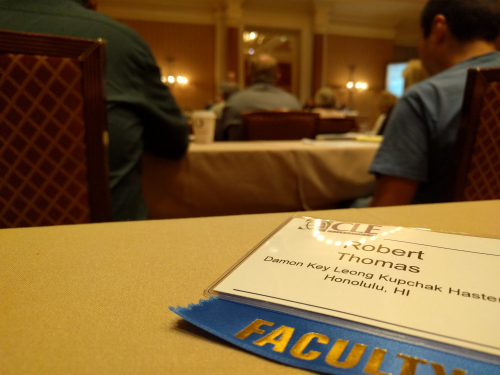
 IMG_20160929_102807
During. Good crowd.

20160929_074511
Before. Note the power strips on the tables.
Well played, Caesar’s, well played
.

To supplement your written materials, here are the decisions and other materials which we spoke about this morning at the CLE International Eminent Domain seminar:

Continue Reading Links And Notes From Today’s Las Vegas Eminent Domain Seminar

This one is kind of Colorado specific, but there are lessons here for the rest of us.

In Colorado Dep’t of Transportation v. Amerco Real Estate Co., No. 16SA75 (Sep. 26, 2016), the Colorado Supreme Court prohibited the DOT from taking Amerco’s land (leased to U-Haul) for a highway project because the transportation commission had not first determined via the process required by statute that the taking would serve the public interest.

U-Haul argued these statutes required the commission to adopt a resolution — based on a report by the chief engineer — to establish that the taking of this specific property would be in the public interest, and that it wasn’t sufficient that these things were done for the project in general. The DOT asserted that an earlier resolution by the transportation commission gave the DOT all the power it needed, because it had delegated the power to acquire

Continue Reading When Statute Requires Commission Approve Taking, DOT Can’t Do It

The speed of the internet: we were all set to post our thoughts on the opinion of the Court of Appeals of Indiana in Bellwether Properties, LLC v. Duke Energy Indiana, LLC, No. 53A-04-1511-CR-1880 (Sep. 13, 2016), when the Indiana Lawyer beat us to the punch with “COA: Discovery rule applies in inverse condemnation action against Duke Energy.”

We can’t report on this decision any better than they did, so check it out. 

Bellwether Properties, LLC v. Duke Energy Indiana, LLC, No. 53A04-1511-CT-1880 (Ind. App. Sep. 13, 2016)

Continue Reading Indiana App: Statutes Of Limitation And Inverse Condemnation

We like property rights. We really do. And here is a new law review article on property rights. But the jury’s still out whether this will be useful to us (or you) in the practice of law, because, well, the article is about animals having property rights.

You read that right. Property rights. For animals.

Now we’ll admit, our first thought was “is this the quality of legal scholarship that law students are going hundreds of thousands of dollars into debt to learn?”

But really, who are we to judge? We know that cats already think they own everything and everyone, including their putative owners. So what is so outrageous about the rest of the animal kingdom owning things?   

Here’s the abstract:

What if animals could own property? This Article presents a thought experiment of extending our anthropocentric property regime to animals. This exercise yields new insights into

Continue Reading New Law Review Article On Property Rights … For Animals.

Preamble

Today is Constitution Day, even though every day really is Constitution Day, no?

In that vein, here is what is probably our favorite work of modern art, a piece titled “Preamble,” which hangs in the Smithsonian American Art Museum in Washington, D.C. Yes, those are real license plates, and when read together spell out the preamble to the Constitution. We like the piece so much, we’ve got a print hanging in our office.Continue Reading Happy Constitution Day 2017

This one reminds us of a recent decision by the Texas Court of Appeals, because the Mississippi Supreme Court, like the Texas court, concluded that an inverse condemnation plaintiff lacked standing because it didn’t own the property at the time of the taking. Russell Real Property Services, LLC v. Mississippi, No. 2015-CA-01306-SCT (Sep. 15, 2016).

But where the Texas court’s analysis failed to satisfy, we think the Mississippi court’s approach was much more sound.

Russell claimed it owned a half interest in property which the State leased to the City of Pass Christian for use as a harbor and related development, and sued both for inverse condemnation. But Russell had only been quitclaimed its interest from the prior owner after the city and the state had entered into the lease. It claimed the taking occurred when the Secretary of State executed the lease. 

But even applying Mississippi’s “liberal” standing rules

Continue Reading Mississippi: No Ownership At Time Of The Taking = No Standing

A new article worth your time by economist William Wade, “Theory and Misuse of Just Compensation for Income-Producing Property in Federal Courts: A View From Above the Forest,” 46 Tex. Envtl L. J. 139 (2016).

Bill is familiar to regular readers, as he has been a frequent guest poster, and a prolific author. This article is his latest, and focuses on how compensation should be calculated in regulatory takings cases, and contrasts how lawyers view economic losses, and how economists view the same thing (not necessarily the same way). 

We are grateful to the Texas Environmental Law Journal and the Environmental and Natural Resources Section of the Texas State Bar for their permission to post the article. Continue Reading New Article: “Theory and Misuse of Just Compensation for Income-Producing Property in Federal Courts: A View From Above the Forest”

2016 BrighamKanner Property Rights Conference Program_Page_01

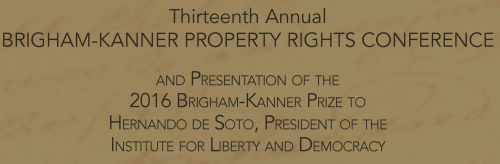
As we noted here, this year’s Brigham-Kanner Property Rights Conference honoring Hernando de Soto will to be held in The Hague, Netherlands, at the International Court of Justice on October 19-21, 2016.

To push out word, the Owners’ Counsel of America kindly produced a press release announcing our participation in two of the panel discussions, “Property’s Role in the Fundamental Political Structure of Nations,” and “Defining and Protecting Property Rights in Intangible Assets.” 

We mention it here only to note, as this post’s headline states, this may be the only press release (ever?) to mention Hugo Grotius. Left unanswered: how to pronounce “Grotius.”

“I am honored to have been invited to speak at the Brigham-Kanner Conference, especially when the Conference is honoring Hernando de Soto, whose work on property rights has had such international influence,” said Thomas. “I’m also glad the Conference will be held at

Continue Reading Maybe The Only Press Release Ever To Cite Hugo Grotius

Denials of rehearing and motions for en banc review from a state intermediate appellate court generally do not catch our attention. But Ganson v. City of Marathon, No. 3D12-777 (Sep. 14, 2016) is the exception to that rule.

This is a long-running regulatory takings dispute between property owners in the Florida Keys — who are making a Lucas claim that the City’s regulations prohibit economically beneficial use of their island — and the appropriately-named City of Marathon (see here and here, for example). 

The majority ruling is just what you’d expect in a disposition such as this: a one word per curiam “Denied,” with 6 judges concurring. The reason we’re posting the ruling, however, is the 3-judge dissent, which starts off like this:

This is a significant regulatory takings case, the holding of which is that a local government can regulate private property to an extent that is

Continue Reading Wasting* Away Again In Margaritaville: En Banc Denied In Lucas Takings Case, Over Compelling Dissent

We love quo warranto cases. Not just because “if it ain’t Latin, it ain’t the law’ (as one of our favorite law school profs informed us), but because they are yet another means for citizens to challenge those holding and exercising power.  

Here’s the latest from the Hawaii appellate courts, Ford v. Leithead-Todd, No. CAAP-15-0000561 (Sep. 8, 2016).

The case involved the requirement in the County of Hawaii Charter that the Director of the Department of Environmental Management possess “an engineering degree or a degree in a related field.” The mayor and county council hired a lawyer who did not have an engineering degree — only a bachelors with a major in English and a minor in Hawaiian studies, plus a JD — and a citizen brought a quo warranto suit challenging her qualification for office.  

The circuit court granted the County’s motion for summary judgment

Continue Reading Quo Warranto Fu: Does County Environmental Manager’s Law Degree Qualify As “Engineering … or related?”