
2015

One for the appellate practitioners in the audience.

In City of Little Rock v. Hermitage Dev. Corp., No. CV-15-842 (Ark. Dec. 3, 2015), the Arkansas Supreme Court granted the property owners’ motion to dismiss an appeal filed by the city from a jury verdict awarding just compensation. The court agreed that the City missed its deadlines to get the record on appeal lodged even though the trial court granted an extension of time to allow the court reporter preparing trial transcripts to get those done (and get paid).
The Supreme Court concluded that the trial court should not have granted the request for an extension, because the rules require strict compliance, the rules are jurisdictional, and the city had not made the proper financial arrangements with the court reporter to get her paid. The rules require that this means the reporter is actually paid, “not merely making promises

Continue Reading Arkansas: City Missed Appeal Of Just Comp Verdict By Not Paying The Court Reporter In Time

Another short one, this time from the Arkansas Supreme Court.

In City of Siloam Springs v. La-De LLC, No. CV-15-194 (Ark. Nov. 19, 2015), the court concluded that an Arkansas statute which requires the state to pay reasonable attorneys’ fees if the just compensation exceeds the deposit by more than 10%, does not apply when a city is the condemnor against whom the condemnation judgment is entered. 

The statute was clear enough, because it required the court to award fees “against the State of Arkansas and in favor of the party entitled thereto,” and here, the condemnation judgment involved the city, not the state. There is no statutory authority for an award of fees in eminent domain cases against cities. Seems simple enough, no? 

But the twist was that the condemnation in this case was actually instituted by the State Department of Transportation, after which it was granted immediate

Continue Reading Arkansas: Eminent Domain Fee Shifting Statute Only Applies To State Condemnations, Not City, Even Though State DOT Initiated The Taking

Another one in our year-end opinion rush.

In Board of Supervisors of Louisiana State University v. Villavaso, No. 2014-CA-1277 (Dec. 23, 2015), the Louisiana Court of Appeals upheld the trial court’s view of just compensation after a bench trial, in a case about LSU’s taking of property being used for a parking lot in New Orleans. The court concluded that the verdict was a choice between the property owner’s appraiser and LSU’s, which was “a pure credibility call.” Slip op. at 9. And you know what that means when an appellate court says such things: affirmed.

The court also upheld the verdict regarding business losses, and the lower court’s ruling that the owner was entitled to compensation both for the taking of the land, as well as the value of the parking business. Same result on LSU’s claim that the trial judge erroneously prohibited one of LSU’s

Continue Reading La App: Trial Court’s Ruling On Value “A Pure Credibility Call”

S062766

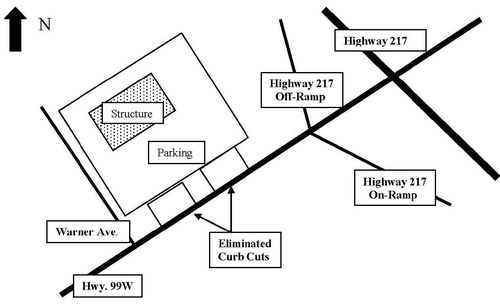
Here’s one in which we’ve been waiting for the ball to drop, since we filed an amicus brief in the case. Unfortunately, the result in State of Oregon v. Alderwoods (Oregon), Ltd., No. SC062766 (Dec. 31, 2015) wasn’t as hoped for, but looking for silver linings, was a lot less bad than it could have been.

Bottom line is that the Oregon Supreme Court concluded that a property owner does not have a right of direct access to a highway, only a right of reasonable access. Thus, when a project to improve Highway 99 cut off Alderwoods’ driveways on Highway 99, it was not a taking of access because Alderwoods still had access to Highway 99 via a driveway on Warner Avenue:

The above cases demonstrate three governing principles regarding the common-law right of access of a property owner to an abutting public road. First, it is well

Continue Reading Oregon: Cutting Off Direct Highway Access Is OK, Provided Property Isn’t Totally Landlocked

Calling all Hawaii appellate types, or those who want to become one: The Appellate Pro Bono Pilot Program is underway, and offering those who do not already have appellate experience, the opportunity to get trained so that they can serve as counsel to assist low-income litigants in Hawaii’s appellate courts. 

January 15, 2016
8:00 a.m. to 11:00 a.m.

HSBA Conference Room
   1100 Alakea Street, Suite 1000
   Honolulu, Hawaii 96813

Presenters

Rebecca Copeland, Esq. & Dan Kunkel, Esq.

RSVP by January 13, 2016 to
E-mail: justine@vlsh.org or call: 808-528-7058

Topics: Nuts and Bolts of Appellate Procedure; Appellate Jurisdiction and the Final Judgment Rule; and an Introduction to the Appellate Pro Bono Pilot Project

CLE Credits:  1.5 CLE Credits upon the completion of 6 hours of pro bono hours or completion of 1 full representation appellate pro bono case through the Appellate Pro Bono Pilot Program.  Volunteer Legal Services Hawaii

Continue Reading Hawaii Appellate Opportunity

Another short one that’s been in the hopper for a while, Sorrells v. City of Macomb, No. 3-13-0763 (Ill. App. Oct. 23, 2015), involving a claim for inverse condemnation that was a result of flooding.

The inundation of the plaintiffs’ property came from a street that was developed privately, but later dedicated to the city. The court of appeals concluded that this was not sufficient to state a claim for inverse condemnation:

In this case, the plaintiffs alleged that the streets were constructed by DK Linde and “dedicated” to the City. According to plaintiffs’ allegations, the City had taken the plaintiffs’ property in the form of a “drainage easement” for the drainage of its streets. “It is well established that the government may not take an easement without just compensation.” Ridge Line, Inc. v. United States, 346 F.3d 1346, 1352-53 (Fed. Cir. 2003) (quoting United States v. Dickinson

Continue Reading Illinois App: Allegation Of Flooding Caused By Street Developed Privately, But Dedicated To City, Not Sufficient To State Inverse Condemnation Claim

One more in our year-end opinion rush, a short one from the U.S. Court of Appeals of the Eighth Circuit. Here’s what you need to know about Tubbs v. Surface Trans. Bd., No. 14-3898 (8th Cir. Dec. 28, 2015):

Finally, the Tubbses argue that the Board has prevented them from bringing a claim for just compensation under the Fifth and Fourteenth Amendments. In short, the Tubbses claim that the Board has foreclosed their ability to bring a claim based on the Takings Clause of the Constitution and thus affected a taking. We are not persuaded. The loss of a cause of action, which is not a vested interest until it is reduced to a final judgment, is too speculative to constitute a taking. See Jones Truck Lines, Inc. v. Whittier Wood Products Co. (In re Jones Truck Lines, Inc.), 57 F.3d 642, 651 (8th

Continue Reading Eighth Circuit: Wiping Out Unrealized Rails-to-Trails Takings Claim Is Not A Taking

ALI-CLE-2016-masthead

Here’s our second day of highlights from the upcoming American Law Institute-CLE Eminent Domain and Land Valuation Litigation / Condemnation 101 Conference, which will be held in Austin, Texas, from January 28-30, 2016.  

This is the first time the conference has been to Austin, and we’re hoping for a good turnout. Here’s the full agenda for the program. 

  • We especially focused on the ethics component this year, and are looking forward to the session on “Ethics: Tips and Traps for the Eminent Domain Practitioner” at the first plenary session on the second day, taught by Jamila A. Johnson (Schwabe, Williamson & Wyatt, Seattle), Robert B. Neblett, (Jackson Walker L.L.P., Austin). and Joseph V. Sherman (Waldo & Lyle, P.C., Norfolk, Virginia). 
  • Pipeline takings are a huge issue, and we’ve got the lawyers on the very tip of the spear on these cases. “Pipelines and Energy


Continue Reading More On The Upcoming ALI-CLE Eminent Domain Conference (Austin, Jan 28-30, 2016)

Here’s one from the Federal Circuit that doesn’t break new ground, but is founded on an arcane point of Florida law. 

Rogers v. United States, No. 13-5098 (Dec. 28, 2015) is a rails-to-trails case, so the background is pretty standard: old railroad right-of-way, abandoned, followed by a NITU (Notice of Interim Trail Use), which ripened takings claims for the reversionary interest. Followed by standard government tactic: avoid the takings by showing that the reversionary interest isn’t property.

And that’s where Florida law comes in, the question being whether the deeds which originally conveyed the land to the railroads conveyed a fee simple interest or something like an easement. The Court of Federal Claims concluded the deeds conveyed a fee simple interest (the deeds used the words “fee simple,” after all), but on appeal, the Federal Circuit was not as sure because there was no “controlling” state law authority. So

Continue Reading Fed Cir: No Property, No Taking

ALI-CLE-2016-masthead

We’re exactly one month away from the 2016 Eminent Domain and Land Valuation Litigation / Condemnation 101 Conference, which runs from January 28-30, 2016, in Austin, Texas. 

Together with our friends and colleagues Joe Waldo, Jack Sperber, and Andrew Brigham, we think we’re put together a pretty good program that covers a lot of ground. This is the first time the conference has been to Austin, and we’re hoping for a good turnout. 

Here’s the full agenda for the program. 

If you have not already signed up, there is more than enough room, and there’s still time.

If you haven’t yet pulled the trigger, we’d like to convince you to come. So over the next few days, we’re going to be posting highlights from the agenda, featuring our stellar faculty.

  • We’ll start off with a talk welcoming us to the city by Austin Mayor Steve Adler


Continue Reading Counting Down To The ALI-CLE Eminent Domain Conference (Austin, Jan 28-30, 2016)