
2009

We don’t normally post press releases (except our own, natch), but this one jumped out for its uniqueness. Georgia property owners who object to the taking of their store and land are trying to sell their property to “anyone and everyone” and get the new owners on the deed to force the city to serve notice on every record owner, and thus thwart another condemnation attempt.

Here’s their story:

STOCKBRIDGE, Ga., December 16, 2009 – At a news conference and flanked by anti-eminent domain abuse demonstrators, owners of Stockbridge Florist & Gifts unveiled their newest weapon in their high-stakes battle over control and ownership of their property – the public. In a first-ever, history-making land offering, Mark and Regina Meeks are selling land at the site of their flower shop to ANYONE and EVERYONE. In a never attempted land deed modification, the Meeks will seek to add thousands of new

Continue Reading That’s One Way To Battle Eminent Domain…

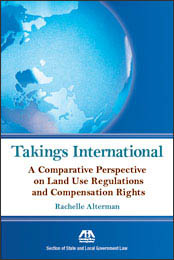
5330205_big Next month, the ABA Section of State & Local Government Law will be publishing a book by Professor Rachelle Alterman, Takings International: A Comparative Perspective on Land Use Regulations and Compensation Rights:

Everywhere in the world, land use law and regulation affect realproperty values–either increasing or decreasing them. Regulatorytakings is the potential raw nerve of land use regulation, yetpolicymakers and civic groups have tackled the issue without theperspective that a cross-national exchange of ideologies, laws, andpractices can provide.

Takings International is the firstlarge-scale effort devoted to this controversial issue, providing avast platform of comparative knowledge on direct, indirect,categorical, and partial takings. Written for legal professionals,academics, urban and regional planners, real estate developers, andcivil-society groups, the book analyzes thirteen advanced economycountries representing a variety of legal regimes, institutionalstructures, cultures, geographic sizes, and population densities.

Thecomparative prism yields some surprising and counterintuitiveobservations. In a climate of intensifying controversies about propertyand

Continue Reading New Book – Takings International: A Comparative Perspective on Land Use Regulations and Compensation Rights
This is Part II of our preview of the oral arguments in Unite Here! Local 5 v. City and County of Honolulu, the case in which the IntermediateCourt of Appeals held that unless the project changes, a supplementalEIS is not required under the Hawaii Environmental Policy Act, Haw.Rev. Stat. ch. 343.

In this post, we summarize the arguments of the parties and the amici. Part I of our preview (the summary of the issues and links to the opinion below and the briefs) is posted here.

A reminder: my colleague Mark Murakami, who blogs over at hawaiioceanlaw.com will be live blogging the arguments here (mirrored here). Tune in a few minutes before 9:00 when he goes live. I will also be commenting.

Keep the North Shore Country – Sierra Club, Hawaii Chapter

The parties seeking to overturn the ICA’s decision are Keep the North Shore Country

Continue Reading Oral Argument Preview, Part II: Hawaii Supreme Court Considers Whether A Change In “Context,” But Not The Project, Triggers A Supplemental EIS

Hawsctbldg

On Thursday, December 17, 2009, at 9:00 a.m. Hawaii time, the Hawaii Supreme Court will hear oral arguments in Unite Here! Local 5 v. City and County of Honolulu. Note: Justice Recktenwald is recused and Circuit Judge Derrick Chan will be taking his place. 

This post will review the issues in the case, and provide links to the parties’ and the amici briefs. In part II, we will summarize the arguments made by the various parties.

My colleague Mark Murakami, who blogs over at hawaiioceanlaw.com will be live blogging the arguments here (mirrored here). Tune in a few minutes before 9:00 when he goes live. I will also be commenting.

[Disclosure: although I have not participated in this case, two of my Damon Key colleagues — Mark, and Greg Kugle — have. They represented a party in the circuit court; Greg filed an amicus brief in the

Continue Reading Oral Argument Preview, Part I: Hawaii Supreme Court Considers Whether A Change In “Context,” But Not The Project, Triggers A Supplemental EIS

For better or worse, the U.S. Supreme Court’s 1954 decision in Berman v. Parker,348U.S. 26 (1954) marks the legal genesis of modern public use jurisprudence. The Court’s opinion in the case is pretty thin on facts, however, and does not provide any real clue regarding what was going on, or how the case came about.

Now, thanks to Albany Law’s Amy Lavine, you can discover the backstory. Urban Renewal and the Story of Berman v. Parker (posted on SSRN here). It’s fascinating reading. From the abstract:

TheSupreme Court’s 1954 decision in Berman v. Parker serves as thefoundation for much of our modern eminent domain jurisprudence,including the controversial 2005 Supreme Court decision in Kelo v. NewLondon. But the story behind the case starts well before 1954, and itcarries implications that are relevant today. It’s a story that playedout in many cities across the nation, just as it did in

Continue Reading Behind The Music: Berman v. Parker

In the editorial “Eminent Domain in New York,” (Dec. 13, 2009), the New York Times opines about the two recent eminent domain decisions from the New York state appellate courts:

A New York State appellate court has misguidedly put a roadblock in theway of Columbia University’s expansion plans, ruling that the statemisused eminent domain to help Columbia assemble the land it needs.This decision conflicts with the relevant law and will make it muchharder for the university to move ahead with a project that wouldbenefit the surrounding neighborhood and the entire city.

The editorial is referring to Kaur v. New York State Urban Dev. Corp.,2009 NY Slip Op 08976 (Dec. 3, 2009), in which the New York SupremeCourt, Appellate Division (First Department) struckdown the attempted taking of land north of Columbia University in NewYork City because of the record reflected the condemnor’s claim the properties are”blighted” was a

Continue Reading NY Times Editorial On Eminent Domain: Columbia Case “Completely Out Of Step With Eminent Domain Law” And Is “Weakly Reasoned.” Really?

This is the live blog of the Hawaii Supreme Court oral arguments in Unite Here! Local 5 v. City and County of Honolulu, the case in which the IntermediateCourt of Appeals held that unless the project changes, a supplementalEIS is not required under the Hawaii Environmental Policy Act, Haw.Rev. Stat. ch. 343.

The recording of the oral argument is available here. Or stream it below and follow along with the live blog archive:

More about the issues here, and our summary of the arguments in the briefs here.
Continue Reading Live Blog Of Turtle Bay/Kuilima EIS Case: Is A Change In “Context,” But Not The Project, Enough To Trigger Supplemental EIS?

I was reading this article in the San Francisco Chronicle about a dispute over whether a “concrete, flat-roofed Berkeley building [scroll down to the “Mobilized Women of Berkeley” listing] loosely linked to [architect] Bernard Maybeck” could be landmarked. According to the story:

The architect whose name is on the drawings of 1007 University Ave., however, is Phillip L. Coats, and it was built nine years after Maybeck retired.

The city’s landmark commission said Coats was a friend of Maybeck’s, and that’s close enough to merit protection. The commission voted unanimously in September to grant landmark status to the 1949 structure, citing Maybeck’s possible influence as well as the cultural history of the building.

Architectural historians say the building, with its uniqueglass-and-concrete lattice pattern, unmistakably bears Maybeck’simprint. Maybeck had worked extensively with the contractor and Coats,and would have been involved with this project because he had designedthe primary structure and

Continue Reading Landmarked For Being Loosely Linked To Famous Architect?

Until recently, a Maine property owner who sought review of a Claims Commission award of compensation needed to provide notice to the Commission of the appeal to Superior Court. Mr. Morrill believed a Commission award was insufficient and appealed, but did not provide notice. The Superior Court dismissed the case.

Morrill was in luck, however, because during the pendency of his appeal to the Maine Supreme Court, the Legislature amended the statute to eliminate the notice requirement. The Legislature also provided that the new procedures would apply retroactively to certain appeals. The Maine Supreme Court concluded this language saved Morrill’s bacon:

This Act applies to appeals from an award of the State Claims Commission that were pending on or after January 1, 2009, except that an appeal pending on or after January 1, 2009 but prior to the effective date of this Act for which notice was provided in accordance

Continue Reading Maine Supreme Court: No Notice To Claims Commission Under New Law

In State ex rel. Bd. of Regents v. McCloskey Brothers, No. 105228 (Dec. 8, 2009), the Oklahoma Supreme Court held that Oklahoma State University can take property for creation of an “athletic village.” Here’s the entirety of the public use holding:

The landowner argues that the taking was not for a proper public purpose as required by the Oklahoma Const. art 2, §§ 23-2461 because the land was to be used as an “athletic village” instead of some use which would further the academic goals of the University. The Regents argue that the proposed use is a public use/public purpose. The question of whether a proposed taking is for a “public use” is a judicial question. Nevertheless, here, the Legislature has already expressly declared such use a public use by its enactment of 70 O.S. 2001 § 4001,63 in which the Regents are authorized to take land for the

Continue Reading University’s Taking For “Athletic Village” Is For Public Use