
I was reading this article in the San Francisco Chronicle about a dispute over whether a “concrete, flat-roofed Berkeley building [scroll down to the “Mobilized Women of Berkeley” listing] loosely linked to [architect] Bernard Maybeck” could be landmarked. According to the story:
The architect whose name is on the drawings of 1007 University Ave., however, is Phillip L. Coats, and it was built nine years after Maybeck retired.
The city’s landmark commission said Coats was a friend of Maybeck’s, and that’s close enough to merit protection. The commission voted unanimously in September to grant landmark status to the 1949 structure, citing Maybeck’s possible influence as well as the cultural history of the building.
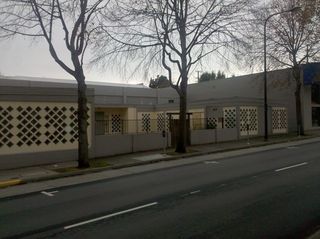
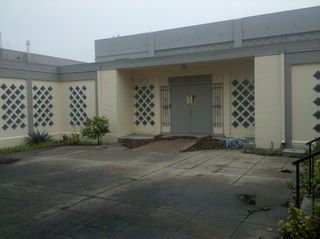
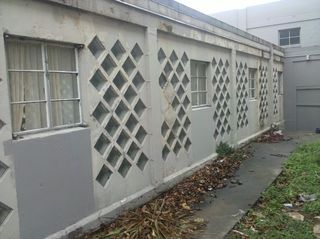
Architectural historians say the building, with its uniqueglass-and-concrete lattice pattern, unmistakably bears Maybeck’simprint. Maybeck had worked extensively with the contractor and Coats,and would have been involved with this project because he had designedthe primary structure and his wife was a leader in the charity.
Since the building is on the main drag into Berkeley off the freeway, I decided it might be worth stopping by to take a look at this Maybeck-maybe-sorta-had-something-to-do-with-it gem. After all, I’ve driven by it literally hundreds of times over the years, and despite patronizing the art supply place which used to be next door and the spice and grocery store across University Avenue, I’d never appreciated this Philip Coats-created landmark. (Coats seems to have successfully avoided the notoriety the Berkeley Landmark Commission believes he is due, since he has somehow found a way to turn up no results on a Google search.)
So armed with my trusty digital camera, I stopped by to indulge my Friday cinéma vérité urges, and the above video and the below pictures are the result. I even got up close to the “unique glass-and-concrete lattice pattern.”
The article continues:
“I never claimed it was by Maybeck, but he definitely had something todo with it,” said Susan Cerny, a preservationist with the BerkeleyArchitectural Heritage Association who submitted the property forlandmark status. “It’s my feeling that he made suggestions, sketches,gave some ideas. In any case, the building really is unusual.”
Whether or not the building was designed by Maybeck is a moot point,Olson said. It’s a significant structure on its own merits, and playsan important role in Berkeley history, she said.
The Mobilized Women of Berkeley was a pro-military group, an anomalyfor peace-loving Berkeley, and the concrete-and-glass construction wasa breakthrough in inexpensive, fireproof industrial architecture, shesaid.
“No one could possibly say whether Maybeck had direct involvement in1007 University, but undoubtedly he had indirect involvement,” shesaid. “I just want great buildings like this to remain, and leave uswith a rich, diverse cityscape.”
A pro-military group in Berkeley? Now that is about as rare as hen’s teeth. Maybe they’re onto something.