
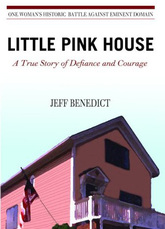
 I was fortunate enough yesterday to attend an event with Jeff Benedict, who spoke about his recently-published book Little Pink House – A True Story of Defiance and Courage (Grand Central Publishing 2009) (available from Amazon here).
Little Pink House gives the backstory to the infamous Supreme Court eminent domain decision Kelo v. City of New London, 545 U.S. 469 (2005). It’s not a dry recounting of the legal issues or the Court’s opinion, but a story of how one property owner’s determination to keep her home ended up in the U.S. Supreme Court, and eventually took on a life of its own. The book has been reviewed in the New York Times and the Wall Street Journal among other places. Robert S. Poliner, the Connecticut Ombudsman for Property Rights also reviewed the book; we’ve reprinted his review here.
The highlights of Benedict’s talk:
- The first contact Susette Kelo received from the New London Redevelopment Corporation was a knock on the door and an agent asking “how can we help you relocate?”
- He felt the “ah-ha” moment in the legal case was when Justice O’Connor asked NLDC’s attorney “do you mean that the city can take land from Motel 6 and give it to the Ritz-Carlton, if the Ritz is projected to generate more taxes?” NLDC’s counsel answered “yes.”
- He also described how an issue that is lost in the Supreme Court can turn into a winner in the long run.
Dana Berliner and Scott Bullock from the Institute for Justice — the attorneys who represented Susette Kelo — also spoke. Bullock noted that Kelo was the logical endpoint for the Court’s takings clause jurisprudence which has strayed from the “public use” set forth in the text of the Fifth Amendment. He noted the interpretation has transformed from “public use” to “public purpose,” and that now it means “public benefit.” He also noted that the universal revulsion at the Court’s decision resulted in many state courts and legislatures rejecting it. He wrapped up by noting that the little pink house was taken apart and rebuilt on another site in New London as a permanent reminder, and that the original site of Kelo’s house remains vacant to this day.
Berliner focused on California law, particularly its redevelopment code and the ease of a “blight” finding. She referenced the 2008 study by the IJ “California Scheming,” which details how so-called “blight” designations can be abused to cloud property for years.
We recommend: read the report, read the book.