
February 2009

Little-pink-house

[This review was originally published in the Honolulu Star-Bulletin on September 20, 2009]

You remember that line in the Stevie Wonder classic — “For once I can say this is mine, you can’t take it“?

It turns out they can.

In 2005 in Kelo v. New London, the U.S. Supreme Court held the government can take a home and give it to a developer if the developer is projected to pay more taxes. Your property can be condemned if someone else may make “better” use of it than you do.
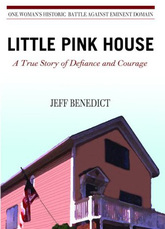
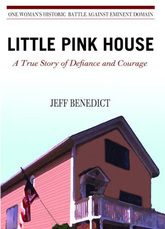
A new book, “Little Pink House: A True Story of Defiance and Courage,” tells the story of Susette Kelo, the case’s namesake who owned a little pink house in Connecticut taken by eminent domain. It’s not a dry recounting of legal doctrines, but a fast-paced insider account explaining why property owners resist losing their land even in

Continue Reading Book Review: Little Pink House — A True Story Of Defiance And Courage

Lph Certain addresses — real and fictitious — are instantly recognizable: 1600 Pennsylvania Avenue NW, Washington, DC and 221B Baker Street, London for example.

8 East Street, New London, Connecticut, however, isn’t an address that most people recognize. 

is the former address of the “little pink house” which is the subject of Jeff Benedict’s Little Pink House – A True Story of Defiance and Courage (Grand Central Publishing 2009) (available from Amazon here)

County of Hawaii v. C&J Coupe Family Ltd. P’ship, 119 Haw. 352, 198 P.3d 615 (2008) 

Disclosure: we filed an amicus brief (posted here) supporting Susette Kelo’s arguments in the U.S. Supreme Court.Continue Reading Book Review: Little Pink House – A True Story Of Defiance And Courage

Articles and books

Takings, Eminent Domain, and Land Use: Sublimating Municipal Home Rule and Separation of Powers in Knick v. Township of Scott, 47 Fordham Urb. L.J. 509 (2020)

Takings and Land Use: Restatement (SCOTUS) of Property: What Happened to Use in Murr v. Wisconsin? 87 UMKC L. Rev. 891 (2019) Takings:

Property and Land Use Law: Back to the Future of Land Use Regulation, 7 Brigham-Kanner Prop. Rts. J. 109 (2018)

Takings and Land Use: Murr v. Wisconsin: The Supreme Court Rewrites Property Rules in Multiple-Parcel Regulatory Takings Cases, 41 Zoning & Planning Law Report 1 (2018)  

Sharing Economy and Takings:  “Property” and Investment-Backed Expectations in Ridesharing Regulatory Takings Cases, 39 U. Haw. L. Rev. 301 (2017).

Appellate Law: Federal Appellate Practice Manual (Haw. St. Bar Ass’n 2014) (chapters on Briefing – Merits and Amicus, and Supreme Court Review)

Eminent Domain and Takings:

Continue Reading Publications

Some interesting items have crossed my desk on Friday and Saturday:

  • From the Grand Theft: Property blog, Jim Mattson posts his thoughts about Monks v. City of Rancho Palos Verdes, 67 Cal. App. 4th 263 (Cal. Ct. App. 2008), the case in which a California Court of Appeals held that a municipality’s development moratorium was a Lucas taking.
  • From the New York Zoning and Municipal Law blog comes a summary and analysis of the recent oral arguments in the latest phase of the Atlantic Yards eminent domain fight from Brooklyn. 
  • More on AmeriSource v. United States, No. 08-497 (cert. petition filed Oct. 15,


Continue Reading Weekend Round-Up

Your first reaction to this post’s title may be “well, duh!”

But wait, there’s more.

In Empress Casino Joliet Corp. v. Giannoulias, 896 N.E.2d 277 (Ill., June 5, 2008),the Illinois Supreme Court held that a regulation that imposes a 3%”surcharge” on Illinois casinos with gross receipts over $200 million per year, and then gives the money to horse racing tracks is not a taking of property.  Several casinos challenged the law asserting, among other arguments, that the redistribution of their money to tracks was a taking.  The Illinois Supreme Court rejected the argument; the court’s taking analysis begins at page 14 of the slip opinion. The court held that the regulation was a tax, and not subject to takings analysis:

[W]e conclude that the surcharge at issue here is not subject to a takings challenge. The Act does not involve an interest in physical or intellectual property, nor does


Continue Reading New Cert Petition: The Government Can “Take” Money

At first, it was a bit odd to see Washington, D.C. attorney Kannon Shanmugam, counsel for the Office of Hawaiian Affairs in the “ceded lands” case immediately concede in oral argument that the U.S. Supreme Court should rule against OHA — and hold the Apology Resolution was simply a symbolic statement of regret — if the Hawaii Supreme Court’s decision relied on it. Responding to a question from Justice Ruth Bader Ginsburg, he stated: 

Let me — let me be clear about this, Justice Ginsburg,if the Hawaii Supreme Court’s opinion is read to construe the ApologyResolution as creating some affirmative duty or obligation as a matterof Federal law, we agree that that would be erroneous. And if the Court–

Tr. at 31.  Later, Shanmugam again conceded the point:

Andit’s for that reason, Justice Ginsburg, that we freely concede that ifthe Hawaii Supreme Court had relied on the Apology Resolution

Continue Reading Argument To SCOTUS: “Don’t Taze Me, Bro!” — What Was Really Going On In The “Ceded Lands” Oral Arguments?

5430464_big A recent book of interest to condemnation lawyers, Current Condemnation Law: Takings, Compensation & Benefits (2d ed.).

The book is co-edited by my Owner’s Counsel of America colleague Alan T. Ackerman. (He also has a blog about eminent domain issues.)

From the blurb:

Condemnation of property is an especially topical subject after the U.S. Supreme Court’s controversial decision in Kelo v. City of New London. This completely revised edition of Current Condemnation Lawexamines the many complexities involved in the practice of eminentdomain law in order to assist lawyers in best protecting the clients’interests in these cases. The book brings together experts in thespecialty to provide analysis of both major and specialty areas ofcondemnation law, providing “how to” tips along with currentdiscussions of case law and theory.

The chapters in Current Condemnation Lawprovide a thought-provoking mix of articles covering the key topics ofbusiness valuation, contamination issues, the right

Continue Reading New Eminent Domain Book: Current Condemnation Law: Takings, Compensation & Benefits (2d ed.)

This continues our summary of today’s oral arguments in the “ceded lands” case. The summary of the state’s argument is posted here, the summary of OHA’s argument is posted here, and the transcript is posted here.

What Issues Are Presented?

Assistant to the Solicitor General William Jay argued for the Obama Administration as amicus curiae, supporting the state’s position. His initial argument — that “three federal laws” (the Newlands Resolution, the Organic Act, and the Admission Act) make it clear that the State of Hawaii has absolute fee simple title to the ceded lands — was immediately challenged by the Chief Justice as perhaps being beyond the the Question Presented (whether the Apology Resolution had any substantive legal effect).  Jay responded that the other issues have been in the case since the start, and were considered by the Hawaii Supreme Court. The Question Presented also posed

Continue Reading Federal Goverment’s Arguments In SCOTUS “Ceded Lands” Case

This continues our summary of today’s oral arguments in the “ceded lands” case. The summary of the state’s argument is posted here, and the transcript is posted here.

Washington, D.C. attorney Kannon Shanmugam argued for OHA. He began by asserting  that the issue in the case should be very narrowly drawn: whether the Hawaii Supreme Court’s decision was based on the Apology Resolution. He staked OHA’s entire argument on the factual issue of whether the Hawaii Supreme Court’s decision was based on the state’s fiduciary duties to Native Hawaiians under state law, and whether the court only relied on the Apology Resolution as a recognition that Native Hawaiians have political claims.  He conceded that if the Hawaii Supreme Court’s decision was based on the Apology Resolution, OHA should lose:

And it’s for that reason, Justice Ginsburg, that we freely concede that if the Hawaii Supreme Court had

Continue Reading OHA’s Argument In SCOTUS “Ceded Lands” Case

The transcript of today’s oral arguments in the “ceded lands” case is posted here.

Hawaii Attorney General Mark Bennett argued for the State.  He began by asserting that the Apology Resolution did not alter the state’s right to transfer the lands, and that it was, “as its sponsor said at the time, a simple apology, and no more.” He argued that the Apology Resolution did not cloud the state’s perfect title to the ceded lands, title that was derived from the United States’ title, transferred to the state in the Admissions Act.

Equitable Interest?

Justice Stevens started off the questioning, asking whether that proposition addresses OHA’s claims to an “equitable” interest in the ceded lands. Bennett responded by pointing out that “from day one in this case,” OHA argued that it has a property right in the land. Justice Kennedy asked hypothetically whether under Hawaii law, the state as

Continue Reading State’s Argument In SCOTUS “Ceded Lands” Case