
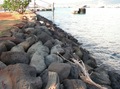
 No easy answers on seawalls, a column in today’s Advertiser, poses an interesting question. Is it legal to walk on seawalls where there is no beach makai (seaward) of the wall:
Q. In Kane’ohe Bay on O’ahu, there are numerous stretches of the coastline that do not have a beach but rather, the ‘aina ends abruptly with a seawall that is about 2 to 5 feet high. Walking along the makai side of the seawall is not possible due to the depth of the ocean, so is it OK to walk on top of the seawall? Would this be considered the high water mark?
A. There’s no easy answer, and this might be something for the Legislature to address.
The article then goes on to discuss the possibilities: the legislature can address the issue, or perhaps such seawalls are already subject to public use. Let me add my two cents on these points.
The issue is whether the tops of these seawalls are public or private property. I suppose the Legislature could declare that the public is allowed to walk atop all such seawalls. However, unless that law provided for compensation for property owners, it would likely be unconstitutional as a regulatory taking. The Legislature, you see, has no power to declare that private property is open to public access without the payment of just compensation. The US Supreme Court held in Kaiser Aetna v. United States, 444 U.S. 164 (1979) — the case arising out of the efforts to make Hawaii Kai marina a public waterway — that just because the government has the power to regulate private property does not mean it has the power to force public access without condemning the property and paying just compensation.
This rule would prohibit the Legislature from mandating public access to all seawalls under, for example, the Coastal Zone Management Act, which is a regulatory system, and contains no compensation mechanism.
Under Hawaii law, the boundary between public and private beachfront is defined by the “high wash of the waves.” See In re Ashford, 50 Haw. 314, 440 P.2d 76 (1968). For existing permitted seawalls, the “high wash” presumably is somewhere below the top of the seawall, so there should be no public ability to walk across the top, and it is too late for government to retroactively require public access. For future seawall permits, the government could not require access as a condition of building or repair, unless the government could also show that the seawall would impair existing lateral access along the public beach. If not, access cannot be made a condition of a permit.
The final issue involves seawalls that are built on private land, but inhibit the “normal” wash of the waves. Is the public/private boundary thus mauka (mountainwards) of the seawall because the “natural” high wash of the waves in presumably inland? I’d suggest no.
The Ashford rule is not based on the “natural” or “unimpeded” high wash of the waves, and ancient Hawaiian culture and traditions recognized that manmade structures inhibit wave action, the most well-known being the rock walls of loko kuapa fishponds, which resemble seawalls. Under Hawaiian custom, these rock walls were not subject to public access, and were treated as the equivalent of private fast (dry) land. For an example of their treatment under Hawaii and U.S. law, see Boone v. United States, 944 F.2d 1489 (9th Cir. 1989), a case I litigated a few years back. Besides, any rule that is based on the “natural” flow of the waves is simply unworkable, for what is the baseline for “natural” and when is it measured, when the size and shape of beaches change all the time for a variety of causes? Legal rules are supposed to provide a measure of certainty, and as the title of today’s article rightly suggests, there are, unfortunately, no “easy answers,” and the public and property owners are left guessing for the most part.