
January 2007

Waves KITV reports that “Waves Wash Debris Onto North Shore Roadways” during winter high surf on Oahu’s famed North Shore. 

What does this mean when the boundary between public property and private land on the shoreline is the upper reaches of the wash of the waves, as evidenced by the vegetation or the debris line?  Would a single rogue wave that washes far up past the usual high wash move the property line?
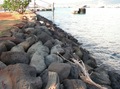
This question may seem far-fetched, but under the present standard for measuring the line between private property and the public beach, there is little standing in the way of a claim that wave action moves property lines.  Good thing Maverick’s, with its 100-footers, isn’t nearby.

Continue Reading ▪ “High Wash of the Waves?”

Seawall_1 No easy answers on seawalls, a column in today’s Advertiser, poses an interesting question.  Is it legal to walk on seawalls where there is no beach makai (seaward) of the wall:

Q. In Kane’ohe Bay on O’ahu, there are numerous stretches of the coastline that do not have a beach but rather, the ‘aina ends abruptly with a seawall that is about 2 to 5 feet high. Walking along the makai side of the seawall is not possible due to the depth of the ocean, so is it OK to walk on top of the seawall?  Would this be considered the high water mark?

A. There’s no easy answer, and this might be something for the Legislature to address.

The article then goes on to discuss the possibilities: the legislature can address the issue, or perhaps such seawalls are already subject to public use.  Let me add my

Continue Reading ▪ Trespassing on Shoreline Private Property

We all know that in Public Access Shoreline Hawaii v. Hawaii Planning Comm’n, 79 Haw. 25, 903 P.2d 1246 (1995), the Hawaii Supreme Court held:

Our examination of the relevant legal developments in Hawaiian history leads us to the conclusion that the western concept of exclusivity is not universally applicable in Hawai’i.

The court also noted that “western concepts” of property include a certain bundle of rights:

The western doctrine of “property” has traditionally implied certain rights. Among these are the right to the use of the property, the right to exclude others[,] and the right to transfer the property with the consent of the “owner”.

In 2000, the Hawaii Legislature amended the state’s environmental assessment/impact statement law, Haw. Rev. Stat. ch. 343 to require examination of cultural practices as well as environmental policies, economic welfare, and social welfare:

“Significant effect” means the sum of effects on the quality

Continue Reading ▪ Are Constitutional Property Rights “Cultural Practices” That Should be Considered?

I had the pleasure and honor to participate as faculty in this year’s Hawaii Land Use Conference, which wrapped up yesterday. 

The two-day conference covered the spectrum of topics relating to land use, including eminent domain, regulatory takings, endangered species act and federal Corps of Engineers permits, the treatment of agricultural land under Hawaii’s unique regulatory system, zoning and subdivision rules, RLUIPA, vested rights and development agreements, and cultural impact statements.  All presented by the leaders in their respective fields.  I presented a session of shoreline law and regulation (materials posted here), and spent the remainder of the time listening. 

Great stuff.  If you didn’t have the chance to attend this year, you should consider it for next.Continue Reading ▪ Hawaii Land Use Conference Summary

For those of you who attended the Hawaii Land Use Law Conference, thank you.  Here are the materials I mentioned in my session on Water, Water, Everywhere: Coastal Zone Management Permits; Hawaii’s Floodway, Floodplain and Coastal Inundation Zone Requirements, plus a few others I did not have time to cover:

  • Summary of Diamond case and commentary – 2006’s second “big case” about the CZMA; the “shoreline” issue determined in that case was about the baseline for setbacks, not ownership.
  • Kaiser Aetna v. United States, 444 U.S. 164 (1979) – government’s ability to regulate does not equal the ability to affect ownership rights without just compensation.
  • Boone v. United States, 944 F.2d 1489 (9th Cir. 1989) – guess what, Kaiser Aetna meant what it said.
  • Alameda Gateway, Ltd. v. United States, 45 Fed. Cl. 757 (1999) – Kaiser Aetna really meant what it said – just because a navigable ship repair facility in San Francisco Bay is subject to regulation does not mean property rights are affected.
  • Items I didn’t have time to talk about, but are worth mentioning:

        
    Continue Reading ▪ Land Use Law Conference Materials

    In addition to the bills mentioned earlier here and here, even more measures have been introduced in the Hawaii legislature to amend state eminent domain law.  I believe that these are it for the year, as the deadline to introduce bills has now passed. 

    Prohibits use of eminent domain for private purpose; defines private purpose; where condemned property is transferred to private entity, not a common carrier or public utility, burden is on condemning authority to prove public purpose.

    “The Hawaii supreme court, in a previous decision, Hawaii Housing Authority v. Lyman, 68 Haw. 55, 704 P.2d 888 (1985), indicated that it would not interpret the “public use” provisions of article I, section 20, of the Hawaii state constitution as broadly as the United States Supreme Court has interpreted the corresponding provisions of the fifth amendment.  Nevertheless, the Hawaii supreme court in

    Continue Reading ▪ Even More Eminent Domain Measures Introduced (Last Ones)

    The Chief Justice of the Supreme Court of Hawaii has given his State of the Judiciary address, available here.  Here’s an excerpt:

    Legislators, as you well know, enact laws in accordance with what they understand to be the popular will and in the public interest.  Judges, however, apply the law that is the result of longstanding common law traditions and legislative processes to the evidence in individual cases; judges do so even when the loudest voices at the time may have other conceptions about what the law or result should be in a particular case.  In short, a judge’s first and foremost duty is to fairly and impartially apply the constitution and the law to the facts of the case.  A judge’s personal feelings about what the law “should be” has no place in his or her deliberations.

        
    Continue Reading ▪ State of the Judiciary

    In addition to the bills I mentioned earlier, more measures have been introduced in the Hawaii legislature to amend state eminent domain law.

    Prohibits use of eminent domain for private purpose; defines private purpose; where condemned property is transferred to private entity, not a common carrier or public utility, burden is on condemning authority to prove public purpose.

    “However, the legislature finds that other takings of private property for transfer to private entities may be susceptible to abuse.  Even under Kelo, the taking of property from one person simply to benefit another private person violates the protections of the public use clause.  Similarly, a taking that is intended to favor a private party, with only incidental or pretextual public benefits, would not be sustained.  Likewise, a taking that is simply for the purpose of providing economic benefits without remedying any harm or

    Continue Reading ▪ More Eminent Domain Measures Introduced

    QueenstIt’s being reported that the Hawaii Community Development Authority has backed off its plans to widen Queen Street in Honolulu because of delays and increasing costs.  The plans would have used the power of eminent domain to take the property of businesses on both sides of the street.  More stories posted here and here (video).  Update (2/8/2007) – the Star-Bulletin reports that the ID 11 project was killed by a unanimous vote by HDCA.

    The widening project was thought by many to be a “done deal,” believing there was no way to stop the taking.  But this just shows that even in a jurisdiction with fairly weak protections for owners whose property is targeted for acquisition by the government, there are ways to object and protect your property.

        
    Continue Reading ▪ Honolulu Street Widening Halted

    According to one U.S. District Court (N.D. Iowa), there is no right to a jury trial on the issue of whether a land use ordinance is constitutional.  The decision applies City of Monterey v. Del Monte Dunes at Monterey, Ltd., 526 U.S. 687 (1999).  In Doctor John’s Inc., v. City of Sioux City, a case involving the regulation of the plaintiff’s “adult” store, the district court held that the  City has no Seventh Amendment right to trial by jury on the issue of whether its ordinances are constitutional.

    The court’s decision can be found here (pdf).

        
    Continue Reading ▪ No Jury Trial on “Constitutionality” of Land Use Laws