Games people play
Night or day they’re just not matchin’
What they should do
Keeps me feelin’ blue
Been down too long
Right, wrong, I just can’t stop it

This one isn’t about takings, but is nonetheless a must-read.

In Health Freedom Defense Fund, Inc. v. Carvalho, No. 22-55908 (June 7, 2024), a panel of the U.S. Court of Appeals for the Ninth Circuit (yes, the Ninth Circuit!) held that the litigation was not moot even though the government had revised the challenged regulation. The Ninth Circuit also vacated and remanded the District Court’s dismissal of the challenge to the Los Angeles Unified School District’s requirement that its employees be vaccinated 

The sequence of facts is important. Check out the shell game shenanigans that LAUSD went through, after which it told the courts with a straight face that this was just routine and not it playing litigation games:

  • LAUSD


Continue Reading Games Government Play: Ninth Circuit Doesn’t Buy Attempt To Moot Constitutional Challenge To Co-19 Vaccination Policy By Sandbagging And Withdrawing

Here are three federal circuit opinions, all unpublished. None of them worthy of a stand-alone post, but also not to be overlooked entirely.

  • GHP Management Corp. v. City of Los Angeles, No. 23-55013 (9th Cir. May 31, 2024): Lessors “failed to state a claim for a Fifth Amendment per se physical taking[,]” in their challenge to LA’s eviction moratorium. You know why: you waived your right to exclude by renting your properties, so the government prohibiting you from getting breaching tenants out is merely a regulation of the landlord/tenant relationship. Yee.
  • Innova Investment Group, LLC v. Village of Key Biscayne, No. 21-11877 (11th Cir. May 29, 2024): After the Village tagged Innova with a NOV and $4k fine for not obtaining an interior demolition permit and Innova failed to correct the violations within the 60-day deadline, the Village imposed $4k per day fines and “aggregate penalties of


Continue Reading Unpublished Wednesday: Eviction Moratorium Taking, Excessive Fines Taking, And 1983 Zoning Statutes Of Limitations

Devillier

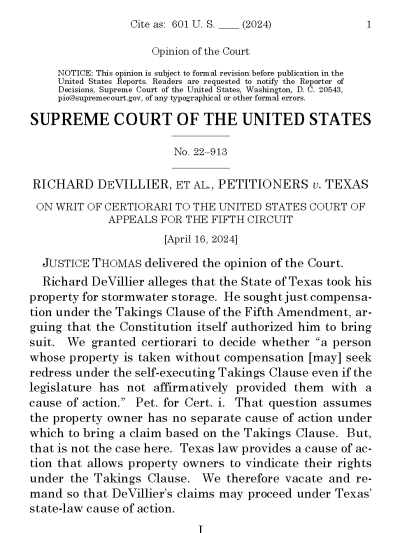
Note: this is the second of our posts on the U.S. Supreme Court’s recent decision in Devillier v. Texas. The first — which tries to put the weird post-opinion controversy over which party “won” at the Supreme Court into its proper perspective — is here.

In this post we’ll cover the case’s facts, the odd procedural path that Texas dragged everyone through (only ultimately abandon a key position once at the Supreme Court), and what the Court actually decided, if anything.

The State Flooding Private Property is a Taking Under Everyone’s Constitutions

After the Texas DOT flooded his property as part of a freeway project by creating a dam that caused rainwater to collect on his land, Devillier and other landowners sued the State of Texas for a taking, aka inverse condemnation.

The state flooding someone’s property is one of those “classic” cases which are considered takings,

Continue Reading Devillier v. Texas (Part II): After Rope-a-Dope By Texas, Unanimous SCOTUS Saves The State Immunity Issue For Later

The winner takes it all
The loser’s standing small
Beside the victory
That’s her destiny

Note: this is the first of a short series of posts on the U.S. Supreme Court’s recent decision in Devillier v. Texas.

In Part II, we’ll cover the case, the procedural path that Texas dragged everyone through, only to abandon it at the Supreme  Court), and what the Court actually decided, if anything,

Three Common Questions for Lawyers

In the classroom, I often ask students to use their intuition to guess the three most common questions that lawyers almost always get from potential clients. Put yourself in a client’s shoes: what would you want to know?

The students mostly get it right. “What’s this going to cost?” Check. “How long will this take?” Check. And perhaps most obviously, “What are my chances of winning?

That last

Continue Reading In Devillier v. Texas, The Winner Takes It All (Part I)

Even if the world were open today, the doors to most Hawaii state, county, and city offices would still be locked. Because Friday, March 29, 2024 is the day that Hawaii celebrates Good Friday.

Yes, Good Friday is an an official state-sanctioned holiday in the 808 area code, so we’re reposting our annual recounting of how it came to be that the State commemorates the date of the crucifixion, and how that squares with the Establishment Clause of the First Amendment

Turns out that we don’t really commemorate Good Friday as the crucifixion date, and it is just coincidence that the official State “spring holiday” occurs on the same day. (And this being Hawaii, in the end it’s really a public worker union thing like a lot of things.)

Good Friday is a legal holiday in the State of Hawaii pursuant to Haw. Rev. Stat. § 8-1.

Continue Reading Today Is Hawaii’s Secular Good Friday Holiday – What’s Up With That?

In Brinkmann v. Town of Southold, No. 22-2722 (Mar. 13, 2024), the U.S. Court of Appeals for the Second Circuit addressed a longstanding issue left unresolved by the Supreme Court in Kelo v. City of New London, 545 U.S. 469 (2005): is it enough that a condemnor’s professed use qualifies as a public use, or may a property owner nonetheless challenge a taking on the grounds that the real reason for the taking is not a public use?

Yes, the “pretext” issue is back!

The facts of the case are pretty straightforward. The Brinkmanns wanted to build a big box hardware store on a 1.7 acre vacant parcel. The usual objections from area residents and the Town itself appeared (you know the drill): a store like this would result in too much additional traffic (traffic study said no), special permits and impact studies are needed (the owners began

Continue Reading It’s OK To Do Good Things For Bad Reasons: CA2 On Spite Takings – As Long As Taking Is For A Public Use, The Real Reason Is Irrelevant

You’ll want to check out the U.S. Court of Appeals’ opinion in Gerlach v. Rokita, No. 23-1792 (Mar. 6, 2024), even though it mostly retraces grounds already tread by other courts.

The takings claim was based on the actions of Indiana government officials who didn’t give the interest earned on unclaimed funds to the owner of those funds. The court got the property owner coming and going: it held the claim for declaratory and injunctive relief was moot, and also that the claim for just compensation could not be pursued in federal court (Eleventh Amendment). In short, no claim at all.

First, some background. After a specified period of inaction, Indiana takes custody of things like unclaimed wages, unclaimed insurance proceeds, and uncashed public entity checks. These funds go into a special account, and owners may make claims to recover their property. Any excess in this account over what

Continue Reading Coming And Going: Eleventh Amendment Trumps Fifth Amendment – States Must Consent To Be Sued In Federal Court, Even For Just Compensation

Screenshot 2024-02-28 at 13-12-21 Call for Papers Too Far Imagining the Future of Regulatory Takings PDF Justice Crime & Violence

Have thoughts about where regulatory takings are (or should be) headed? Here’s your chance to get in on the conversation, and to shape the future of the law. Our outfit, the Pacific Legal Foundation, in cooperation with the Antonin Scalia Law School’s Journal of Law, Economics, and Policy, are calling for papers on “Imagining the Future of Regulatory Takings.” There will be an in-person discussion of these papers at the Law School in October 2024.

Here’s the full description:

A century ago, Oliver Wendell Holmes, speaking for the Supreme Court, assured us that “[t]he general rule at least is that while property may be regulated to a certain extent, if regulation goes too far it will be recognized as a taking.” In the ensuing one hundred years, courts have struggled to draw the line defining “too far.” Some still wonder whether such a line should even exist. As Justice Clarence

Continue Reading Call For Academic Papers: “Too Far: Imagining The Future of Regulatory Takings”

In Rhone v. City of Texas City, No. 22-40551 (Feb. 14, 2024), the U.S. Court of Appeals for the Fifth Circuit held that a municipality’s conclusion that Rhone’s apartment building had not been properly maintained, and a subsequent municipal court demolition order, might be a taking … or it might not be.

We won’t get too far into the facts, except to say that Rhone argued that the city had it out for him, and that the municipal court judge who issued the demolition order was in a contractual relationship with the city by which the judge had to submit for approval all of the court’s decisions to the city attorney (the very party pressing the nuisance claims against Rhone). Weird, but apparently a product of Texas law. Short story, according tot the court: “[a]ll of this, facially at least, is a declaration of a lack of independence of

Continue Reading Too Soon For CA5 To Figure Out Whether City Demolishing Property For Code Violations Is A Taking

ALI-CLE brochure cover page

When it comes to the longstanding ALI-CLE American Law Institute-CLE Eminent Domain and Land Valuation Litigation Conferences, we’re always ready to go. You know that. But this year’s version — the 41st — was buzzing like no other in recent memory.

Maybe it was the New Orleans venue with its atmo, food, and music for our after-class activities, or even the timing (the second-to-last week on the Mardi Gras parade season, and our conference hotel was right on the routes). It might have been the nice weather (oh, it rained buckets one evening, but there wasn’t an ice storm like we experienced in Austin in 2023). Or maybe it was the capacity crowd, and new topics and speakers on the agenda. Or maybe it was just the prospect of seeing our friends and colleagues again after a year.

Here’s a photo essay of some of the Conference highlights.

And

Continue Reading Pass A Good Time: Our Report From The 41st ALI-CLE Eminent Domain & Land Valuation Litigation Conference, Feb 1-3, 2024, New Orleans