
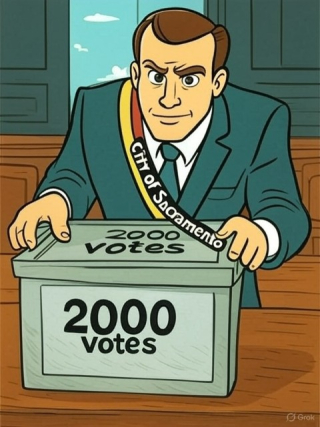
The above is the image Skynet returned when we
asked for a graphic for this post
The California Court of Appeal’s recent opinion in Dessins LLC v. City of Sacramento, No. C100644 (July 9, 2025) doesn’t deal with eminent domain or takings, but is about municipal fees and the way California requires these things get adopted. But we’re going to cover it, if only briefly.
Why? Because it turns out that this decision tells us a lot about how California courts seem to look for any way to uphold exercises of government power. And when that power comes directly into conflict with the voters as it does here, one guess who wins.
A bit of background for you non-Californians.
If you were to not have an understanding of the history of local fee collection and property taxation in California, you might be under the impression that it is pretty tough to get a new tax or fee approved approved or increased. After all, one of the centerpieces of California’s property tax policy is Proposition 13, a voter-adopted state constitutional amendment that limits the amount of annual increase in property tax local governments may collect, based on the owner’s acquisition date. Prop 13 also requires a two-thirds vote of the electorate to impose special taxes.
After the adoption of Prop 13, rather than living under these restrictions, local governments pushed back by shifting the heretofore permitted profligate property and special taxation to special benefit assessments. After all, special benefits and improvements aren’t covered by Prop 13, so let’s just change the label and the justification, and voila! California’s courts played along, holding that special benefit assessments are not special taxes under Prop 13, and thus not subject to voter approval. As a consequence, 18 years after Prop 13, the voters went back to the polls and adopted another constitutional provision, Proposition 218. This requires voters approve special benefit districts.
With that foundation, back to the Dessins case. The city wanted to impose a new $20 million storm drainage fee. Which means it’s time for an election. But who votes on this? You muni law types know that it isn’t the entire city electorate, but rather in these kind of things, the voting can be limited. Here, it is limited to property owners who receive storm drainage services.
Here’s the rub: the voting isn’t one owner, one vote, but rather one property, one vote. In short, the more you own, the more you vote. That doesn’t seem inherently unfair, as you can imagine that whether to approve spending on some limited benefit should be voted on by those who have to pay for the benefit. And guess who (or what) is a major owner of Sacramento property? That’s right, the City of Sacramento owns 2,007 parcels which would be subject to the new fee.
Any guess how the city council directed the mayor to vote all of its votes, yea or nay? Amazingly not a single one of the city’s 2,007 votes voted nay (we are being sarcastic, in case you are wondering).
Here’s what happened next:
Based on these results, the City adopted the storm drainage fee and authorized the creation of a new accounting fund—the Storm Drainage Property Fee Fund. It is undisputed that had the City not voted its 2,007 properties in favor of the fee, the fee would not have been approved by a majority of the votes.
Slip op. at 2-3. A lawsuit by a losing voter ensued, asserting that “the adoption of the fee violated [the California Constitution] because the City’s votes should not have counted toward reaching the required majority approval.” Slip op. at 3.
The court rejected the argument, holding that because the city owns 2,007 properties, it can vote 2,007 times. Prop 218 says that all “property owners” can vote, and under the plain meaning of the text the city is a property owner because, well, it owns 2,007 properties. End of story.
What about the notion that the point of the requirement of a vote is to ensure that the property owners who are going to pay the assessment are okay with it? After all, the reality is that the city isn’t going to be paying squat, unless you count the city “paying” itself the fee by shifting taxpayer money from the city’s left pocket to its right, with, no doubt a nice little administrative vig for processing and handling along the way.
With inexplicable reasoning, the court held oh no, the city will be “paying” because it has to spend the fees collected on storm drainage and not use the fees for something else:
By imposing the fee, the City is requiring itself to pay “the proportional cost of the service” and to not use what it pays for any other purpose than for which the fee was imposed. (Art. XIII D, § 6, subd. (b)(2)-(3).) Thus, the fee will obligate the City to spend about $496,000 a year on its storm drainage system that is not provided by the other property owners.
Slip op. at 9-10. Are we off base when it looks like the court is holding that the requirement that the city spend the fees on sewage infrastructure and not on something else, is the city “paying” the fee? As we note in the title of this post, that seems like sleight-of-law, at best. And a really warped world view, at worst.
In our view, the court never truly considered the “does it pay?” question beyond that, and stopped after it concluded that the city is a property owner: once the meaning is plain, you don’t need to deal with intent or the liberal construction that constitutional provisions are supposedly entitled, because the required liberal construction can never overcome plain meaning. That canon of statutory construction seems about as malleable as any might desire. Remember, this is the same court which held the plain meaning meaning of “fish” in a statute includes bees.
We post this one just as an illustration of how far it seems courts can go to boost the power of government, even where it is pretty obvious that protecting municipal self-dealing isn’t what Prop 218 was all about. But there it is.
Dessins LLC v. City of Sacramento, No. C100644 (Cal. App. July 9, 2025)