
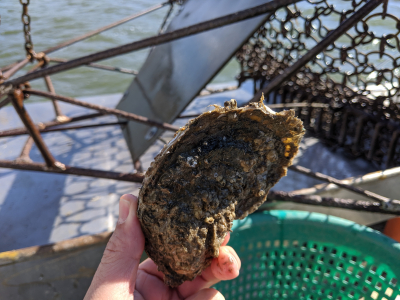
Here’s the latest in a case we’ve been following for some time.
You remember when the Court of Federal Claims denied the government’s motion to dismiss a takings claim and issued a very readable opinion rejecting the argument that oysters planted on submerged land leased from Louisiana are not “private property.” The CFC opinion held that “plaintiffs have all three essential features of the ‘bundle of rights’ commonly characterized as ‘property’ under Louisiana law.”
Very Lockean. The kind of opinion that you want to read over and over.
But like all court orders made before entry of final judgment, the CFC’s opinion was interlocutory. Meaning subject to change. And change it did: after further briefing and argument, the CFC saw the issue differently — whether the plaintiffs possessed a property right in the oysters turned on whether their leases prohibited suit — and dismissed the case.
In Campo v. United States, No. 24-2312 (May 21, 2026), in an unpublished opinion the Federal Circuit affirmed.
Let’s go back and refresh ourselves on the situation. The plaintiffs leased submerged lands from the State of Louisiana which they used as oyster beds. In 2019, the Corps of Engineers opened the Bonnet Carré Spillway releasing thousands of cubic feet of fresh water. This fresh water diluted the salinity of the water on the oyster beds. Oysters, you see, prefer moderate salinities (brackish water), not fresh. In the plaintiffs’ oyster beds, oyster mortality rates were up to 100% in some areas. The Louisiana Department of Health ordered several of the oyster areas closed due to low salinity levels.
The oyster farmers brought a claim for a permanent taking against the United States in the CFC. The property claimed to be taken was the oysters and the oyster reefs. The government sought dismissal for failure to state a claim, arguing that the plaintiffs oysters are not “property” protected by the Fifth Amendment. The State of Louisiana owns the waters, the government argued, and the Louisiana Supreme Court (in Avenal v. State, 886 So. 2d 1085 (La. 2004)), held that there’s no private property in these situations.
As noted above, at first the CFC didn’t buy the argument that there’s no private property in the oysters, holding that the plaintiffs put their labor into the oysters — but later shifted gears and held that there’s no property because the plaintiffs’ leases with Louisiana said there’s no property right.
The Federal Circuit agreed. The “main issue on appeal is whether there was a permanent taking of Appellants’ property interests in violation of the Fifth Amendment.” Slip op. at 5. No private property, no taking. Footnote 1 is key: “Appellants conceded at oral argument that if the relevant 2016 Louisiana statutes applied, then they would not have a takings claim.” Slip op. at 5 n.1.
These statutes defined the scope of the rights granted by the state leases. The statute stated that any property rights granted by the leases are “subordinate” to the “rights or responsibilities” of the state and the federal governments, “to take action in furtherance of coastal protection, conservation, or restoration.” Slip op. at 6 (quoting La. Stat. Ann. § 56:423(A) (2006)). The statute also made clear that “no lessee shall have any right to maintain any action against” the state or federal governments “for any claim arising from any project, plan, act, or activity in relation to coastal protection, conservation, or restoration[.]” Slip op. at 7 (quoting La. Stat. Ann. § 56:423(B)(1)).
What sealed it for the Federal Circuit was the statute’s defining the spillway project as a “project, plan, act, or activity for the protection, . . . maintenance, or management of the coast.” Slip op. at 7.
Thus, Appellants have failed to state a claim under the 2006 amendments, which subordinate Appellants’ oyster leases to the Corps’ operation of the Spillway and place limits on claims against the United States.
Slip op. at 8.
No mention of Locke or the labor theory of property, unfortunately.
Campo v. United States, No. 24-2312 (Fed. Cir. May 21, 20260 (unpub.)