

You land user types know that the concept of “vested rights” or “zoning estoppel” and related doctrines line nonconforming uses are very state-specific. From early vesting jurisdictions where merely filing an application for a permitted use locks in the then-existing restrictions on use, to places like California where you need to have driven the last nail before you can say you are vested. Then there are those jurisdictions somewhere in the middle which say there has to be some action by government that induces reasonable reliance in the form of expenditures.
A long time back (circa 2004), we and two of our colleagues published an article about the various approaches and one way to avoid any uncertainty where the development agreement process has been authorized by the legislature, if you want to find our more. Most of the stuff in the article remains applicable today, although the citations in the footnotes might need a bit of updating.
One of the questions we addressed was whether an owner could rely on zoning alone, particularly where the regulatory scheme applicable to the property in question does not require the owner to obtain more than ministerial approvals. Some states like Florida say yes, even though the general rule is no (see Rhode Island for example).
In Worthwhile Wind LLC v. Worth County Board of Supervisors, No. 24-1813 (Apr. 24, 2026), the Iowa Supreme Court joined the “no” camp, making clear that a vested right to complete a planned use unless it obtains some form of affirmative approvals from the government, and that Iowa does not recognize vested rights “in the prior zoning regime” alone. Slip op. at 2.
The factual set in the case should be pretty familiar to those of you experienced in vested rights situations: developer (here of win turbines) wanted to build a wind project. It did the usual groundwork like environmental studies, engineering assessments, something called “bat acoustic surveys,” and entered into leases with over 100 property owners. But according to the opinion, “[a]lthough Worthwhile completed many preliminary activities in the development of the project, the essential parameters of the project remained unspecified and unstarted.” Slip op. at 3.
When the project was started, the county was “partially zoned,” and “[n]o countywide ordinance regulating the construction of wind turbines exists, and no county permits were required for development in the unzoned portions of the proposed project area.” Slip op. at 4. The county looked like a place that was really in favor of these type of projects (it even approved the Freeborn Wind Farm, a project in an adjacent county, but which also extended into Worth County).
But predictably, that didn’t last and what was good yesterday to the public became no good:
In 2021, public sentiment in the county regarding wind development turned based on the public’s complaints about the turbines following the completion of the Freeborn Wind Farm project. The public elected two new supervisors to the Board of Supervisors reflecting the change in sentiment.
Slip op. at 5. And you know what happened next: temporary moratorium to allow time to construct a regulatory regime, followed by adoption of a new ordinance which subjected these things to a lot of restrictions on height, setbacks, noise, and the like.
Next, a claim from the developer that these new rules don’t apply to us because we’re vested, with the trial court agreeing:
Worthwhile did not attempt to modify the project to comply with the new ordinance, nor did it seek waivers or any other accommodation. Instead, Worthwhile filed this declaratory judgment action. In count I, Worthwhile sought a declaration that it had vested rights to complete the project under pre-moratorium law. In count I, it also claimed that the county enacted the new ordinance in bad faith and therefore the new ordinance could not be enforced against Worthwhile. In count II, Worthwhile alleged the new ordinance was arbitrary, capricious, unreasonable, and contrary to public policy. Following a bench trial, the district court ruled in favor of Worthwhile on count I. The district concluded that Worthwhile had vested rights in the project and that the county acted in bad faith. The court ordered that Worthwhile “has a vested right to complete development of its commercial wind energy system project in accordance with Worth County law that existed before Resolution No. 2020.04.05 (moratorium) and Worth County Ordinance 2022.06.27 (new ordinance).” The county appealed.
Slip op. at 6-7.
The Iowa Supreme Court reversed. After reviewing the various approaches to the doctrine, the court concluded you can’t vest unless you first ask the government for something and it says yes. A subdivision plat, or a permit to operate for example:
Applying these principles here, we conclude that Worthwhile’s vested rights claim fails as a matter of law. Worth County never formally approved a plat. Worthwhile never applied for or obtained a permit to construct or operate the commercial wind turbines that are the object of the project.
Slip op. at 12.
Hold on, the developer argued, before the county adopted the regulations, there was no permit required, no zoning restrictions, no nothing. See slip op. at 13 (“Worthwhile argues that requiring governmental approval as a predicate to vesting produces an absurd result in this case. In unzoned areas where no permit is required or available, Worthwhile argues, a developer could never acquire vested rights regardless of the magnitude of its investment.”).
The court said no, this “vested rights” thing you are talking about is applicable “only in limited circumstances,” and is there to protect settled expectations. Id. But those expectations only “crystallize, when the government, through its established permitting or approval process, has signaled that a proposed use conforms with the applicable regulatory framework.” Id.
And here’s the money quote from the case:
In an unzoned area, no such signal has been given. A developer who spends money in an unzoned area does so with knowledge that local government retains the full scope of its legislative power to enact zoning regulations. No enforceable right arises in a regulatory vacuum.
Id.
Read that again, just to be sure: that’s right, you have no rights to use your property unless the government approves of it first, even where there’s no government regulations in place at all. Your expectations cannot “crystallize” in the absence of regulations. All you have are unorganized grabasstic pieces of amphibian expectations (to paraphrase someone).
To us, that seems entirely backwards. Sure, the government has the power to regulate and restrict your use of your property when doing so furthers the public’s health, safety, welfare, and morals. But an owner’s rights to use the property (including develop it) don’t seem to be dependent upon the government first regulating the property, with the owner only having the right to use whatever might be allowed. Something seems to have short-circuited in the Iowa court’s Locke vs. Hobbes wiring.
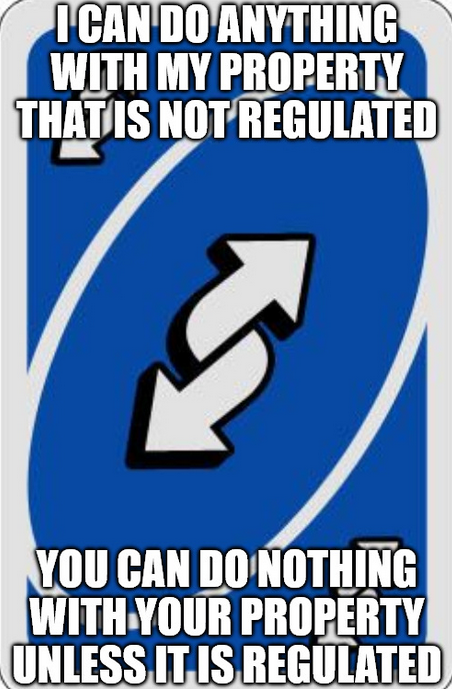
The court might be on more defendable ground if the county had asserted the development of a wind project was injurious to the public health, safety, welfare, or morals such that it was never part of the owner’s rights in the first place. The court tries to get around this essential contradiction by asserting that other protections are available in an unzoned area:
In addition, the vested rights doctrine is not the only protection available to a developer in an unzoned area. The bad faith doctrine, the Contracts Clause, the Due Process Clause, and the Takings Clause of the State and Federal Constitutions might provide alternative avenues of relief against arbitrary or confiscatory governmental action.
Id.
That to use also seems backwards: the common law vested rights doctrine should be the first line of defense, not the backstop to baseline constitutional limitations, some of which under existing doctrine are paper tigers at best (see, e.g., Contracts Clause and substantive due process [at least until Nectow is revived). And a takings claim would be is based, rightly or wrongly, in part on expectations, and the court just held that the developer has none, so good luck with that. Thus, you know that if the developer were to bring any of these claims they would very likely flounder on some shoal: lack of a “property” interest (the court just held you have no right to develop), lack of a Contracts Clause cause of action, or no expectations worthy of protection. So please spare us the assertion that the opinion’s rationale is saved by the availability of constitutional claims.
In the end, the Iowa court seems to be making a naked philosophical assertion: you have no right to use your property unless and until the government both regulates it and agrees that you can do something with it. Which seems entirely backwards to us.
Worthwhile Wind LLC v. Worth County Board of Supervisors, No. 24-1813 (Iowa Apr. 24, 2026)