
Here’s the latest in our continuing series of dirt law pilgrimages, where we visit the site of some of the more important cases in our favorite area of law.
As every dirt lawyer knows, you can see photos, read descriptions, and study plat maps. But when it comes to understanding about the property at issue, nothing substitutes for getting your shoes in the dirt on-site, seeing the area for yourself, smelling the air. Walking the earth.
We’ve visited the Kelo site, the cement plant in Boomer, the site of the first case in which the Supreme Court applied the Fifth Amendment’s Just Compensation requirement to states and cities (Chicago, Burlington), the Loretto building, Hadacheck’s former brick plant, the Nollan home, and more. Even Monet’s famous garden (yes, even that place had a property fight).
Just a few days ago, we noted the 98th anniversary of Nectow v. City of Cambridge, 277 U.S. 183 (1928), although we wanted to be on-site for that anniversary (like we were for the Mahon case), we were tied up in court, just down the road in Providence.
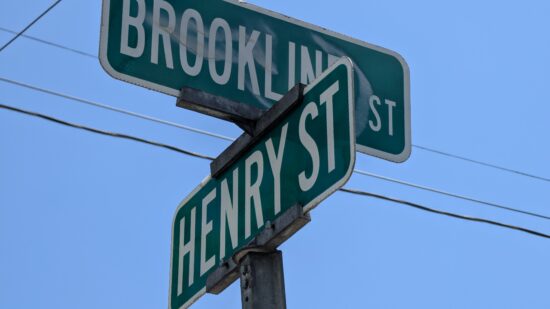
But after that appearance wrapped we headed towards Cambridge, Mass. Specifically, the corner of Brookline and Henry Streets.
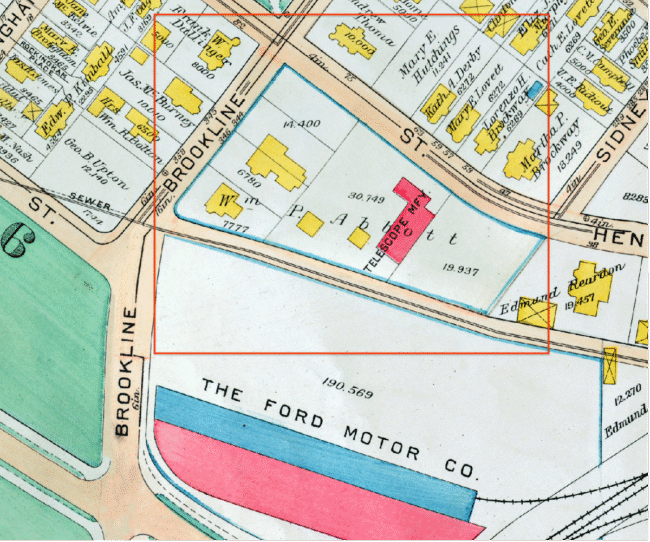
After finding a place to park, it was time to scope out the site of the Nectow case, which, as the Supreme Court noted in its 1928 opinion, the master did in that case: “After a view of the premises and the surrounding territory, and a hearing, the master made and reported his findings.” Nectow, 277 U.S. at 186.
We endeavored to do the same.
And there it is, across the street from the northwest corner of Brookline and Henry.
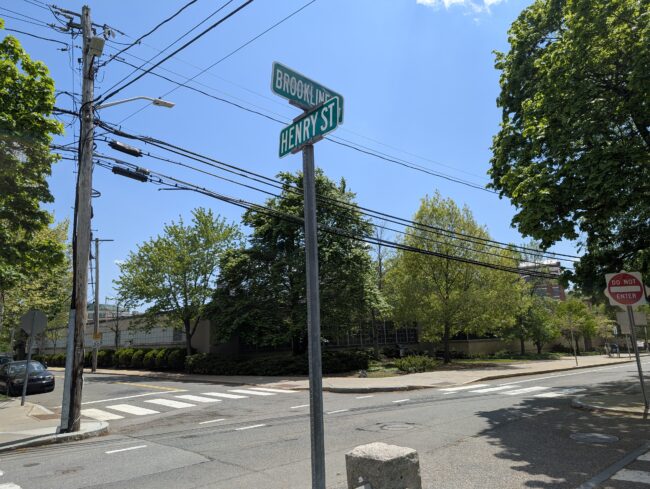
The Locus
As the Supreme Court opinion described it:
When the zoning ordinance was enacted, plaintiff in error was and still is the owner of a tract of land containing 140,000 square feet, of which the locus here in question is a part. The locus contains about 29,000 square feet, with a frontage on Brookline Street, lying west, of 304.75 feet, on Henry Street, lying north, of 100 feet, on the other land of the plaintiff in error, lying east, of 264 feet, and on land of the Ford Motor Company, lying southerly, of 75 feet. The territory lying east and south is unrestricted. The lands beyond Henry Street to the north and beyond Brookline Street to the west are within a restricted residential district. The effect of the zoning is to separate from the west end of plaintiff in error’s tract a strip 100 feet in width. The Ford Motor Company has a large auto assembling factory south of the locus, and a soap factory and the tracks of the Boston & Albany Railroad lie near. Opposite the locus, on Brookline Street, and included in the same district, there are some residences, and opposite the locus, on Henry Street, and in the same district, are other residences. The locus is now vacant, although it was once occupied by a mansion house.
Nectow, 277 U.S. at 186-187.
“The locus contains about 29,000 square feet, with a frontage on Brookline Street … The effect of the zoning is to separate from the west end of plaintiff in error’s tract a strip 100 feet in width.”
This is that strip, or at least a part of it, looking south down Brookline from Henry.
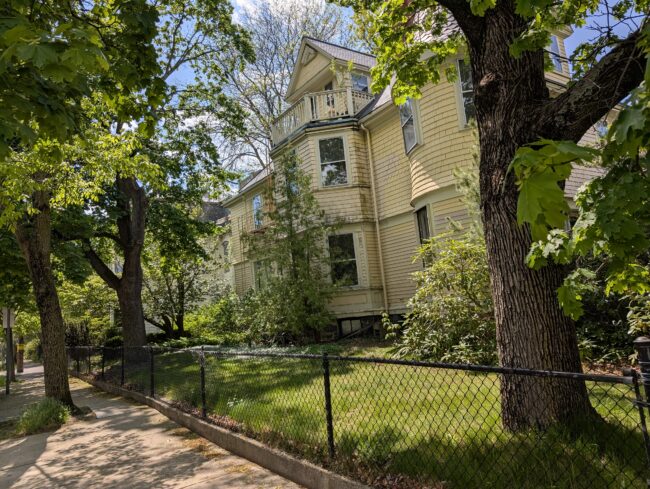
“Opposite the locus, on Brookline Street, and included in the same district, there are some residences….”
Here’s one that is no doubt from that time, and existed at the time of Nectow (we estimate it’s the house noted as owned by Dallinger on the color map).
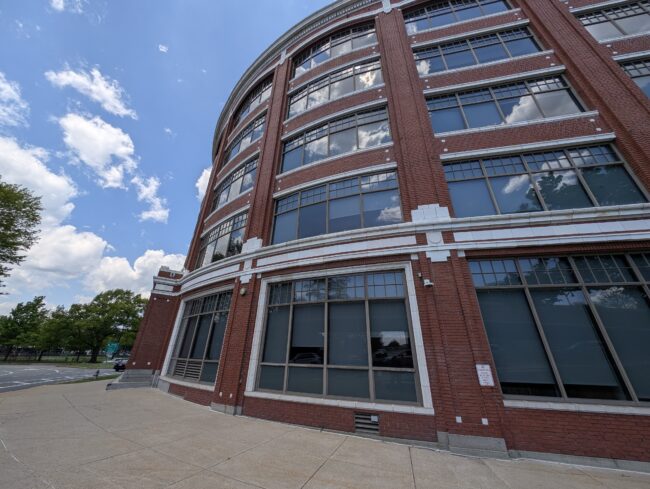
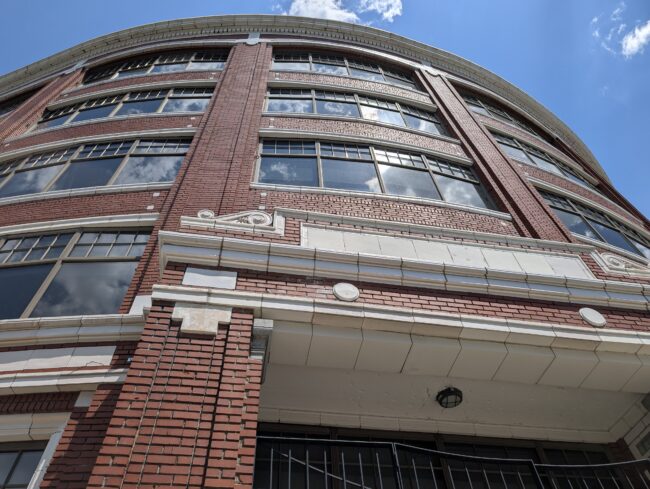
“The Ford Motor Company has a large auto assembling factory south of the locus …”
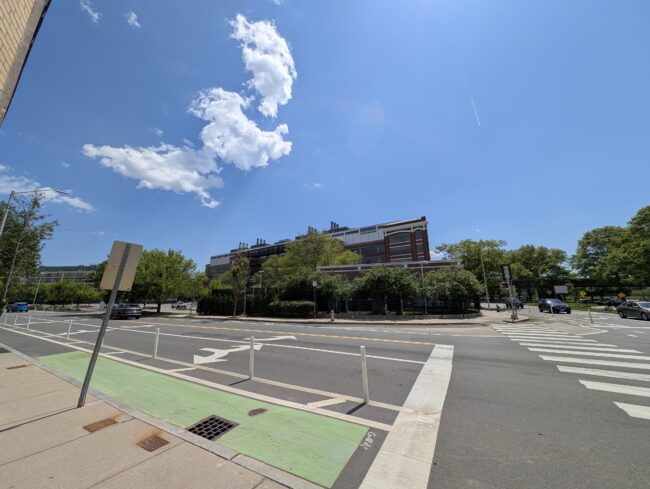
“The locus [is also] … on land of the Ford Motor Company, lying southerly, of 75 feet.”
There’s a parking lot there now where this part of Nectow’s “locus” was located.
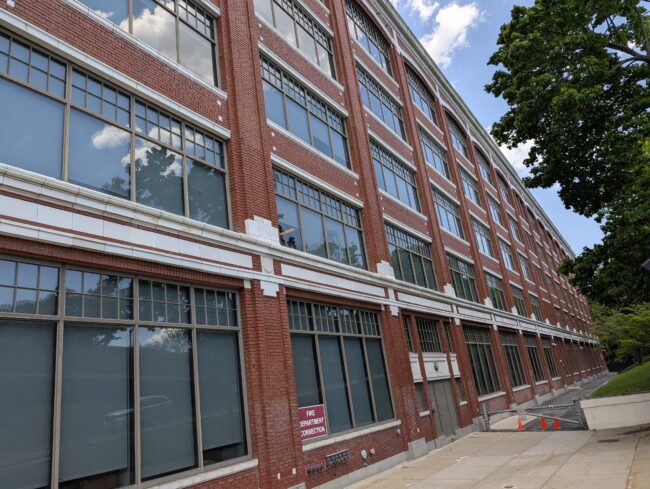
There’s no actual sign or cornerstone that we could locate today that this was a Model-T plant. But you can kinda just tell, can’t you?
As the Library of Congress notes:
The Ford Motor Company Assembly plant was built in 1913 in the first stage of decentralization of Ford production from Detroit to sites around the country. The Northeast branch of the Ford Company was initially located in Boston and, following construction of a new plant on Memorial Drive, moved to Cambridge in 1914.
Here’s a more complete history: “Cars in Cambridge by Doug Brown.”
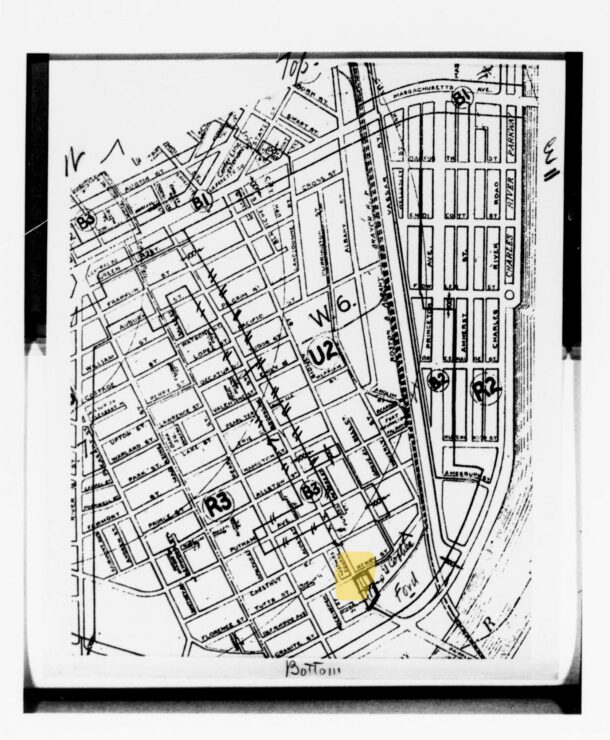
“…and a soap factory and the tracks of the Boston & Albany Railroad lie near.” On this map (from the Supreme Court record), you can see the location of the railroad tracks.
You can also see “[t]he lands beyond Henry Street to the north and beyond Brookline Street to the west are within a restricted residential district.”
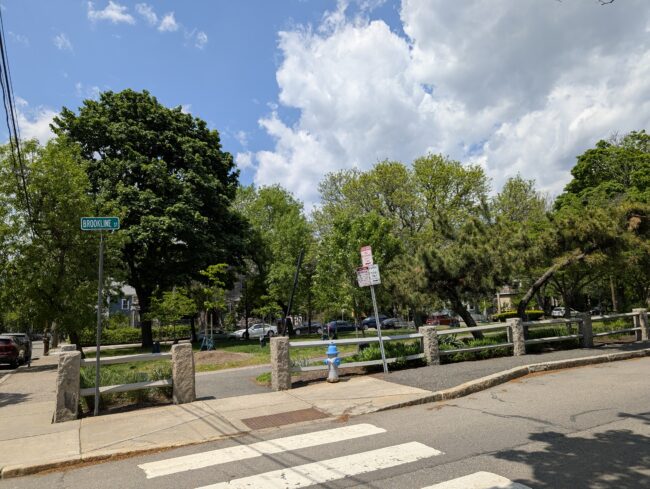
On the opposite corner of Brookline and Henry from the Nectow property, Hastings Square is still there.
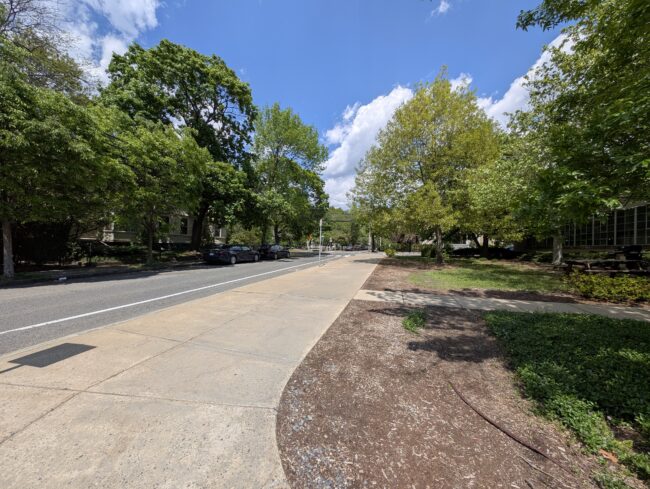
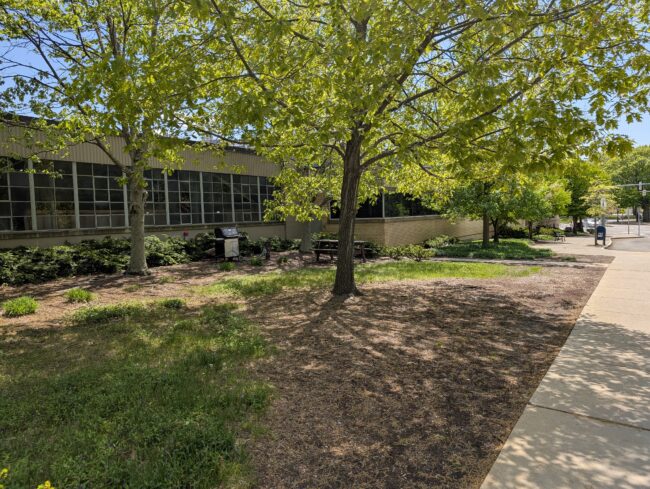
A view from the Nectow property towards the corner of Brookline and Henry. “The locus is now vacant, although it was once occupied by a mansion house.” The mansion house is now obviously gone, but the land is no longer totally vacant, either.
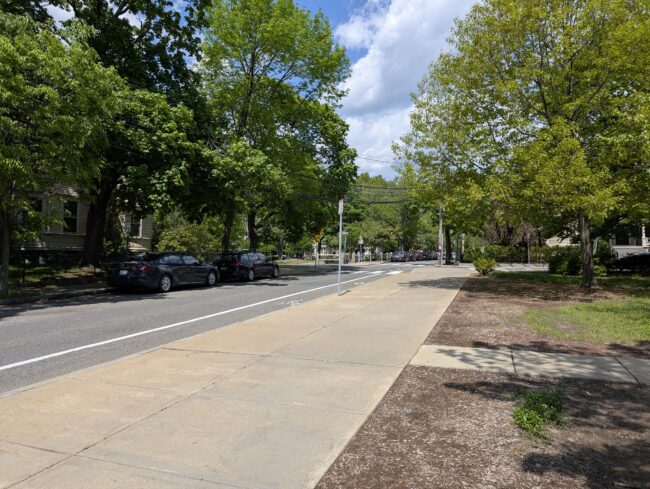
“The effect of the zoning is to separate from the west end of plaintiff in error’s tract a strip 100 feet in width.” The right side of the above photo (the area encompassing the sidewalk and the solitary tree) is the “west end of plaintiff in error’s tract.”
The building now on the site belongs to MIT, and houses the university’s mail services and Furniture Exchange.
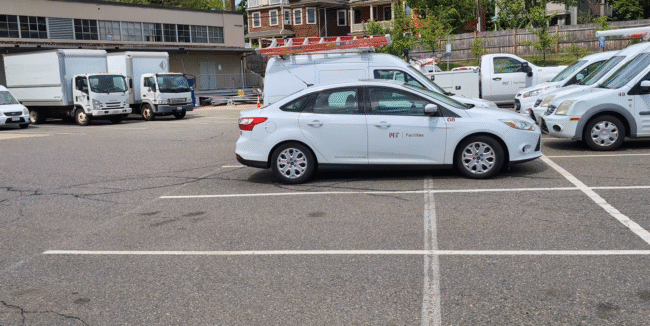
Viewed from the southwest corner of the property at Waverly, towards the former Ford plant.
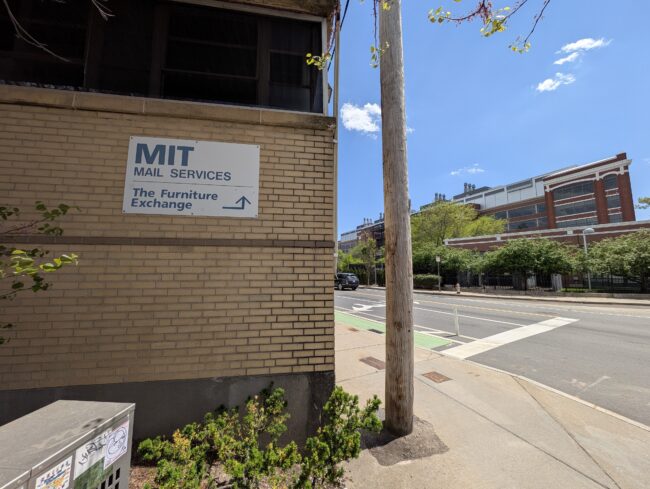
The site of the former “Telescope Mfy.” on the color map above is now the parking lot for the mail services facility and Furniture Exchange.
“…and opposite the locus, on Henry Street, and in the same district, are other residences.”
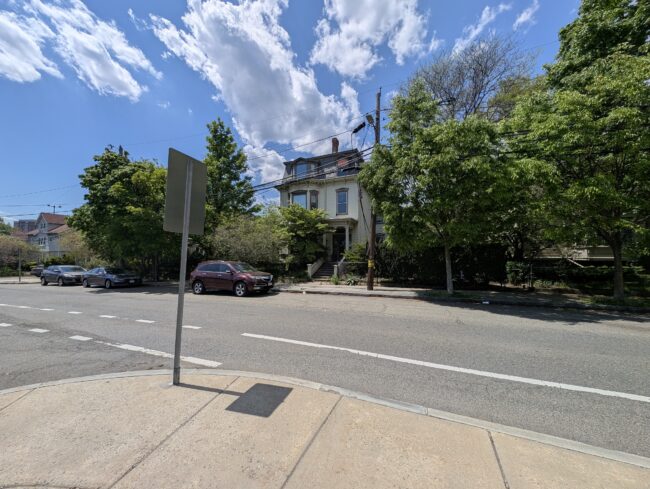
This is labeled the “Lovett” house on the color map above.
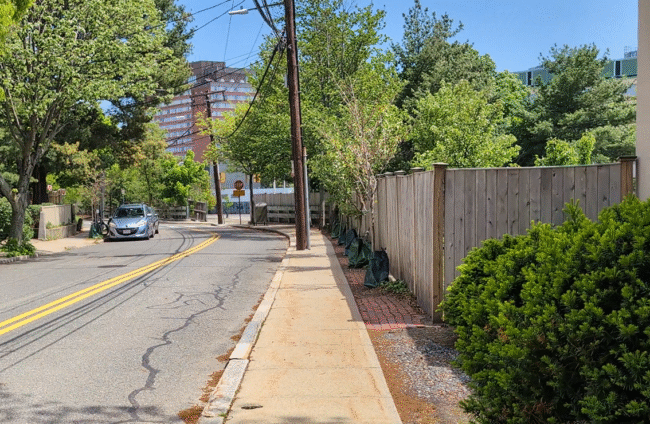
“The territory lying east and south is unrestricted.”
Beyond that stop sign at the corner of Henry and Sidney is “[t]he territory lying east and south” that “is unrestricted” and the railroad tracks.
As we wrote last week, we think that Nectow has not received the attention it is due. After all, it should be seen as the companion case to Euclid: it was authored by same Justice who wrote Euclid (Justice Sutherland), and there’s a straight line between all three parts of the Court’s 1920’s land use trilogy (Mahon, Euclid, and Nectow), two of which are strong reaffirmations of property rights.
But today, Nectow is often dismissed as a byproduct of an earlier time, Lochnering of the substantive due process rational basis test, or even just too archaic to pay attention to.
But unlike Euclid, which was a facial challenge to zoning generally, Nectow was an as-applied challenge, asserting that placing some of Nectow’s land in a residential zone — and thereby causing a contract for sale of the land for non-residential uses to be cancelled — was arbitrary and capricious.
A master appointed to find facts determined the residential designation was out of sync with the mixed uses in the surrounding area. But the Supreme Judicial Court of Massachusetts took Euclid and Justice Sutherland at their word and concluded “who are we, mere judges, to question what Cambridge’s zoning officials say is in the public interest?” (We’re paraphrasing of course, but that was the vibe.)
But Justice Sutherland concluded that we need to pay attention to what the Court actually held in Euclid, reminding us that Euclid was a facial challenge, not as-applied:
The ordinance is an elaborate one, and of the same general character as that considered by this Court in Euclid v. Ambler Co., 272 U.S. 365. In its general scope, it is conceded to be constitutional within that decision. The land of plaintiff in error was put in District R-3, in which are permitted only dwellings, hotels, clubs, churches, schools, philanthropic institutions, greenhouses and gardening, with customary incidental accessories. The attack upon the ordinance is that, as specifically applied to plaintiff in error, it deprived him of his property without due process of law in contravention of the Fourteenth Amendment.
Nectow, 277 U.S. at 185.
The Nectow Court held that while zoning may be facially constitutional, it is unconstitutional if, when applying that zoning to a particular parcel, the government fails to show the classification and restriction on use bears a “substantial relation to the public health, safety, morals, or general welfare.” Id. at 188.
As the Court put it:
Nevertheless, if that were all, we should not be warranted in substituting our judgment for that of the zoning authorities primarily charged with the duty and responsibility of determining the question. Zahn v. Board of Public Works, 274 U. S. 325, 328, 47 S. Ct. 594, 71 L. Ed. 1074, and cases cited. But that is not all. The governmental power to interfere by zoning regulations with the general rights of the land owner by restricting the character of his use, is not unlimited, and, other questions aside, such restriction cannot be imposed if it does not bear a substantial relation to the public health, safety, morals, or general welfare. Euclid v. Ambler Co., supra, p. 395 (47 S. Ct. 114). Here, the express finding of the master, already quoted, confirmed by the court below, is that the health, safety, convenience, and general welfare of the inhabitants of the part of the city affected will not be promoted by the disposition made by the ordinance of the locus in question. This finding of the master, after a hearing and an inspection of the entire area affected, supported, as we think it is, by other findings of fact, is determinative of the case. That the invasion of the property of plaintiff in error was serious and highly injurious is clearly established; and, since a necessary basis for the support of that invasion is wanting, the action of the zoning authorities comes within the ban of the Fourteenth Amendment and cannot be sustained.
Id. at 188-189.
So yes, zoning as a concept is within the police power, but we must keep at the forefront the core principle that property rights are to be respected. Facts, and not some vague incantation of the rational basis test should serve as the standard.
As James Metzenbaum, the lawyer who represented the Village of Euclid later wrote:
It is essential that there be kept in mind the ever-true doctrine that the owner of property does have some inalienable rights. A corollary of this doctrine is that it is the duty of the lawyer to fight for the preservation of such rights and not to permit overly zealous zoning experts who draft ordinances nor obliging Councils who pass them, to promulgate legislation which is unreasonable or which unlawfully tends toward the divestment of the property owners’ constitutional rights.
See James Metzenbaum, The History of Zoning – A Thumbnail Sketch, 9 W. Res. L. Rev. 36, 42 (1957).
So here’s how we see it: go ahead and zone, government (Euclid). But do it carefully: it’s not carte blanche to do anything you want, and its gotta make actual sense (Nectow). And even if it does makes sense but nonetheless deprives the property owner of essential rights, you have to pay for the privilege (Mahon).
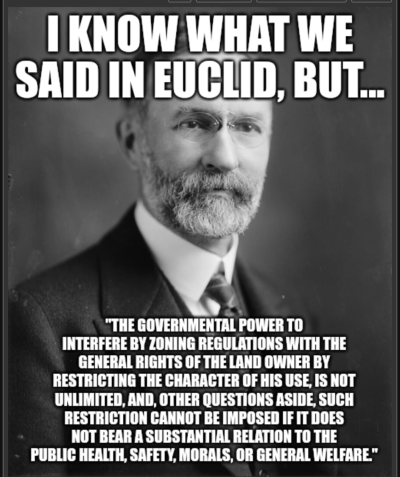
Earlier this year at an event to mark the 100th anniversary of Euclid, several lawprofs (from across the police power spectrum) noted that we should be refocusing on Nectow and its limiting principles. So we are not alone.
Nearly a century has passed since the time the Court decided the case. As a reminder that this case involved real people and their rights, we also paid a visit to the final resting place of Mr. and Mrs. Nectow at the Temple Israel cemetery in Wakefield, about a 15 minute drive from the famous locus.
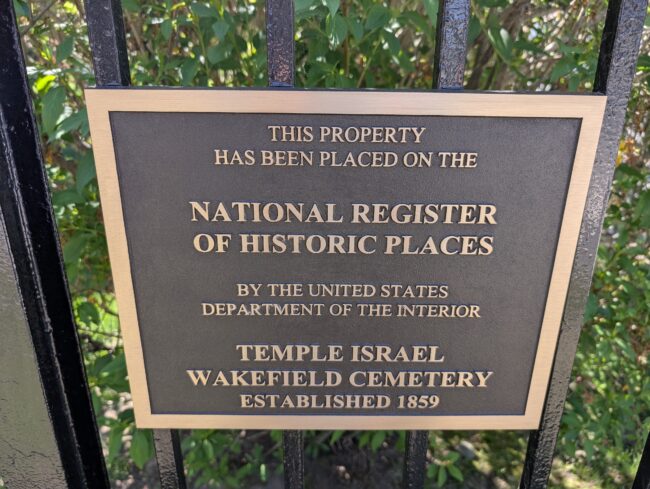
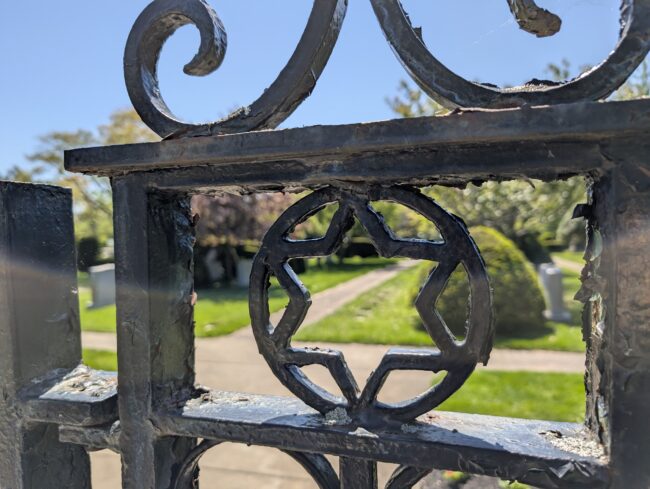
We’d like to think that if we were around back in the 1920s, Mr. Nectow might have been our client.
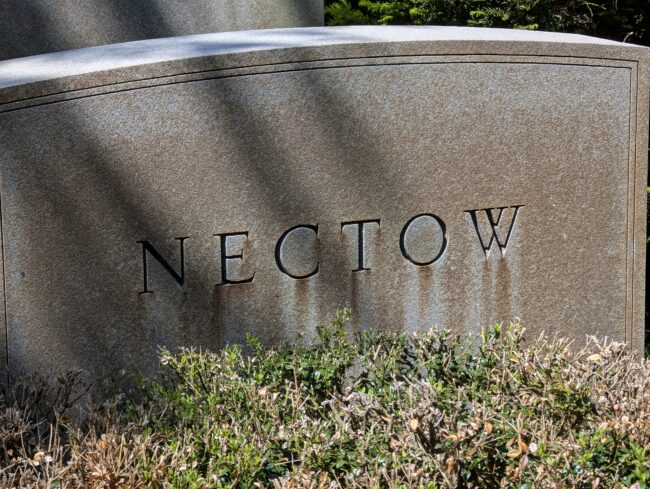
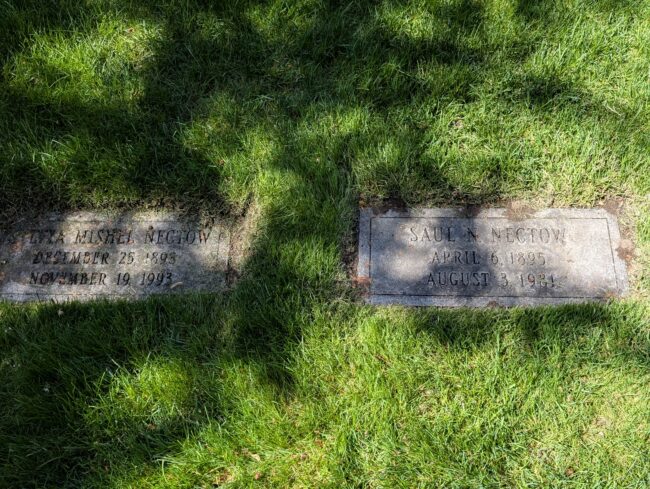
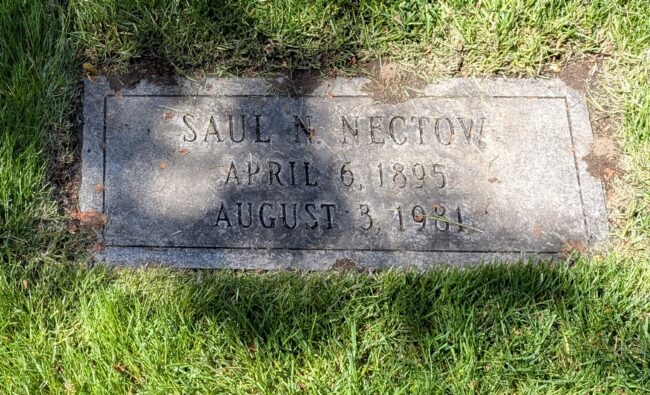

Thank you for fighting the good fight, Mr. Nectow. It now falls to use to bring your big win back into the public light.
Nectow v. City of Cambridge, 277 U.S. 183 (May 14, 1928)