
Here’s one worth reading that you can filed under “not now, but maybe later.”
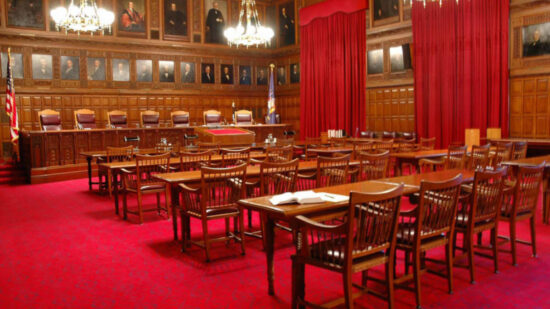
In People v. Commons West, LLC, No. 86 (N.Y. Nov. 23, 2026), the New York Court of Appeals (dun-dun) rejected the arguments of residential lessors claiming that New York’s source-of-income law is facially unconstitutional because it forces them into the federal Section 8 program and, consequently, into consenting to government inspections of their property and records. The vote was 4-3.
Here’s how the court described the owners’ argument:
The [statute]’s prohibition on source-of-income discrimination means that landlords confronted with a qualified prospective renter must accept Section 8 vouchers. Federal regulations compel landlords receiving payment through Section 8 vouchers to sign HAP contracts, in which they agree to provide “full and free access” to the apartment, the premises and all relevant accounts and records. Federal law requires the local PHA administering the program to perform an inspection of the rental unit, the equipment that services the unit and any common areas of the building; the PHA must conduct those inspections before the unit is occupied and again regularly during the term of the tenancy (see 42 USC § 1437f [o] [8] [A], [D]; 24 CFR 982.405). The HAP contract also requires that landlords must make available to the PHA their records concerning the apartment in question as well as the amounts of rent they charge for other units (see 24 CFR 982.507). Together, the landlords allege, these requirements combine to create a scheme wherein the landlords must consent to warrantless search of their premises and documents if an otherwise qualified tenant eligible for Section 8 assistance applies to rent a vacant unit.
Slip op. at 9-10.
The majority concluded that the owners aimed too broadly. New York’s statute doesn’t itself require a search, and a facial challenge requires showing constitutional defect in essentially every application. That didn’t mean, however, that compelled participation in Section 8 can never present a Fourth Amendment problem, only that it doesn’t always. Judge Singas expressly left that door open for an as-applied challenge in a concurring opinion:
In sum, we should reject respondents’ attempt to repackage their unripe as-applied challenge to Executive Law § 296 (5) (a) (1) as a facial one. Waiting until the proper juncture to answer the difficult questions that respondents’ challenge poses will avoid striking down a legislative enactment based on speculation about what the law may require and how it may be implemented. The bar for a facial challenge is high for a reason.
Singas, concurring at 9.
The dissent would have walked through it now. Judge Garcia reasoned that if the State forces someone to participate in a federal program that requires participants to consent to unwarranted searches, separating the two doesn’t make the coercion disappear.
This case is worth keeping an eye on.