
The focus in the Kelo majority on Euclidean-style planning — if a taking where a private party either ends up with the land or is benefited is part of some kind of plan, then it is likely ok — raises the question: how much planning must the condemning agency do before it can take property?
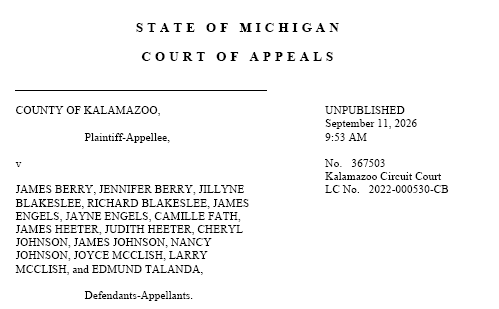
The Michigan Court of Appeals took up that question in County of Kalamazoo v. Berry, No. 367503 (Sep. 11, 2026) (per curiam), concluding that identifying a valid public use and explaining why the property is needed is about all a “plan” needs to be, at least under Michigan’s statutory requirement for a plan. The court affirmed the condemnation of a family-owned cottage surrounded on three sides by a county park and on the fourth by a lake, rejecting the owners’ arguments that the plans were too vague.
The property is an “inholding” — a privately-owned parcel surrounded by public land. In 2022, the county adopted a resolution of necessity declaring that acquisition of the property was needed “to complete and enhance” the county park.
The owners first asserted the county had not satisfied the jurisdictional requirements of Michigan’s Uniform Condemnation Procedures Act because it never adequately identified a “plan” for the property. The county’s explanations, they argued, amounted to little more than a generalized desire to “complete” a park project that had started in 1962.
The court disagreed. Michigan’s condemnation statute requires a complaint to include “[a] plan showing the property to be taken.” The owners argued that “plan” meant a development plan or detailed proposal explaining exactly what the county intended to do with the parcel after acquisition. The court held no, a plan showing the property to be taken means exactly that: a depiction of the property proposed for acquisition. Because the county attached maps, surveys, legal descriptions, and other materials identifying the parcel, the statutory requirement for a plan was satisfied.
The owners also challenged the taking on public use grounds. But that’s a difficult argument when the proposed use is a public park and there’s no claim of pretext or ulterior motive. The county’s parks director testified that the parcel would simply be absorbed into the surrounding park. He explained that private ownership in the middle of public parkland creates management complications, infrastructure burdens, funding issues, and conflicts between private and public uses. According to the testimony, maintaining access to the cottage complicated plans to restore portions of the park to a more natural condition and made applications for certain improvement funding more difficult.
And that was enough for the court to conclude that incorporation of the parcel into a county park is a public use. Michigan counties are authorized by statute to acquire property for park purposes, including through eminent domain. There was no admissible evidence that the county intended anything other than park use.
The most interesting part of the opinion may be the necessity analysis.
As readers know, necessity review in eminent domain cases is often highly deferential. Michigan follows that familiar pattern. Once the condemning authority adopts a resolution of necessity, courts generally review only for fraud, error of law, or abuse of discretion. The question is not whether judges would make the same decision, but whether the agency’s determination is so lacking in justification that it falls outside permissible bounds. Here, the owners argued that a vision dating back to the Kennedy Administration could not justify a taking in 2022. They relied on older Michigan precedent holding that condemnation cannot be based on speculative future needs.
But the court viewed the case differently. The county wasn’t seeking land for some distant future project. It wanted the property right now. According to the county’s evidence, continued private ownership interfered with park management, funding opportunities, infrastructure planning, and restoration efforts. That present-day need supplied the required necessity.
County of Kalamazoo v. Berry, No. 367503 (Mich. Ct. App. Sep. 11, 2026) (per curiam)