Skip to content

March 2025

Kudos to whomever added the Wilhelm Scream

In trial court litigation, the “final judgment” is a milestone. That’s when your window to an appeal starts, that’s when it is truly done in a trial court. If you are one of the parties or lawyers in the trial court, that’s when you can respond to the question “did you win?” truly with a “yes” or “no.”
And that little voice in our head keeps reminding us that until final judgment, in the (perhaps apocryphal) words of Yogi Berra, “it ain’t over ’til its over.” Yes, you might win a partial summary judgment. Or that motion gets denied. Or the court decides that yes, the court has jurisdiction. Or whatever. All that stuff is mostly interlocutory and therefore subject to revision, revocation, or reconsideration. Or in the case of subject-matter jurisdiction, something that can come back to bit a plaintiff

Continue Reading CAFED: It Ain’t Over Til It’s Over – CFC Free To Revisit Seven-Year-Past Denial Of Motion To Dismiss

Here’s the latest in a case we’ve been following closely (and disclosure: our firm filed an amicus brief in the Texas Supreme Court).

First, the bottom line: in The Commons at Lake Houston, Ltd. v. City of Houston, No. 23-0474 (Mar. 21, 2025), the Texas Supreme Court held that merely because a regulation is a justified exercise of police power does not insulate it from a claim that it goes too far and is also a taking requiring compensation. 

The Texas Court of Appeals held that the city could not be liable for a taking for an ordinance that limited development and use within the city’s 100-and-500-year floodplains because the ordinance was a valid exercise of police power and otherwise survived the rational basis test.

As we wrote here, that seems like utter nonsense to say that a valid police power reason categorically insulates a government action

Continue Reading Breaking: Texas Takings Law Enters The 20th Century!

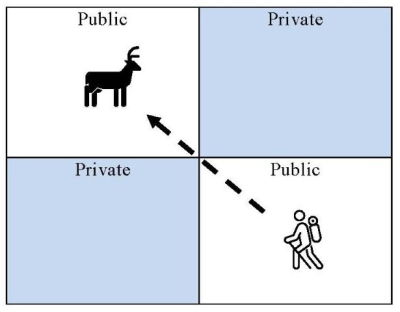
CornercrossingThe opinion gets that diagrams are good. 

Here’s the latest in a case we’ve been following

A case that should end up in Property casebooks (it will almost certainly make an appearance in our William and Mary Eminent Domain and Property Rights course in the fall).

Dirt lawyers know the “ad coelum” doctrine (owner owns airspace, and down to Hades) has a lot of practical challenges in the modern world. The Supreme Court decided a while back in United States v. Causby, 328 U.S. 256 (1946) that no, it isn’t violating the surface owner’s property rights for aircraft to fly high up. In the modern world, the owner can’t reasonably expect to be compensated for invasions into the coelum, except when the invasion is down fairly low, and likely to cause a problem on the surface. The doctrine has some continuing vitality, especially in that all-to-frequent

Continue Reading CA10 On Causby, Open Range, And Corner Crossings: Owners Have A Right To Exclude, But Not If Doing So Fully Encloses Public Lands

Wondering what happened to that case we posted about last week, where our outfit is representing property owners in a federal court challenge to a Rhode Island town’s efforts to take their land by eminent domain?

Well, here’s the latest. The court just issued this Temporary Restraining Order. Read it for the details. This is our case, so we’re not going to say more here.

But for further details about what brought this about, read Christian Britschgi’s piece at Reason, “Town Secretly Seizes Developers’ Property Then Threatens Them With Trespassing Citation” (Mar. 18, 2025).

Temporary Restraining Order, SCLS Realty, LLC v. Town of Johnston, No. 25-00088-MRD-PAS (D. R.I. Mar. 19, 2…

Continue Reading Latest In Public Use Eminent Domain Pretext Challenge: Federal Court TRO

Today we have a guest post by New York colleague Jennifer Polovetsky, who writes about an exactions case that is headed for the New York Court of Appeals. Disclosure: our firm represents the property owners in that court. 

Thanks to Jennifer (and to the New York Law Journal) for allowing us to republish her intriguing piece.

_____________________________

NY Zoning Law Mandating Contributions Deemed an Unconstitutional Taking

by Jennifer Polovetsky

A few years ago, on December 15, 2021, the City of New York (the City) amended §143–13 of the City Zoning Resolution (the ZR Amendment). A portion of this ZR Amendment required property owners to pay a mandatory, nonrefundable contribution to the SoHo–NoHo Arts Fund (Arts Fund), as a precondition to filing for a permit to convert joint living-work quarters for artists (JLWQA) to unlimited residential use.

What is the problem with the ZR Amendment, you may ask? Well, according


Continue Reading Guest Post (Jennifer Polovetsky): “NY Zoning Law Mandating Contributions Deemed an Unconstitutional Taking”

Eminent domain has been on our mind a lot lately

But did you know there’s an award-wining play, “Eminent Domain?” Neither did we. Based on a book, it appears.

Soon to be on the stage at Lincoln, Nebraska’s Lied Center for the Performing Arts, produced by the Angels Theatre Company. Here’s the summary:

Any Nebraska farmer or rancher worth their salt will tell you their connection to the land is equally as strong as their bonds to family, community, and their good name. When Rob McLeod is confronted with a threat underneath his land, he and his entire family discover how fragile and endangered their bonds will become.

An award-winning play, written by Nebraska playwright Laura Leininger-Campbell, Eminent Domain digs beneath the day-to-day struggles facing our family farms. Dig deeper, and the greatest threat to America’s Heartland is revealed: how can this way of

Continue Reading Anyone Up For A Road Trip To Nebraska For “Eminent Domain” In Lincoln This Month?

Purpose

Before we go further, a disclosure: this is one of ours.

Here’s the Complaint for Violations of Constitutional and Civil Rights, filed yesterday by the Santoro Family in federal court in Rhode Island. This lawsuit challenges, under the Public Use Clause, a RI town’s eminent domaining the family’s land for the ostensible purpose of building a new municipal campus

Sounds like a “classic” public use, you say? Not so fast. As alleged in the complaint, the actual use, purpose, and necessity for the taking is something else: to stop the Santoros from building 250+ low- to moderate-income housing.

Because this is one of ours, we won’t say more. But here’s the story, from the Complaint:

1. SCLS Realty, LLC, and Sixty Three Johnston, LLC, family-owned homebuilders whose members are Lucille Santoro, Salvatore Compagnone, Ralph Santoro, and Suzanne Santoro (the plaintiff LLCs are referred to herein jointly as

Continue Reading Challenge To Sham Eminent Domain: The Government Can’t Lie About Why It Takes Property

Virginia eminent domain 2025

Virginians: now is a good time to register for the Virginia Eminent Domain Conference, May 8-9, 2025, at the Kingsmill Resort in Williamsburg.

We have spoken and attended the Conference in past editions, and can report that it is excellent. We’re looking forward to joining friends and colleagues again in The Burg in the spring. Check out the faculty and agenda, and then register and reserve your spot.

We’ll see you there.Continue Reading Virginia Eminent Domain Conference: May 8-9, 2025, Williamsburg

TX Em Domain 2025 Austin

Texans: now is a good time to register for the 24th Annual Texas Eminent Domain Superconference, March 27-28, 2025, at the Austin Country Club in Austin.

We spoke at the Conference a couple of years agolast year and in other editions, and can report that it is excellent. Check out the faculty and agenda, and then register and reserve your spot.Continue Reading Texas Eminent Domain Conference – Austin, March 27-28, 2025

Mulvaney_front_page.jjpg

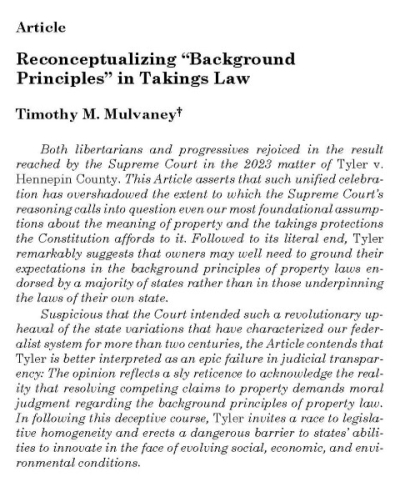
Lawprof Timothy Mulvaney has published “Reconceptualizing ‘Background Principles’ in Takings Law,” 109 Minn. L. Rev. 689 (2025). 

If the title alone doesn’t grab your interest, here’s the summary from the article’s introduction:

Both libertarians and progressives rejoiced in the result reached by the Supreme Court in the 2023 matter of Tyler v. Hennepin County. This Article asserts that such unified celebration has overshadowed the extent to which the Supreme Court’s reasoning calls into question even our most foundational assumptions about the meaning of property and the takings protections the Constitution affords to it. Followed to its literal end, Tyler remarkably suggests that owners may well need to ground their expectations in the background principles of property laws endorsed by a majority of states rather than in those underpinning the laws of their own state.

Suspicious that the Court intended such a revolutionary upheaval of the state variations that have characterized our federalist system for more than two centuries, the Article contends that Tyler is better interpreted as an epic failure in judicial transparency: The opinion reflects a sly reticence to acknowledge the reality that resolving competing claims to property demands moral judgment regarding the background principles of property law. In following this deceptive course, Tyler invites a race to legislative homogeneity and erects a dangerous barrier to states’ abilities to innovate in the face of evolving social, economic, and environmental conditions.

Check it out.
Continue Reading New Article: “Reconceptualizing ‘Background Principles’ in Takings Law,” 109 Minn. L. Rev. 689 (2025)