November 2024

The latest state supreme court decision involving a takings challenge to a statute permitting precondemnation entries, this time from Iowa.

In Summit Carbon Solutions, LLC v. Kasischke, No. 23-1186 (Nov. 22, 2024), the Iowa Supreme Court concluded that, at least on its face, Iowa’s entry statute for hazardous liquid pipelines, which permits entries for land surveys and requires the payment of actual damages, is not a taking of an owner’s right to exclude:
Kasischke recognizes that section 479B.15 requires “[t]he pipeline company [to] pay the actual damages caused by the entry, survey, and examination” but argues that the mere entry onto his property to conduct the survey is itself a taking of his right to exclude all others, for which he is also entitled to just compensation. Kasischke’s constitutional claim fails because the statute did not take away a property right that he owned. Rather, he has

Continue Reading Iowa: Statute Permitting Precondemnation Surveyor Entry Is “pre-existing limitation on … title”

Thanks to lawprof Donald Kochan for the heads-up: the “Word of the Day” in today’s New York Times is … “eminent domain.”

Defined by the piece as:

“the right of the state to take private property for public use; the Fifth Amendment that was added to the Constitution of the United States requires that just compensation be made”

Ugh. The “right?” No mate, it’s a sovereign power, not a right.

The piece then challenges the reader:

Can you correctly use the word eminent domain in a sentence? Based on the definition and example provided, write a sentence using today’s Word of the Day and share it as a comment on this article. It is most important that your sentence makes sense and demonstrates that you understand the word’s definition, but we also encourage you to be creative and have fun.

OK, we’ll have a go. How’s this for

Continue Reading NYT Word Of The Day: “Eminent Domain”

Here’s the latest in a case we’ve been following with keen interest

Yesterday, the Supreme Court denied certiorari in Baker v. City of McKinney, the case where municipal police severely damaged a home in the course of extracting a criminal suspect, after which the owner successfully sought just compensation for a taking. All good, until the Court of Appeals got it. Here’s the district court’s opinion finding a taking. (As we noted in this brief in an earlier similar case, homeowner’s insurance generally does not provide coverage for damages caused by government.)

And here’s the Fifth Circuit’s opinion reversing, concluding (correctly) that there is not a categorical “police power” exception to takings liability, but also that just compensation is not required when the government action and the resulting damage is “objectively necessary” for public safety.

Teed up that way, we thought this one had a chance. But alas, the Cert Fairy left a lump of coal under the pillow.

Perhaps a silver lining to the denial, however: two Justices (Sotomayor joined by Gorsuch – kind of an odd combination) issued a statement noting that the issues in the case, if refined and presented in a different case, could be of interest to the Court.

The very interesting part of the Statement starts on page 3, where Justice Sotomayor writes:

I write separately to emphasize that petitioner raises a serious question: whether the Takings Clause permits the government to destroy private property without paying just compensation, as long as the government had no choice but to do so. Had McKinney razed Baker’s home to build a public park, Baker undoubtedly would be entitled to compensation. Here, the McKinney police destroyed Baker’s home for a different public benefit: to protect local residents and themselves from an armed and dangerous individual.

….

This Court has yet to squarely address whether the government can, pursuant to its police power,require some individuals to bear such a public burden. This Court’s precedents suggest that there may be, at a minimum, a necessity exception to the Takings Clause when the destruction of property is inevitable.

Statement at 3-4.

Note the two cases cited by Justice Sotomayor next: Bowditch v. Boston, 101 U.S. 16 (1879), and United States v. Caltex (Philippines), Inc., 344 U.S. 149 (1952), which “do not resolve Baker’s claim …  because the destruction of her property was necessary, but not inevitable.” Statement at 5. In both Bowditch and Caltex, the destruction of the plaintiff’s property was pretty certainly going to happen anyway (in Bowditch by fire, by Caltex by the advancing Imperial Japanese Army — the “fortunes of war,” as the Court put it). The government blowing up the properties in these cases only hastened the inevitable. For more on these cases and the “inevitable” vibe, see the amicus brief our outfit (Pacific Legal Foundation) submitted.

Also worth checking out is Mitchell v. Harmony, 54 U.S. (13 How.) 115 (1851), where the Court held that commandeering property to prevent it from falling into the hands of the enemy in war was not a taking as long as the danger is “immediate and impending,” and waiting around for civil authority would be too late.

We wrote about these cases and the notion that even a compelling police power reason isn’t alone enough to avoid takings liability and the Armstrong redistribution principle, and similar in our article, “Evaluating Emergency Takings: Flattening the Economic Curve,” 29 Wm. & Mary Bill of Rights J. 1145 (2021).

Justice Sotomayor continued, “Whether the inevitable-destruction cases should extend to this distinct context remains an open question.” Statement at 5. The Statement also points out the lower court split in reasoning (but not outcome), and concludes:

All those decisions, save the Sixth Circuit’s, however, predate the Fifth Circuit’s determination that there is an “objectively necessary” exception to the Takings Clause. Whether any such exception exists (and how the Takings Clause applies when the government destroys property pursuant to its police power) is an important and complex question that would benefit from further percolation in the lower courts prior to this Court’s intervention.

Statement at 6.

Count is intrigued.  

Statement of Justice Sotomayor, with whom Justice Gorsuch joins, respecting denial of certiorari, Baker v….

Continue Reading Cert Denied (With Hints) In SWAT Takings Case

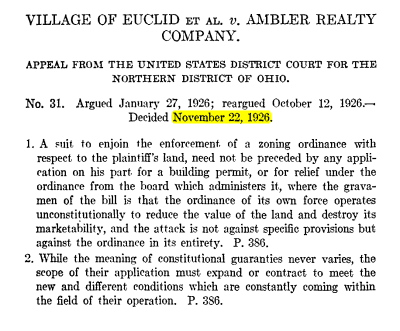
Euclid_front98 years old, and still going (for better or worse)

On this day in 1926, the United States Supreme Court issued its landmark opinion in Village of Euclid v. Ambler Realty Co., 272 U.S. 365 (Nov. 22, 1926).

You know this one (and can you call yourself a dirt lawyer if you don’t?). It’s the one in which the Supreme Court first upheld — against a facial due process challenge — the validity of this thing we call “zoning.” While in the intervening century, zoning has become a catch-all term for all sorts of regulatory restrictions on the uses of real property, land users know that “zoning” — ackshually — refers only to the regulation and separation of uses, and restrictions on density, and height regulation. At least that’s how it began.

While “Euclid” and “Euclidean zoning” have become part of the land use

Continue Reading (Un?)Happy Euclid Day!

Screenshot 2024-11-20 at 09-16-50 Lake Worth Lagoon - Google Maps
Lake Worth: the “lago” in Mar-a-Lago

You know his name. He’s taken on the City of Riviera Beach twice at the U.S. Supreme Court. And won both times. The houseboat that isn’t a boat. The government can’t shut you out from speaking your mind simply because you irritate them.

That’s right, it’s Fane Lozman. A “Florida Man” that you can like and admire. And he’s back for Round 3.

He owns property that’s mostly in (in, not near) Lake Worth. Two-tenths of an acre is uplands, and the rest (7.75 acres) is submerged. As the Eleventh Circuit noted, “[o]nly a sliver of Lozman’s property is above water.” 

The city, in accordance with the usual approach to land use regulation has a comprehensive plan. That plan designates submerged lands as “Special Preservation Future Land Use,” a label which should set off your Lucas

Continue Reading CA11: Takings Claim Not Ready Despite Govt’s Enforcement Actions

We usually don’t cover unpublished opinions, but the New Jersey Appellate Division’s reasoning in Hudson County Improvement Authority v. Mariana Properties, Inc., No. A-2686-22 (Oct. 29, 2024) stuck in our craw a bit. 

This is an eminent domain case in which the Authority is taking an easement and intends to construct one of the most “New Jersey” forms of infrastructure, a “jug handle” turn. The stated public use supporting the taking:

The Easement would create a jug handle allowing trucks heading west on the Bellevue Turnpike to turn left onto Crosspike Drive. The Spine Road would provide access to a public facility, the New Jersey Transit Grid Traction Power System Project, and three new industrial warehouses. To do so, the Spine Road would cut across the Property and leave the Property’s southeastern corner , fronting the Belleville Turnpike, separate from its larger remainder. The Easement would total

Continue Reading NJ App: “Public Use” Is What Condemnor Says It Is, Not What Use Actually Will Be Made

2025 San Diego

Get ready to join your colleagues and friends in San Diego for the 42d ALI-CLE Eminent Domain & Land Valuation Litigation Conference.

The 41st Conference was in New Orleans. Here’s a report of that event, and here are our reports from prior conferences in Austin and Scottsdale.

Here are some of the highlights of the upcoming Conference:

  • Property Rights at the Supreme Court: DeVillier and Sheetz and What’s Next
  • Slow Take: Possession, Rent, Relocation, and Offset
  • The Jury’s View: How Jurors See Your Case
  • From Penn Coal to Penn Central: How to Prove “Too Far”
  • Leveraging Expertise in Eminent Domain Litigation: Working with Land Planners, Engineers, and Other Predicate Experts
  • Kelo at Twenty: What Changed, What Didn’t, and What’s on the Horizon
  • Viva Las Vegas: How the Nevada Judiciary Upheld Property Rights in 180 Land’s Inverse Condemnation Taking
  • Ethics: Guiding the Trolley: Perspectives on Professional Ethics in


Continue Reading Registration For The 42d ALI-CLE Eminent Domain & Land Valuation Litigation Conference Is Underway (Don’t Miss Out!)

We’re not going to pretend to fully understand the Supreme Court of India’s recent decision in Property Owners Ass’n v. State of Maharashtra, No. 2012-2022 (Nov. 4, 2024) for obvious reasons (plus, the judgement and various opinions and dissents total 193 pages).

But we post it here because we think it gives some insight how other jurisdictions and cultures view expropriation, and the role of property rights in free societies.

Some background. The Constitution of India (article 39(b)) has been held by the Supreme Court to embody a concept known as “constitutional socialism.” It provides:

The State shall, in particular, direct its policy towards securing–

(b) that the ownership and control of the material resources of the community are so distributed as best to sub serve the common good.

Not quite the Fifth Amendment, is it?

Indeed, Justices of the Supreme Court have opined that constitutional

Continue Reading Blight Redevelopment & Eminent Domain, India Style: Private Property As A Basis For “Economic Democracy”

Here are the cases and other materials we discussed in today’s Section of State & Local Government Law Land Use group meeting on takings:


Continue Reading Links From Today’s ABA Land Use Session

Untitled Extract Pages

Here’s the latest in a case we’ve been following. This morning, in this Order, the Supreme Court denied cert in two cases which seemed to have a good chance at a grant, on two pressing issues which have divided lower courts, the physical occupation in tenancies (aka Yee), and the nature of the Penn Central takings test. Only Justice Gorsuch would have granted.

Here are the Questions Presented:

New York’s Housing Stability and Tenant Protection Act of 2019 transforms a temporary rent- regulation system into a permanent expropriation of vast swaths of private real estate, without just compensation, in the name of “affordable housing.” Among other things, the Act prohibits owners—even of small and midsized apartment buildings like Petitioners—from reclaiming rental units for their own personal use, and grants tenants a collective veto right over condo/co-op conversions. As Justice Thomas has observed, the constitutionality of regimes like New York’s

Continue Reading SCOTUS Declines To Review NYC Rent Control Challenge