
October 2024

Here’s the latest in a case we’ve been following, which has now results in a cert petition from Michael Berger. This one involves some very intriguing questions about what limits the Constitution places on the government acquiring property for a public use (in this case, an “airport purpose”) but then later deciding it would rather do something else with the property.

Check out the Questions Presented:

The City and County of Denver condemned 8,360 acres of land from Petitioner Monaghan Farms as part of its land acquisition for the creation of the Denver International Airport, including a large area surrounding the facility to serve as an environmental buffer and safety zone. Thirty-four years later, Denver decided to use approximately half that land (which had not been used for airport purposes) for commercial nonaeronautical developments. But the power of eminent domain may only be used to take property for

Continue Reading New Cert Petition: Does A Taking For Public Use Become A Problem If The Govt Later Abandons That Use?

Screenshot 2024-10-25 at 13-19-32 Housing and Exactions The Next Frontiers After Sheetz Pacific Legal Foundation

Our outfit (Pacific Legal Foundation) has put out a call for papers. on the topic of land use exactions and housing law. Honorarium included for accepted papers, and there will be a workshop to follow.

Here’s the description:

This workshop seeks to build on the result of Sheetz v. County of El Dorado and chart the course of the next steps in exactions/unconstitutional-conditions law. From Nollan v. California Coastal Commission, through Dolan v. City of Tigard and Koontz v. St. John’s River Water Management District, and now including Sheetz, the Supreme Court has looked to the doctrine of exactions and unconstitutional conditions to ensure property rights are protected. In doing so, it has created a constitutional bulwark protecting the right to build housing on private property, an important stick in the property rights bundle.

The Supreme Court’s unanimous decision in Sheetz held that legislatively-imposed development-fee schedules are

Continue Reading Call For Papers: “Housing and Exactions: The Next Frontiers After Sheetz“

Those of you who are students of eminent domain and the public use requirement know that in Berman v. Parker, 348 U.S. 26 (1954), the Court (in)famously held, “when the legislature has spoken, the public interest has been declared in terms well nigh conclusive.”

Not only was the Court in Berman signalling that it was washing its hands of the Public Use Clause, but that case also — less overtly — revealed a shift from examining the use the property was to be put, to the purpose for which the property was being acquired, or as the above quote highlights, where a taking furthers the public interest. (A shift that, if you missed it, the Court confirmed in Midkiff where it held the eminent domain and police powers are “coterminous,” and both are reviewed under the deferential rational basis standard.)

If that wasn’t clear enough, the majority in Kelo

Continue Reading Nevada: Private-to-Private Takings By Privately-Owned Utilities Are OK, Even Though State Constitution Prohibits “transfer … from one private party to another”

Screenshot 2024-10-24 at 12-28-24 Vacancy Taxes A Possible Taking The University of Chicago Law Review

A new student-authored journal article worth reading, Christine Dong, “Vacancy Taxes: A Possible Taking?,” 91 U. Chi. L. Rev. 1725 (2024).

Here’s the Abstract:

Vacancy taxes are an increasingly popular solution to the paradoxical problem of high housing demand coupled with high vacancy. Cities across the country facing housing shortages have either implemented or are considering adopting vacancy taxes to encourage property owners to rent or sell their property. Soon after San Francisco adopted a vacancy tax with one of the broadest definitions of vacancy, property owners lobbed a constitutional challenge under the Takings Clause, taking advantage of a moment of doctrinal instability.

This Comment seeks to make sense of how this and similar potential challenges would fare, given an expanding, property-protective takings doctrine, but a high constitutional tolerance for taxes. Using the San Francisco vacancy tax as a concrete example, this Comment evaluates possible arguments that the

Continue Reading New Article (Comment): “Vacancy Taxes: A Possible Taking?” (U. Chi. L. Rev.)

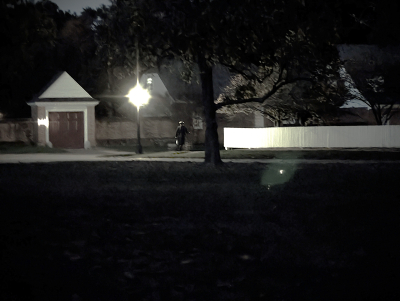
PXL_20241023_225039087.MP
Like most “paranormal caught on camera” shots,
this one is grainy.
But you can just make Mr. Jefferson out.

Colonial Williamsburg is adjacent to the William & Mary Law School, so from time-to-time, we’ll take a walk over just to soak up the atmosphere. The vibe picks up in the autumn season, when the leaves are turning and there’s a slight chill in the air. We try to time these visits for the evenings, because the atmo is particularly intense. 

And so it was yesterday afternoon and into the evening, as we were walking about CW that we happened to run into Thomas Jefferson, Esq., an up-and-coming Williamsburg lawyer, who was kind enough to spend a bit of time chatting. At the end of an educational and enjoyable conversation, we shook hands and went about our business.

A paranormal encounter with the spirit of Mr. Jefferson, author of

Continue Reading Last Night, I Shook Hands With Mr. Jefferson’s Ghost
Screenshot 2024-10-21 at 19-32-18 Freestone®

On Monday, we joined our land use colleagues Dwight Merriam, Professor Shelley Saxer, and Professor David Callies for the Hawaii Bar Association’s Section of Real Property and Financial Services program, “Property Rights & Regulatory Takings,” a wide-ranging and very well-attended program for Hawaii dirt lawyers.

As the above photo notes (L to R: Charles Nelson Reilly, Dwight Merriam, Shelly Saxer, David Callies), we were not able to be in the room with our colleagues, but had to remote in, as our duties at William & Mary Law School kept us in Virginia and not able to be in downtown Honolulu at the same time. Ah well!

Here are the cases and materials we discussed:

  • State of Hawaii v. Williams (Intermediate Court of Appeals, Summary Disposition Order): property owner should not have been prohibited from introducing evidence of the current use of his property at the time of the


Continue Reading Links And Materials From Hawaii Bar Association Takings Program

Brinkmann

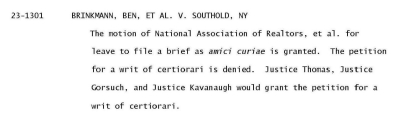
So close: if just one more Justice had agreed, the U.S. Supreme Court would have taken up a public use case we’ve been following, Brinkmann v. Town of Southhold. After all, this one had a lot of the usual markers: a divided court below, an allegation of a lower court split, beaucoup amicus support, and a long-festering issue that has remained open for almost 20 years.

But alas, in this Order, the Court denied the cert petition. Perhaps not surprising given the small number of cases the Supreme Court takes up these days (those of us who have been around for a while remember the days when the Court’s docket was up to 140 argued cases each Term). But nonetheless a disappointment.

One hint for future similar cases: three Justices (Thomas, Gorsuch, and Kavanaugh) “would grant the petition.” We wonder why one more Justice among at least

Continue Reading By The Thinnest Of Margins, SCOTUS Declines Public Use Pretext “Spite Taking” Case
This out of Sweden: the Royal Swedish Academy of Science has announced that it will be awarding the 2024 Nobel Prize in Economics to three U.S. econ professors whose research demonstrates that the rule of law and property rights foster an environment where democracy and prosperity flourish:

The laureates have shown that one explanation for differences in countries’ prosperity is the societal institutions that were introduced during colonisation. Inclusive institutions were often introduced in countries that were poor when they were colonised, over time resulting in a generally prosperous population. This is an important reason for why former colonies that were once rich are now poor, and vice versa.

Some countries become trapped in a situation with extractive institutions and low economic growth. The introduction of inclusive institutions would create long-term benefits for everyone, but extractive institutions provide short-term gains for the people in power. As long as the political

Continue Reading Nobel Economics Prize To Research Confirming The Importance Of The Rule Of Law And Property Rights

Following up on our recent post about the California Coastal Commission denying permission for Space-X to increase the number of annual launches from Vandenberg, comes this, the other shoe.

The Commission has now been sued, with Space-X alleging that the Commission denied permission due to CEO Elon Musk’s political leanings and his public statements.

I really appreciate the work of the Space Force,” said Commission Chair Caryl Hart. “But here we’re dealing with a company, the head of which has aggressively injected himself into the presidential race and he’s managed a company in a way that was just described by Commissioner Newsom that I find to be very disturbing.”

Here’s the complaint, filed in the U.S. District Court (Central District of California). 

Was the Commission’s denial a product of concern for “wildlife like threatened snowy plovers,” or the Commission members’ dislike of Musk?

Continue Reading Apparently, The “Final Frontier” Isn’t Space, But The California Coastal Zone

Here’s the latest in a case we’ve been following, which asks whether a local ordinance which allowed non-paying tenants to remain in the lessor’s property is a physical taking, or merely the regulation of the lessor/lessee relationship under the Yee theory, which posits that once an owner voluntarily rents property to a tenant, the government then allowing that tenant to remain rent free isn’t facilitating an unauthorized physical occupation, but rather is merely a regulation of the existing lessor/lessee relationship. In short, you let ’em in property owner, so suck it up.

The property owner has now filed this cert petition challenging that rationale.

As we’ve noted previously, some courts’ reliance on Yee in this and similar situations is a misreading of that decision. Besides that, these courts essentially upend the longstanding common law of property governing the owner/tenant relationship, and the contractual nature of that relationship

Continue Reading New Cert Petition: Eviction Moratorium Transferred Possession Easement To Nonpaying Tenants