May 2024

Here’s the latest in an issue we’ve been following.

In SCS Carbon Transport LLC v. Malloy, No. 20230149 (May 30, 2024), the North Dakota Supreme Court held that that’s state’s statute which allows prospective condemnors to enter land to conduct surveys and the like before instituting eminent domain without liability is not unconstitutional, either on its face or as applied to SCS’s entries.

SCS is building a CO2 pipeline and decided it needed an interest in Malloy’s land. It asked if could enter to take a survey, but Malloy said no. So SCS sued, asserting its power under the statute, asserting it was planning on restoring the property to its “pre-examination” condition, and it was willing to pay compensation for any damage it caused:

In all cases when land is required for public use, the person or corporation, or the person’s or corporation’s agents, in charge of


Continue Reading ND: “Minimally Invasive” Precondemnation Entries Are Not Unconstitutional

The Texas DOT had an easement over a portion of the Self property. The Selfs rebuilt a fence a few feet inboard of the easement (in other words, well into the part of the land not burdened by the easement). On the TxDOT side of the fence — but still outside the TxDOT easement area — grew some old trees.

As part of a highway maintenance project, TxDOT worked with a private contractor which it hired to remove brush and trees from the easement. The trees to be removed were supposed to be marked with an “X,” but the instructions to the contractor said to “clear everything between the fences.” Whoops.

The contractor did as instructed and “cut all trees up to the Selfs’ fence line.” TxDOT acknowledged that the trees were cut at its direction and that it has not undertaken a survey, but asserted that the trees were

Continue Reading Texas: If TxDOT Intentionally Cut Down Trees Outside Of Easement Area…You Have An Inverse Claim

Before we go on, a disclosure: this is one of ours (we filed an amicus brief in support of the property owners).

In Walton v. Newkowin Regional Sanitary Authority, No. S069004 (May 23, 2024), the Oregon Supreme Court held that the six-year state statute of limitations applicable to physical invasion inverse condemnation claims (under both the Oregon and U.S. Constitutions) begins to run at the time of the invasion, and not when subsequent events show that the invasion was adverse to the owner’s property rights. 

This case went up the appeals chain after the trial court granted the Authority’s motion for summary judgment. The background of the case is that back in the day (1995, although some of us actually remember that far back), the Authority installed two sewer lines on land belonging to the plaintiffs’ father. This was done without the owner’s permission. Slip op. at 3. 

But

Continue Reading Oregon: Statute Of Limitations On Physical Inverse Claim Runs From The Occupation, Even If It Was Permissive

Please be sure to check this out: a new animated film, “Love of the Land,” which “highlights [the] tragic story of Vermont farmer Romaine Tenney.”

You remember Mr. Tenney, who was one of those classic Vermonters. He tragically entered the pages of history more than fifty years ago when, in reaction to the taking of his farm for Interstate 91, he burned his house and farm buildings down, and shot himself. He had nowhere else to go. An informal memorial to Mr. Tenney — a maple tree (how Vermont) — stood on the site of his former property near Exit 8, until the tree was too diseased to remain and was removed.

We learned more about Mr. Tenney when we spoke with Howard Mansfield Howard Mansfield about his book “The Habit of Turning the World Upside Down – Our Belief in Property and the

Continue Reading Must Watch: “Love of the Land” – Romain Tenney’s Eminent Domain Protest

IMG_20170323_143119 (Medium)

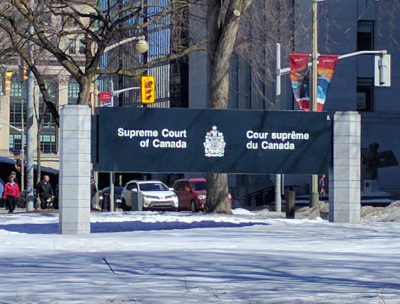
Readers know that from time-to-time, we like to cover the going’s on in the courts of our neighbors to the north. See here and here, for example. Although property rights are not a constitutional principle in Canada (the people did not include property as a fundamental constitutional right when the Constitution was amended last), there’s a lot for U.S. lawyers to learn from the way Canada law treats those from whom the government must expropriate property (either directly, or in what they call “de facto” or constructive takings (i.e., regulatory takings and inverse condemnation). In some ways, their system treats property owners slightly better than our constitutional system.

Well, here’s the latest in a case we’ve been following.

In St. John’s (City) v. Lynch, 2024 SCC 17 (May 10, 2024), the Supreme Court held that compensation in a de facto taking is calculated by excluding

Continue Reading La Cour suprême du Canada: In Constructive Takings, Compensation Calculated Without Reference To “The Scheme”

Check out the U.S. Court of Appeals for the Fourth Circuit’s opinion in Mountain Valley Pipeline, LLC v. 8.37 Acres of Land, No. 23-1532 (May 14, 2024).

The caption tells you it is a federal eminent domain case, specifically the Mountain Valley Pipeline, a very controversial and much-objected-to natural gas pipeline in the Virginias. The issue was one of the amount of compensation.

One appraiser testified to a certain use and a certain high-low range. Another appraiser testified to different uses and a different high-low range. The jury reached a just compensation verdict that wasn’t based on one appraiser’s testimony or the other’s, but on some amalgamation of the two. 

As we know, a oft-applied rule is that a jury’s just comp verdict must be “inside the range of credited testimony.” The trial judge concluded the verdict violated this rule because the jury had apparently picked-and-chosen. Slip op. at

Continue Reading CA4: Jury Is Free To Cut-And-Paste Various Just Compensation Evidence To Reach A Verdict “Within the range of credited testimony”

1000002646

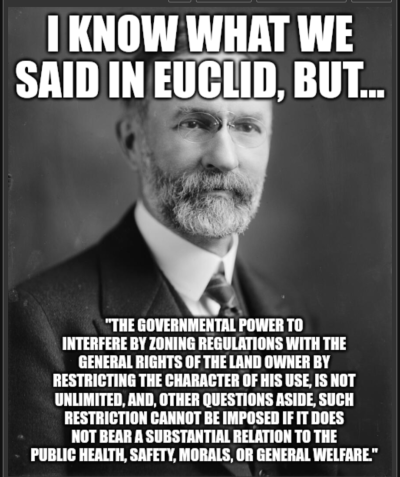
It was on this day in 1928 when the U.S. Supreme Court issued its second most famous decision about zoning, Nectow v. City of Cambridge., 277 U.S. 183 (1928). 

We say “second” because everyone knows that the first is the Court’s decision issued just two years earlier which generally upheld comprehensive use, height, and density regulations as a valid exercise of the government’s police power to regulate property uses to further the public health, safety, welfare, or morals. See Village of Euclid v. Ambler Realty Co., 272 U S. 365 (1926). 

Partly because of the hype surrounding Euclid and the broad governmental embrace of exclusionary land use policies that Euclid unleashed, we think that Nectow has not received the attention it is due. After all, it should be seen as the companion case to Euclid: it was authored by same Justice who wrote Euclid (Justice Sutherland)

Continue Reading Happy Birthday, Nectow v. City of Cambridge!

Here’s the latest in a case we’ve been following.

In Romero v. Shih, the California Supreme Court recognized the doctrine of an “implied exclusive easement” (which sounds an awful lot like a fee simple interest, doesn’t it?) in a private easement disputed between Owner A and Owner B.

The owner on the losing end of the California decision has now filed a cert petition asking the U.S. Supreme Court to take up the case on judicial takings grounds. 

Here are the Questions Presented:

1. Whether a court order that excludes landowners from their real property and allows other private parties to permanently physically invade and occupy the owners’ land without compensation either effects a taking in violation of the Fifth Amendment to the U.S. Constitution or violates the landowners’ due process rights under the Fourteenth Amendment to the U.S. Constitution?

2. Whether the newly decreed judicial doctrine of

Continue Reading New Cert Petition: Newly Decreed Easement Rule That Excludes Owners Is A Judicial Taking

Screenshot 2024-05-09 at 22-29-04 Professor Lee Fennell to Receive Brigham-Kanner Property Rights Prize

Lawprof Lee Anne Fennell, whose work makes frequent appearances here (see here, here, and here for example), has been selected as this year’s recipient of William and Mary Law School’s Brigham-Kanner Property Rights Prize. See this announcement for details.

“Lee Fennell is one of the most thoughtful and thought-provoking scholars writing about property law in the United States today,” said James Y. Stern, Professor of Law at William & Mary Law School and Director of William & Mary’s Property Rights Project. “Her work examining property’s conceptual and social boundaries has almost literally helped to reshape thinking about property law, and the Brigham-Kanner Prize is a fitting tribute to her many contributions.”

Save the date: the Prize will be awarded as part of the 21st Brigham-Kanner Property Rights Conference, to be held at the law school in Williamsburg, Virginia, September 12-13, 2024. That’s a bit

Continue Reading Lawprof Lee Fennell To Be Awarded 2024 Brigham-Kanner Property Rights Prize

This one isn’t so much a property or property rights opinion, but more “property adjacent” as they say.

Even so, we’re not going to comment much about the Massachusetts Appellate Court’s opinion in Lyman v. Lanser, No. 23-P-73 (Mar. 7, 2024), and not just because it seems faintly ridiculous.

The entire court vacated a single justice’s order vacating a preliminary injunction entered by the trial court which ordered the parties who were apparently locked in deadly combat about a jointly-owned dog named “Teddy Bear Lanser-Lyman.” The trial judge had ordered the parties to share custody of Teddy Bear, as if it were a child or something. Well, you clowns named the dog like a child and probably treat it like a child, so why not fight over it as if it were a child? “Pet parenting” gone too far. 

Read the darn thing. Maybe you will laugh, maybe you

Continue Reading Mass App: You Can Share Custody Of A Dog (Named Teddy Bear)