March 2024

Even if the world were open today, the doors to most Hawaii state, county, and city offices would still be locked. Because Friday, March 29, 2024 is the day that Hawaii celebrates Good Friday.

Yes, Good Friday is an an official state-sanctioned holiday in the 808 area code, so we’re reposting our annual recounting of how it came to be that the State commemorates the date of the crucifixion, and how that squares with the Establishment Clause of the First Amendment
Turns out that we don’t really commemorate Good Friday as the crucifixion date, and it is just coincidence that the official State “spring holiday” occurs on the same day. (And this being Hawaii, in the end it’s really a public worker union thing like a lot of things.)

Good Friday is a legal holiday in the State of Hawaii pursuant to Haw. Rev. Stat. § 8-1.

Continue Reading Today Is Hawaii’s Secular Good Friday Holiday – What’s Up With That?

Screenshot 2024-03-26 at 09-12-12 Meme Generator - Imgflip

Check this out: lawprof Ilya Somin has posted “Squatters’ Rights Laws Violate the Takings Clause” at Volokh.

His thesis is just as the title suggests, arguing that state statutes that treat trespassers as tenants are government-authorized physical occupations, and thus are takings:

Ideally, state and local governments should make it easy for property owners to swiftly remove squatters, and should subject the trespassers to civil and criminal sanctions. But where they instead facilitate this violation of property rights, the laws that do so violate the Takings Clause of the Fifth Amendment, which requires payment of “just compensation” whenever the government takes “private property.”

Professor Somin relies on Cedar Point, and addresses the narrow exception to the general rule from that case that all physical invasions and occupations are takings without regard to the diminution in use or value or the owner’s expectations, where the government had enabled

Continue Reading Lawprof Ilya Somin: “Squatters’ Rights Laws Violate the Takings Clause”

New York state, as you might already know, regulates the rent an owner of residential property may charge to a tenant. Under a statute adopted in 1974, regulation is triggered by a locality’s declaration of a housing emergency, and the restrictions extend for the duration of the declared emergency. Most famously — or infamously — New York City has declared a housing emergency under the statute since that time, and indeed has considered housing an “emergency” for over a century. The 1974 statute also applied to three other NYC-adjacent counties, but not the entire Empire State.

Well, in 2019 the legislature changed that, and “allowed municipalities statewide to opt in to the rent adjustment scheme created by the [1974 Emergency statute] upon a declaration of emergency due to a housing vacancy rate of 5% or less[.]”

In 2019, Kingston was thwarted when it determined its vacancy rate was 6.7% —

Continue Reading NY App Div: Inflation, Bah! Rent Gets Cheaper In Kingston!

Here’s our latest, this cert petition, another one asking whether a property owner’s regulatory takings claim is ripe for judicial review.

This is one of ours, so we won’t be commenting in depth other than to say that it doesn’t seem like you should have to seek permission under Futurelaw in order to ripen a claim.

The Question Presented (and the petition itself) set out the issues, and our take on them:

The City of South Burlington, Vermont, established “Habitat Blocks” where all development is banned to preserve open space. It enacted an “interim” land use ordinance that restricted development between 2018 and 2022 while it contemplated the location of its Habitat Blocks. During that period 835 Hinesburg Road, LLC, submitted a development proposal for the construction of commercial and light industrial buildings on its 113.8-acre parcel of undeveloped land, which complied with all elements of the interim ordinance.

Continue Reading New Cert Petition: Denial Of Development Under Existing Law Enough To Ripen A Takings Claim

Untitled Extract Pages (Medium)

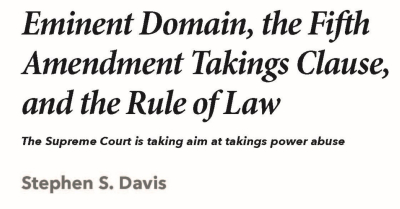
Check this out. Friend and colleague Steve Davis has authored “Eminent Domain, the Fifth Amendment Takings Clause, and the Rule of Law,” 88 Social Education J. 1 (2024).

As summarized on the Federal Takings blog:

Steve explains the rights guaranteed by the Fifth Amendment to the Constitution and focuses on its critically-important (but lesser-known and appreciated) right to compensation when the government takes its citizens’ private property for public use. The article offers a primer on eminent domain history and abuse, from the application of the Takings Clause to the states to the Kelo decision. Steve goes on to present current, real-life issues before the Supreme Court that affect every-day Americans and explains their background and importance.

The article concludes, “the Fifth Amendment’s essential constraints on the government’s extraordinary and easily-abused power of eminent domain remains as important today as it has over centuries—truly a fundamental piece

Continue Reading New Article: “Eminent Domain, the Fifth Amendment Takings Clause, and the Rule of Law” (Steve Davis, Social Education Journal)

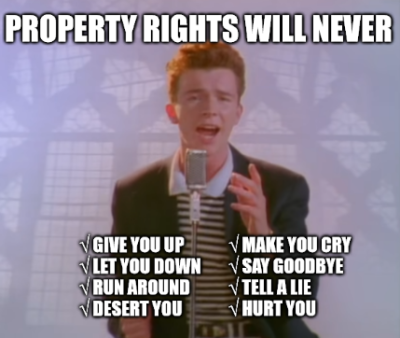
You can spend all your time making money.
You can spend all your love making time.
If it all fell to pieces tomorrow, would you still be mine?

Count me as very surprised, and a bit saddened, when earlier this week my inbox pinged with notification that the latest episode of Clint Schumacher’s Eminent Domain Podcast had dropped. And instead of it being a session with a lawyer, legal scholar, appraiser, property owner, right of way agent, or other fascinating guest, I learned the Episode 128 was to be the final edition. Or as Clint puts it, the “Farewell Episode.”

For the past several years, I got used to twice a month receiving notification that Clint had posted a new episode. I’d click though to the bumper music and that familiar intro:

Welcome to the Eminent Domain Podcast with your host Clint Schumacher of Dawson & Sodd LLP.

Continue Reading Take It To The Limit, Eminent Domain Podcast: Fare Thee Well, Clint.

Zip. Zilch. Zero. Nil. Nada. Squat. Bupkis.

Here’s the latest in a case we’ve been following for a long, long time (see here and here, for example).

In Maunalua Bay Beach Ohana 28 v. State of Hawaii, No. CAAP-19-0000776 (Mar. 18, 2024), the Hawaii Intermediate Court of Appeals confirmed that a state statute declaring certain accreted littoral land to be public property was a temporary regulatory taking of littoral owners’ rights (the common law says that accreted littoral lands belong to the private owner), but that the just compensation the State owes to these owners is a big fat zero.

This case goes back to a statute the Hawaii Legislature adopted in 2003, which made certain land accreted on littoral private property public land. As the court put it, “[i]t effectively made land accreted to the Beach Lots after May 20, 2003, public land not owned by [the adjacent littoral owners].” Slip op. at 3.

Sounds like a taking, and sure enough a lawsuit followed, claiming that the ipse dixiting of accreted land was a taking because it represented a change in the common law under which the adjacent owners would own the accreted land. Nine years later, the legislature “changed the law by terminating the taking effectuated by [the statute].” Slip op. at 9.

The trial court dismissed the takings claim, but the Court of Appeals held that the statute worked an uncompensated taking of the land accreted before the effective date of the statute. (The court rejected a claim that the statute also confiscated future accreted land, but that is another story.) The appeals court sent the case back for a a ruling on whether these plaintiffs own land that qualified, and if so, the valuation of the accreted land.

After a bench trial, the trial court concluded that there was a temporary (nine year) taking, not a permanent one. The parties stipulated that just compensation was to be measured by the “fair rental value of the accreted land” as of the effective date of the statute, subject to the governmental and private restrictions that burdened the land. Slip op. at 5. The trial court concluded that just compensation is $0. 

The court of appeals affirmed, and made short work of the owners’ argument. It based its conclusion entirely on the appellate standard of review:

Beach Lot Owners’ evidence of fair rental value was based on the testimony of Stephany Sofos. The circuit court “did not find Ms. Sofos to be a credible witness” and gave “no weight to her testimony.” “It is well-settled that an appellate court will not pass upon issues dependent upon the credibility of witnesses and the weight of evidence; this is the province of the trier of fact.” Fisher v. Fisher, 111 Hawaii 41, 46, 137 P.3d 355, 360 (2006) (citation omitted).

The circuit court instead credited the testimony of Craig Leong, a licensed real estate appraiser who holds the MAI designation.

Slip op. at 11-12 (footnote omitted).

The State’s appraiser concluded there was no rental value because the size of the accretions were “irregular” and of “narrow widths,” and subject to regulations and restrictions. Slip op. at 12.

The owners couldn’t believe that beachfront property in one of the most desirable residential areas in Honolulu is utterly worthless: “Beach Lot Owners argued that ‘depriving [them] of oceanfront property in Maunalua Bay for 9 years cannot possibly be valued at $0.’” Slip op. at 10. Indeed isn’t it intuitive that ownership of even a small and irregularly-shaped portion of beach — even for a temporary period, and even if open to public access as the plaintiffs stipulated — could be worth something? Especially, as the plaintiffs claimed, as a buffer to the homes built on the adjacent residential lots (what the opinion calls the “Home Lots”).1

Problem is, the plaintiffs making those claims “do not own any Home Lots.” Slip op. at 11. Ouch.

Having noted that the trial court made a determination that the plaintiffs’ appraiser offered incredible testimony (what that testimony was, and what value the appraiser assigned to the accreted lands we don’t know because the opinion does not tell us), and that the government’s appraiser was credible, the court of appeals held the factual conclusion of zero just compensation was not clearly erroneous because there was some evidence in the record to support it. Game, set match.

Also: no nominal damages because the plaintiffs, having scored no just compensation, “did not sustain a ‘technical injury due to a violation of some legal right[.]’” Slip op. at 13. In the court’s view, they were not injured at all.

Finally, the court rejected the argument that the plaintiffs should have been at least awarded attorneys’ fees under the private attorney general doctrine. Read pages 14-20 if you care why (we don’t, sorry).

——————————————–
1. This intuition comes from the “Inversecondemnation on Valuation” treatise by the way. You won’t find a copy of this august work in your law library, sadly. In the end, the trial court found the in-court testimony of expert valuation witnesses a lot more persuasive than your author’s intuition, which, standing alone, is worth doodly-squat in a court of law (as we know). 

Maunalua Bay Beach Ohana 28 v. State of Hawaii, No. CAAP-19-0000776 (Haw. App. Mar. 18, 2024)

Continue Reading Hawaii Beachfront Land Is Worth Nothing: The State May Have Taken Accreted Land, But Just Compensation Is Zero

Screenshot 2024-03-14 at 16-04-25 Planning Law Careers in Land Development

If you’ve been around us long enough, you know that we’re big into the notion of “generational handoff” and doing what we can to make sure that students and others who are building their careers realize that dirt law and related topics are very good areas in which to find your way.

Well, here’s the latest — a free webinar from the American Planning Association’s Planning and Law Division:

Second in a series of webinars aiming to answer student questions about career paths in the planning and law field, this webinar focuses on individuals working, or interested in working, in developing the built environment. Developers, as the main constructors of the built environment, must be familiar with urban conditions and the legal requirements that govern building on or redeveloping land. In-house counsel for development firms help their clients navigate through legal matters related to developing the built environment. Join us

Continue Reading APA Program: “Planning Law Careers in Land Development” (Wed, Mar 27, 2024)

In Brinkmann v. Town of Southold, No. 22-2722 (Mar. 13, 2024), the U.S. Court of Appeals for the Second Circuit addressed a longstanding issue left unresolved by the Supreme Court in Kelo v. City of New London, 545 U.S. 469 (2005): is it enough that a condemnor’s professed use qualifies as a public use, or may a property owner nonetheless challenge a taking on the grounds that the real reason for the taking is not a public use?

Yes, the “pretext” issue is back!

The facts of the case are pretty straightforward. The Brinkmanns wanted to build a big box hardware store on a 1.7 acre vacant parcel. The usual objections from area residents and the Town itself appeared (you know the drill): a store like this would result in too much additional traffic (traffic study said no), special permits and impact studies are needed (the owners began

Continue Reading It’s OK To Do Good Things For Bad Reasons: CA2 On Spite Takings – As Long As Taking Is For A Public Use, The Real Reason Is Irrelevant