May 2023

Here’s a don’t miss episode of friend and colleague Clint Schumacher’s Eminent Domain Podcast, featuring our Pacific Legal Foundation colleague Jon Houghton. With a title like “Jon Houghton and his Penn Central Quest,” how can we resist listening?

In this episode, Jon Houghton with Pacific Legal Foundation joins to discuss the Penn Central test, why he wants to change it, and what he is doing about it. We also discuss NY Jets football and the big Aaron Rodgers trade.

Listen in!Continue Reading Clint Schumacher’s Eminent Domain Podcast: “Jon Houghton and his Penn Central Quest”

Tyler v. Hennepin County wasn’t the only property rights opinion issued by the Supreme Court in one of my law firm’s cases last week.

There’s this one, which we’ve been waiting a lot longer to drop (oral arguments were held on the first day of the Court’s term back in October), Sackett v. Envt’l Prot. Agency, No. 21-454 (May 25, 2023). Like Tyler, this one is our law firm’s, so we’re not going to do much pundificating, and will leave that to others.

The clearest and most objective view (in our view) is that of lawprof Jonathan Adler, who analyzes the opinion over at Volokh Conspiracy in “In Sackett v. EPA, the Supreme Court Cuts Back Federal Regulatory Authority Over Wetlands.” Or check out this Twitter thread by Ilya Shapiro.

Short story: all nine Justices agree that there’s a limit to how far federal regulatory control

Continue Reading Who’ll Stop The WOTUS? SCOTUS Dives Back In To Wetlands

Here are what others are saying about Supreme Court’s recent ruling in Tyler v. Hennepin County, No. 22-166 (U.S. May 25, 2023), the case in which the Court unanimously held that the county’s keeping the excess equity in Ms. Tyler’s home over what she owed in property taxes and fees is an uncompensated taking of private property.

  • As usual, lawprof Ilya Somin was first out of the gate with “Major Unanimous Supreme Court Victory for Property Rights in Tyler v. Hennepin County” (“While the Supreme Court decision left some notable issues unresolved, it nonetheless sets a significant precedent. Most obviously, the jurisdictions that currently authorize home equity theft—some twelve states and the District of Columbia—will no longer be allowed to do so. In addition, the holding that states cannot just redefine property rights at will has important implications for other property rights issues. It makes it harder


Continue Reading Tyler Takings Round-Up

DSCF3117
If you know, you know.

Pacific Legal Foundation (that’s us) has put out a call for papers about “Rethinking Penn Central.” Here’s the details (pdf).

Here’s some of the suggested topics:

  • Can Penn Central be salvaged or does it need to be fully replaced?
  • If it is to be replaced, what should the new test be?
  • Alternatively, what improvements can be made to Penn Central that would address problems raised by critics without uprooting the test entirely?
  • Is economic loss primarily relevant to compensation owed rather than the threshold question of whether a taking has occurred?
  • Can a more categorical approach, like those taken in cases including Cedar Point Nursery v. Hassid, Hodel v. Irving, or Lucas v. South Carolina Coastal Council, adequately address regulatory takings?
  • What insights does the original meaning of the Takings Clause offer regarding how to fix or replace Penn


Continue Reading Rethinking Penn Central: A Call For Symposium Papers

Caesar
We’ll be rendering to unto Caesar, but first we must
decide: classic or creamy?

That was quick: it seems like it was only yesterday — or maybe more accurately, less than a month ago — that we were listening in live to the Supreme Court as it heard arguments in Tyler v. Hennepin County, No. 22-166, our law firm’s case which argues that Hennepin County’s keeping the excess equity in Ms. Tyler’s home over what she owed in property taxes and fees is an uncompensated taking of private property and also violates the Excessive Fines Clause.

This morning, the Court issued this unanimous opinion authored by Chief Justice Roberts (again proving he’s the Court’s “property guy”), in which the Court held that the County’s seizing Ms. Tyler’s condo to satisfy her tax debt and then “keeping the change” is a taking. It’s a relatively short opinion with no

Continue Reading Unanimous SCOTUS: “state law cannot be the only source” Of Property Rights, And “traditional property law principles” As Enforced By The Takings Clause Play A Role

Smiley

Check out this one from the Massachusetts Supreme Judicial Court, Smiley First, LLC v. Dep’t of Transportation, No. SJC-13300 (May 23, 2023). [But first, a disclosure: our law firm filed this amicus brief in support of the property owner.]

Now that that is out of the way, here’s the case.

Back in 1991, MassDOT’s predecessor-in-interest took an easement by eminent domain for the relocation of Conrail facilities displaced by the infamous Big Dig project. The 1991 takings order described the easement taken:

“In connection with the laying out of the State highway hereinbefore described, it is necessary to relocate portions of railroad rights of way and land is hereby acquired for said relocation as follows:

“Easements are hereby taken in parcels 60-E-RR-1, 60-E-RR-5, and 60-E-RR-6, shown on the plan hereinafter referred to, for the relocation of facilities of the Consolidated Rail Corporation, including all trees and structures located

Continue Reading Mass SJC: Big Dig Can’t Squeeze New Easement Into An Old One: Easements Taken By Eminent Domain Are Interpreted Like Every Other Easement

When a court’s opinion (even a trial court’s opinion) starts out with the epigram, “‘Freedom and property rights are inseparable, you cannot have one without the other.’- George Washington,” you know you are in for a ride.

So begins the opinion of the Clay County, Iowa District Court in Navigator Heartland, LLC v. Koenig, No. EQCV034863 (May 3, 2023). The issue was the validity under the Iowa Constitution of Iowa’s precondemnation entry statute, which allows pipeline condemnors to enter property for land surveys:

After the informational meeting or after the filing of a petition if no informational meeting is required, a pipeline company may enter upon private land for the purpose of surveying and examining the land to determine direction or depth of pipelines by giving ten days’ written notice by restricted certified mail to the landowner as defined in section 479B.4 and to any person

Continue Reading Iowa Trial Court: Pipeline Precondemnation Entry Statute Is Facially Unconstitutional

Here’s the latest in a case we’ve been following since its inception, this cert petition seeking Supreme Court review of the U.S. Court of Appeals for the Second Circuit’s affirming the district court’s dismissal of a complaint alleging that New York (state)’s sweeping amendments to its Rent Stabilization (rent control) statute effected categorical and Penn Central takings:

Petitioners’ physical-takings claims would have been allowed to proceed if they were brought in the Eighth Circuit. That is because the Eighth Circuit has correctly held that property owners plead a physical taking under Cedar Point where a law prohibits them from terminating a tenancy at the end of a lease term. See Heights Apartments, LLC v. Walz, 30 F.4th 720, 733 (8th Cir. 2022), reh’g en banc denied, 30 F.4th 720. But the Second Circuit held here—as has the Ninth Circuit—that the physical-takings principles articulated in Cedar Point are

Continue Reading New Cert Petition: Forcing Owners To Rent To Tenants Indefinitely Is A Categorical Taking

Cover

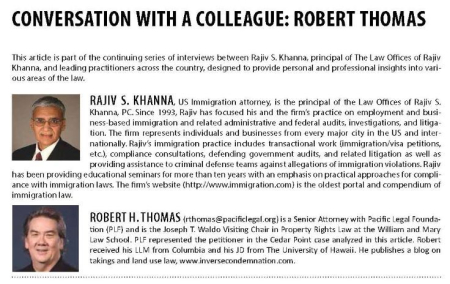
Thank you to to good folks at ALI-CLE’s The Practical Lawyer, for putting me together with Rajiv Khanna, and memorializing our recent conversation in this piece to be published in next month’s issue: “Conversation With a Colleague: Robert Thomas,” The Practical Lawyer (ALI-CLE June 2023).

Rajiv and I chatted about property law (including the Rule Against Perpetuities, even!), the difference between public interest lawyering and private practice, online vs in-person, a national practice vs a local practice, pathways to professional contentment, and considering yourself as a general practitioner in the age of legal specialization:

You still consider yourself to be a general practitioner. You have focused on property in private practice. You teach property in law school, and you also are doing public interest litigation. Out of all of these careers, what do you think you find the most satisfying?

That is truly a tough question. I

Continue Reading In Which We Have A Conversation With A Colleague About Property Law, Public Interest Lawyering, And How To Pronounce “Schedule” (May Be TMI)

When we last visited Sheetz v. El Dorado County, we finished with “stay tuned” because we suspected that the California Court of Appeal’s opinion concluding that the County’s traffic mitigation fee is immune from Nollan/Dolan nexus-and-rough-proportionality review because the legislature imposed the fee on everyone (and Sheetz was not subject to paying it because of an ad hoc agency decision) was not going to be the last word, either in the case or on the legislative exactions issue.

Well, now the predicted other shoe drop: the property owner has filed this cert petition, with this Question Presented:

George Sheetz applied to the County of El Dorado, California, for a permit to build a modest manufactured house on his property. Pursuant to legislation enacted by the County, and as the condition of obtaining the permit, Mr. Sheetz was required to pay a monetary exaction of $23,420 to help finance

Continue Reading New Cert Petition: The Supreme Court Should Resolve The Legislatively-vs-Administratively Imposed Exactions Issue