March 2023

This just in: the U.S. District Court for the Southern District of New York has issued this Opinion & Order in the case which challenges New York City’s rendering “guaranty clauses” in commercial leases unenforceable due to the declared Co-19 emergency.

This is a case we’ve been following. Earlier, the Second Circuit vacated the district court’s dismissal of the case, holding that the city’s ordinance rendering forever unenforceable certain provisions in commercial leases:
A provision in a commercial lease or other rental agreement involving real property located within the city that provides for one or more natural persons who are not the tenant under such agreement to become, upon the occurrence of a default or other event, wholly or partially personally liable for payment of rent, utility expenses or taxes owed by the tenant under such agreement, or fees and charges relating to routine building maintenance owed by the

Continue Reading Bust A Deal, Face The Wheel: NYC Rendering Commercial Lease Guaranty Clauses Unenforceable For Co-19 Violates Contracts Clause

Untitled Extract Pages

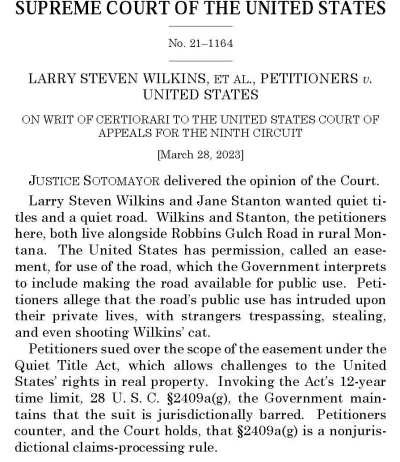
We all know by now that the Supreme Court recently has been on a tear about federal statutes of limitations, and is policing up a lot of earlier too-casual language in some of its opinions about whether this SOL or that SOL is “jurisdictional.” In a series of opinions over the last few years, the Court has almost universally confirmed that it used the term rather loosely, and that upon further review, many statutes of limitations are not “jurisdictional” but are “claims processing rules.”

The Court’s 6-3 opinion in Wilkins v. United States, No. 21-1164 (Mar. 28, 2023) is another in a line of decisions so holding. Wilkins involves the Federal Quiet Title Act’s 12-year SOL (see this preview of the issues by our friend and colleague Stephen Davis). The bottom line is that Wilkins concluded the QTA’s SOL is a claims processing rule because Congress did not “clearly state” that the SOL is jurisdictional.

We’ll leave it to you to read the six-Justice majority opinion authored by Justice Sotomayor, and the three-Justice dissent authored by Justice Thomas, because this case is one where our law firm represents a party, the prevailing petitioners. Our colleague Jeffrey McCoy argued the case a couple of months ago (nice job, Jeff!).

Unfortunately, a lot of the reporting on the decision treat it as a wonky, technical issue (which, admittedly, it is), but in so doing regrettably overlook the importance of the case. For the reasons why we think it is very important, read this. And for some of the reporting that gets why the case is important (and which note the somewhat unexpected line up of Justices) see:

The bottom line is that the property owners will get their day in court, and not get tossed out for an arcane, overly-technical reason. And that sounds like a very good thing.

Wilkins v. United States, No. 21-1164 (U.S. Mar, 28, 2023)

Continue Reading “Larry Steven Wilkins and Jane Stanton wanted quiet titles and a quiet road.” 6-3 SCOTUS Says Federal Quiet Title Act Statute Of Limitations Is Not Jurisdictional

As most of you probably already know, there’s a demon lurking out there in takings claims. Not of the Levon Helm-narrated The Right Stuff variety, but maybe just as deadly in litigation.

That’s right, the too-early-or-too-late thing (or in some cases, the too-early-and-too-late argument). Getting caught between arguments that a takings claim isn’t ripe, and arguments that it is too late (statutes of limitation).

The U.S. Court of Appeals for the Fourth Circuit was dealing with the latter (a statute of limitations) in Epcon Homestead, LLC v. Town of Chapel Hill, No. 21-1713 (Mar. 20, 2023), but there are lessons in the case for the other side of the issue, ripeness.

The facts are pretty straightforward. If you are going to build at least five single-family units, the town’s zoning ordinance contains a requirement of “inclusionary zoning” (aka affordable housing; aka below-market units. Or if

Continue Reading CA4: Exactions Takings Claim Accrues When Owner Knows Of The Demand, Not When It Paid

Check this out, a recently-filed cert petition in a case we’ve been following, filed by our friends and colleagues at the Institute for Justice. This one involves an issue we’ve been on top of also, most recently in these two cases (see here and here).

That is, what does the Supreme Court’s description of the Takings Clause as “self-executing” actually mean? Do you need statutory authorization in order to bring a takings or just compensation claim, or can you sue directly under the Constitution?

In Devillier v. Texas, No. 21-40750 (Nov. 12, 2022), the Fifth Circuit’s cryptic opinion concluded that “the Fifth Amendment Takings Clause as applied to the states through the Fourteenth Amendment does not provide a right to action for takings against a state[.]” Slip op. at 1-2. Here’s the entirety of the decision (minus footnotes):

The State of Texas appeals the district court’s decision

Continue Reading New Cert Petition: Do You Need Statutory Authorization To Sue For A Taking?

There’s a lot to digest in the 36-page Order of the U.S. District Court for the Southern District of Florida in case that mostly concerns the validity of an exaction a small property owner was required to pony up in order to tear down and replace an old home on its land.

Megladon bought the residentially-zoned property in 2016 to tear down the existing building and build a new one. Simple enough, right? It demolished the old house, and applied to the Village to build a new one. But the Village also needed a road, and began making noise about a “possible road dedication.” And sure enough, eventually the Village notified Megladon that “a certificate of occupancy will not be issued until dedication of the right-of-way is complete.” Slip op. at 4. There’s a dispute over exactly whose law requires such a dedication — Village or County? — but

Continue Reading Exactions, Takings, And Ripeness…Oh My! When Planning Officials Say “No,” That’s Enough (Even If They Might Have Said “Yes” Some Other Way)

A short one today from the Wisconsin Court of Appeals.

In Sojenhomer LLC v. Village of Egg Harbor, No. 2021AP1589 (Mar. 14, 2023), the court held that when a statute prohibits the use of eminent domain to acquire property for a “pedestrian way,” the village cannot take for a sidewalk.

Seems pretty obvious, no? Well, it took a 24-page opinion to work through it.

Here’s the statute. Sure enough it does say that “[p]roperty may not be acquired by condemnation to establish or extend a recreational trail; a bicycle way, as defined in s. 340.01 (5s)340.01 (5e)346.02 (8) (a).” And clicking on that last link shows that pedestrian ways are defined as “a walk designated for the use of pedestrian travel.”

Sojenhorner naturally thought so, because when the village “sought to condemn Sojenhomer’s property to establish a sidewalk,” slip op. at 2, it objected.

We’re

Continue Reading When Statute Says No Eminent Domain For “Pedestrian Way,” Does That Include Sidewalks? (Is This A Trick Question?)

IMG_20180720_152115

The Massachusetts Supreme Judicial Court’s recent opinion in Church of the Holy Spirit of Wayland v. Heinrich, No. SJC-13326 (Mar. 14, 2023) isn’t our usual takings-and-related fare, but it is straight-up Dirt Law and a bit land-usey so we’re posting it. Besides, it is just what you need to perk up your ears midweek. 

The church, like a lot of churches, has a place where the dearly departed are interred. But this is not your typical cemetery or graveyard, but a “‘Memorial Garden,’ also referred to as a ‘Churchyard[,]’ [where] [p]arishoners could arrange for cremated remains (cremains” to be interred in the Churchyard by purchasing a certificate from the church.” Slip op. at 3. Those certificates included a provision that subjected the purchaser to church regulation of the Churchyard “now or hereafter in force.” Id.

Over the years, the problems besetting the church were more of the worldly variety:

Continue Reading Mass SJC: Families Have No Common Law Property Right To Have Predecessors’ Remains Remain In Cemetery

If a zoning statute or ordinance sets out the uses permitted in a zone, and the uses not permitted in the zone, and a property owner wants to make a use not permitted in the zone, all she needs to do is apply for a variance, or a Conditional Use Permit, or a nonconforming use permit, or a Special Use Permit, right? After all, isn’t the point of these exceptions to bright-line use prohibitions to build in a large degree of flexibility and afford front-line regulators in the right circumstances the discretion to grant a use the legislature prohibited? One size does not fit all, does it? 

That was the issue that closely divided the Hawaii Supreme Court in Hoomoana Foundation v. Land Use Comm’n, No. SCWC-17-181 (Mar. 10, 2023). In a 3-2 opinion, the court concluded that when a use is expressly barred by a zoning statute (and

Continue Reading Denying Uses (But Allowing Discretionary Ad Hoc Exceptions) Isn’t A Recipe For Rational Land Use

Mortons

A quick one from the Indiana Supreme Court (thanks to our Pacific Legal Foundation colleague Sam Spiegelman for the heads-up on this one).

In Town of Linden v. Birge, No. 22S-PL-352 (Mar. 7, 2023), the court held that intermittent government-induced flooding of property is treated as a permanent invasion and a per se taking if the flooding is inevitably recurring.

A Town owned and maintained drain fell into disrepair, “resulting in frequent flooding of the Town” so replacement and upgrade was in order. The Town did so and formed an improvement district to fund it. The Birge property was assessed $7k, and after some back-and-forth about the location and placement of a manhole cover on the Birge property, the upgrade project went forward. But “[a]fter completion of the project in late 2012, low-lying portions of the Birges’ Property flooded after any heavy rainfall, encumbering the Birges’ farming enterprise. So

Continue Reading When It Rains, It Floods: Intermittent Flooding, Inevitably Recurring, Is Treated As A Permanent Invasion

Screenshot 2023-03-03 at 08-06-54 Robert Thomas inversecondemnation.com on Twitter

Let’s say you know nothing else about an appeal except it is being decided by the U.S. Court of Appeals for the Second Circuit, and the case is a constitutional challenge to rent control. What’s your best guess about the outcome (the district court dismissed for failure to state a claim)?

When the Second Circuit issued its summary order in just such a case last week — a challenge to the “Housing Stability and Tenant Protection Act of 2019” — we decided to undertake a little unscientific poll to see whether others out in the Twitterverse predicted as we did.

Looks like so. Yes, the sampling size was small, and the respondents were only those who voluntarily offered their thoughts. But 95% accurately predicted that the property owners would lose, as the Second Circuit indeed held in an appellate court’s version of “laughing heartily” at an appellant’s arguments:

Continue Reading One Guess What The Second Circuit Did With A Takings Challenge To Rent Control