May 2022

A “fish” need not be “connected to a marine habitat” after all.

You remember that classic lawyer joke?

A company is on the hunt for a new CEO and decides to undertake the search from within existing management. The hiring committee schedules interviews with the company engineer, the company accountant, and the company lawyer. The committee calls each candidate into the boardroom and asks a single question: “what is two-plus-two?”
First up, the engineer. After doing calculations on a slide rule [this is an older joke, you see] and scratching figures and equations with a pencil and paper, the engineer proclaims, “What is two-plus-two? I can say with a 99% level of certainty that two-plus-two is 4, out to the fourth decimal place.”

Same question to the accountant, who after consulting the actuarial tables, the IRS’s schedules for mileage reimbursement, and the latest interest rates, responds, “What is two-plus-two?

Continue Reading Cal App Channels Dickens’ Mr. Bumble: Bumblebees Are Fish Under Cal’s Endangered Species Act

Austinairport

Here’s what we’re reading today:

Continue Reading Tuesday Round-Up: Austin Airport Taking Its Own Land?, The Right To Exclude, And More

Here’s one we’ve been following since its inception, even before we joined the law firm that represents the property owner. (And because our Pacific Legal Foundation colleagues are repping the plaintiffs in this one, we won’t be commenting in-depth.)

You may remember that in Gunderson v. Indiana, 90 N.E.3d 171 (Ind. 2018), the Indiana Supreme Court concluded that the public owns the land up to the ordinary high water mark on Lake Michigan, and had done so all the way back to statehood in 1816. Problem is, according to some lakefront property owners, “undisputed local, state, and federal acknowledgement over the years” was otherwise – the law said that lakefront land was was private, not public, down to the ordinary low water mark. Thus, the plaintiffs alleged, “the Gunderson judgment changed the law of the State of Indiana, as recognized by prior Indiana court precedent as well

Continue Reading CA7: Like Other Circuits, We’re Going To Dodge The Judicial Takings Question

The U.S. Court of Appeals for the Seventh Circuit’s decision in Nowlin v. Pritzker, No. 21-1279 (May 20, 2022), adds to a long line of rulings denying takings claims for coronavirus-related business shutdowns. 

This one challenged the Illinois governor’s executive orders which required “non-essential” businesses to shut down or reduce operations, and limited the size of gatherings. The plaintiffs brought the usual host of constitutional claims (a total of six), which included (naturally) a takings claim. The district court, after granting leave to allow the filing of an amended complaint, dismissed all six claims, concluding either that the plaintiffs had not alleged particularized injuries (and thus lacked standing, and thus the court lacked jurisdiction), or that the complaint failed to state claims.

The Seventh Circuit affirmed that all claims, with the exception of the takings claims, lacked jurisdiction because the plaintiffs had not alleged specific injuries. The court subject

Continue Reading CA7: Co-19 Shutdown Complaint Does Not Meet “Demanding test for alleging a regulatory taking”

In FTB Everett Realty, LLC v. Mass. Gaming Comm’n, No. SJC-13196 (May 23, 2022), the Massachusetts Supreme Judicial Court revived a property owner’s Penn Central takings claim, reversing the trial court grant of summary judgment to the Commission.

This one deals with the intricacies of gambling law and the process necessary to approve the operation of a casino — subjects that we can’t claim to fully understand — so bear with us if there are any inaccuracies.

FBT purchased vacant land which was contaminated and required extensive cleanup. It looked into a variety of possible uses, including a storage facility or big box retain. But two years later, Massachusetts legalized casino gambling and created the Commission. Its duties include issuing gambling licenses.

A branch of the Wynn casino operation wanted the property. It entered into an option agreement with FBT under which it would buy the land if Wynn

Continue Reading Mass SJC Revives Penn Central Takings Claim Because Casino Comm’n Might Have Altered The Deal

Here’s a pretty rare one: a trial court entering summary judgment on liability in favor of the property owner in a takings case. Yes, you read that right.

And to top it off, this ruling comes in a case in which the taking alleged was a police invasion and destruction of a home for the valid public purpose of apprehending a holed-up criminal, a brand of claim that has not met with a whole lot of success. See, for example, this case from the Tenth Circuit, and this case from the Supreme Court of South Carolina.

In this order, the U.S. District Court for the Eastern District of Texas held the City of McKinney liable for a physical taking. The entire order is worth reading, but here are some of the highlights.


Continue Reading District Court: City Liable For Physical Taking For Destroying Home While Apprehending A Criminal

Screenshot 2022-05-13 at 14-45-41 The Impact of Knick on Regulatory Takings and Those Pesky Lucas Exceptions - Property

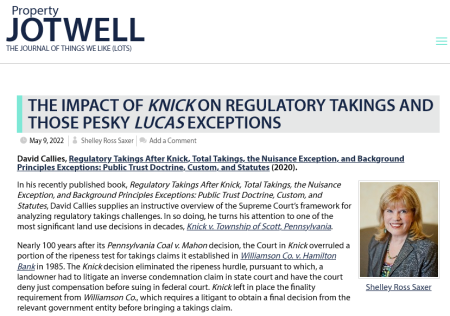
Check this out: Pepperdine lawprof Shelley Saxer has a piece in Jotwell, “The Impact of Knick on Regulatory Takings and Those Pesky Lucas Exceptions,” a review of U. Hawaii lawprof David Callies’ book, “Regulatory Takings After Knick.”

The review is short and to the point, so we suggest you read it. But here’s a teaser:

This small but mighty book offers a concise history and understanding of takings jurisprudence as it stood before and after the Knick decision. It brings clarity to a convoluted chronicle of takings litigation and presents specific situations where litigants have asserted a total taking claim and the defense has relied on the various exceptions to Lucas.

Don’t miss it.Continue Reading Lawprof Saxer On Jotwell: “The Impact of Knick on Regulatory Takings and Those Pesky Lucas Exceptions”

In City of Baytown v. Schrock, No. 20-0309 (May 13, 2022), the Texas Supreme Court held that it isn’t a taking when a city, in violation of state law, cuts off utility services to property.

The issue, as the court restated it, was “whether a claim of economic harm to property resulting from the improper enforcement of a municipal collection ordinance alleges a regulatory taking.” Slip op. at 6. Schrock owned property in Baytown on which he had a mobile home he planned to rent. The water bill wasn’t paid, and Baytown has an ordinance that requires property owners to guarantee utility payments, or file a statement that the owner would not guarantee these payments. Schrock didn’t file a disavowal statement until after had already assessed him nearly two grand for unpaid water bills. Slip op. at 3. 

He didn’t pay, so when one one of Schrock’s prospective tenants

Continue Reading Texas: City Illegally Cutting Off Utilities Isn’t A Taking – It Needs To Be Regulating “Land Use”

After the U.S. Supreme Court in Cedar Point Nursery reminded everyone that the Court’s longstanding focus on the right to exclude others as one of the most fundamental of property rights is as fresh today as it ever was (see Kaiser Aetna (uninvited boaters), Loretto (cable TV box), Nollan (beachcombers) and Horne (segregating raisins, for example), we were left with some questions. Most importantly, some of us were wondering “what’s next?”

Well try this one on for size. Virginia property owners recently sued the Department of Wildlife Resources over the state’s “right to retrieve” law, Va. Code § 18.2-136 (“Fox hunters and coon hunters, when the chase begins on other lands, may follow their dogs on prohibited lands, and hunters of all other game, when the chase begins on other lands, may go upon prohibited lands to retrieve their dogs, falcons, hawks, or

Continue Reading Who Let The Dogs In? Property Owners Challenge Virginia’s “Right to Retrieve” Law That Allows Hunters (& Dogs) To Trespass

The Cass County Water Resource District wanted to acquire the Sauvageau property for a flood control project. That means flooding the property, removing all trees and vegetation, and taking dirt. Putting the land underwater, permanently. Cutting off the public access road. And removing the Sauvageau home.

The District offered to buy the fee interest from the Sauvageaus for $460,000, the appraised value of the fee interest. They declined. So the District offered $460,000 for a permanent easement. Also declined.

Next up, eminent domain, with the District seeking a “permanent right of way easement” by quick take. We’re taking it now, so you have a few months to get out of your home and get off the land. The Sauvageaus objected. You might be able to take our property for a flood control project, but you can’t take our property by quick take. Under the North Dakota Constitution, quick take is

Continue Reading It Isn’t An “Easement” When Condemnor Is Taking Everything, Permanently