
April 2022

Bergerpage

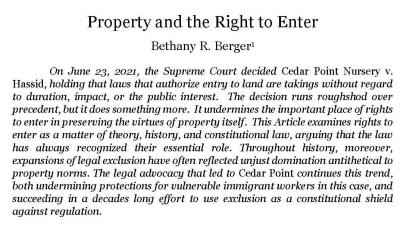
A new article by lawprof Bethany Berger, “Property and the Right to Enter,” criticizing the Supreme Court’s ruling in Cedar Point Nursery. The article builds on the amicus brief in the case, also authored by Prof Berger.

Here’s the Abstract:

On June 23, 2021, the Supreme Court decided Cedar Point Nursery v. Hassid, holding that laws that authorize entry to land are takings without regard to duration, impact, or the public interest. The decision runs roughshod over precedent, but it does something more. It undermines the important place of rights to enter in preserving the virtues of property itself. This Article examines rights to enter as a matter of theory, history, and constitutional law, arguing that the law has always recognized their essential role. Throughout history, moreover, expansions of legal exclusion have often reflected unjust domination antithetical to property norms. The legal advocacy that led to Cedar Point continues this trend, both undermining protections for vulnerable immigrant workers in this case, and succeeding in a decades long effort to use exclusion as a constitutional shield against regulation.

Definitely worth reading.
Continue Reading New Article (Bethany Berger): “Property and the Right to Enter”
PXL_20220422_171653637

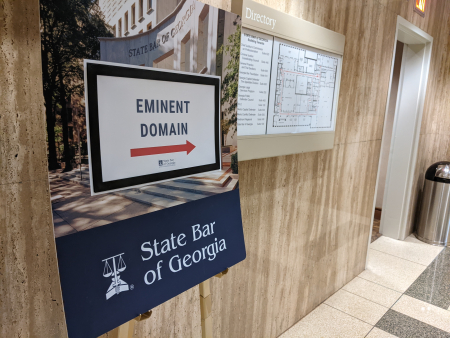
Here are the links to the cases and other materials that we talked about last Friday at the Georgia Bar Association’s annual Eminent Domain Conference. Our talk was entitled “It’s the Chief Justice’s Property World, We Just Live In It: National Trends in Takings, Property, & Eminent Domain,” and was part of the Eminent Domain Section’s (yes, the Georgia Bar has a Section entirely devoted to eminent domain!) annual conference on the topic. I was honored to have been asked to chat with this august and expert group of lawyers.


Continue Reading Links From Last Week’s Georgia Bar Association Eminent Domain Conference

FedCtsTakingsArticlepage1

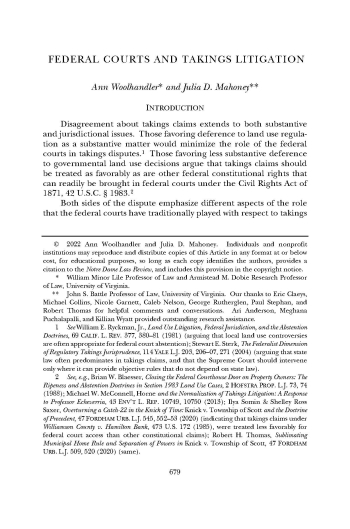
A new article on takings from U. Virginia Law School profs Ann Woolhandler and Julia Mahoney in the Notre Dame Law Review, “Federal Courts and Takings Litigation.” Get the pdf here.

Rather than try and summarize the piece, we’re just going to cut-and-paste the highlights from the article’s Introduction:

While Knick clearly expands the lower federal court role in takings claims, many questions remain. We do not know how federal courts will respond to the increase in claims—whether they will embrace a robust federal role in land use cases, or use various abstention doctrines to rein them in. While pro-regulatory and pro-property rights scholars have predictably taken sharply contrasting positions as to the appropriate federal court role post-Knick, this Article will recommend a middle-of-the-road approach, based partly on history and partly on an assessment of where the lower federal courts may most usefully contribute to the

Continue Reading New Article: Woolhandler & Mahoney, Federal Courts and Takings Litigation, 97 Notre Dame L. Rev. 679 (2022)

Even if the world were open today, the doors to most Hawaii state, county, and city offices would still be locked. Because today is the day that Hawaii celebrates Good Friday.

Yes, Good Friday is an an official state-sanctioned holiday in the 808 area code, so we’re reposting our annual recounting of how it came to be that the State commemorates the date of the crucifixion, and how that squares with the Establishment Clause of the First Amendment

Turns out that we don’t really commemorate today as the crucifixion date, and it is just coincidence that the official State “spring holiday” occurs on the same day. (And this being Hawaii, in the end it’s really a public worker’s union thing.)

Good Friday is a legal holiday in the State of Hawaii pursuant to Haw. Rev. Stat. § 8-1. [Barista’s note: here’s a case we argued a couple

Continue Reading Today Is Hawaii’s Secular Good Friday Holiday – A Day To Celebrate Public Worker Unions

Not too long ago, we posted the Fifth Circuit’s panel opinion in a case where the court held that there’s nothing a federal court can do if a local government does not pay a state-court just compensation judgment. We filed an amicus brief in that case arguing “[t]he Takings Clause does not permit the Sewerage Board to take property and hand the owner an IOU the Board might pay sometime in the future if and when it feels like it. Instead, it requires the Sewerage Board to pay the court ordered just compensation without ‘unreasonable delay.'”

Well, in the interim we’ve traded in our amicus hat for a co-counsel hat, and last week asked the Fifth Circuit to rehear the case en banc, via this en banc petition.

Since we’re now co-counsel in the case, we won’t go into further detail, but will leave it there for you to

Continue Reading Are The Federal Courts Powerless When A Condemnor Doesn’t Pay Just Compensation?

Another takings challenge to a Co-19 shutdown, another “no taking” result.

This time, it is from the Florida District Court of Appeal (Fifth District). In Orlando Bar Group, LLC v. Desantis, No.5D21-1248 (Apr. 8, 2022), the court affirmed dismissal of takings challenges to the governor’s emergency order that barred certain alcohol sales, and limited the service in bars. Orlando-area bar owners sued for inverse condemnation.

The Fifth District concluded that this did not result in a taking. First, the court held that it would not apply a categorical physical rule, because Cedar Point Nursery is not applicable. In that case, the owners were asserting their right to exclude the public, but here the bar owners claimed that the restrictions abrogated their right to include patrons and others. Slip op. at 7 (“The COVID orders at issue here did not permit third parties to access Appellants’ property; they did

Continue Reading Fla App: No Taking, Because COVID Is A Really Good Reason To Shut Bars Down

Here’s the latest case challenging a pandemic-related eviction moratorium, this one from Minnesota and the U.S. Court of Appeals for the Eighth Circuit.

In Heights Apts, LLC v. Walz, No. 21-1278 (Apr. 5, 2022), the court reversed the district court’s dismissal of a property owner’s takings claims. The owner challenged the Minnesota governor’s residential eviction moratorium and later extensions. Like a lot of these things, the Minnesota version was not a rent “holiday” (tenants were still, technically speaking, on the hook for the rent, and there were several limited exceptions under which the property owner could evict). But for the most part, the Minnesota measure, like a lot of these things, effectively left property owners holding the economic bag (good luck collecting thousands in back rent), and turned their units into public pandemic housing. 

The owner’s complaint raised Contract Clause, Petition Clause, and Takings claims.

Before we get to

Continue Reading CA8: Yee v. Escondido Doesn’t Save Eviction Moratorium From Takings Review

6a00d83451707369e20240a4eeb054200d-800wi

When we met for the 39th ALI-CLE Eminent Domain & Land Valuation Litigation Conference in-person in Scottsdale a couple of months ago, we hinted that you’d like the venue for the 2023 Conference. We say “hinted” because without an executed contract with the venue, we could not officially announce it.

But the good folks at ALI-CLE have let us know that signed, sealed, and delivered the agreement, and that we can make the official announcement. So here it is: for the 40th ALI-CLE Eminent Domain & Land Valuation Litigation Conference, we will be returning to one of our favorite cities, Austin, Texas. Details:

Date: February 2-4, 2023 (as usual, the week between the playoffs and the Super Bowl)

Conference hotel: Sheraton Austin Hotel at the Capitol

Programming: the same high-quality presentations you know and love.

We were last in Austin in 2016, and even though the city has

Continue Reading It’s Official, So Mark Your Calendars: ALI-CLE Eminent Domain & Land Valuation Litigation Conference: Feb 2-4, 2023, Austin, Texas