
July 2020

California eminent domain law requires that if property taken isn’t used for the intended public use “within 10 years” of the adoption of the resolution of necessity, then the condemnor must offer to sell the property back to the (former) owner. Unless, that is, the condemnor adopts a new resolution “reauthorizing the existing stated public use.” In Rutgard v. City of Los Angeles, No. B297655 (July 30, 2020), the California Court of Appeal put some meat on the bones of the statute.

We suspect that this situation doesn’t arise all that often. Thus, from the eminent domain perspective, this one seems more interesting than important. But we also think that muni law mavens may find this important, because the court’s analysis focuses on local law:

This appeal presents four cascading questions:

First, does a public entity desiring to retain condemned property under section 1245.245 have to “adopt” its initial

Continue Reading Cal App: When Condemnor Doesn’t Fish Within 10 Years Under Anti-Land Banking Statute, It Better Cut Bait Correctly

There’s a lot going on in the Michigan Supreme Court’s opinion in Mays v. Governor, No. 157335 (July 29, 2020). After all, the case involves claims for personal and property damages resulting from the Flint (Michigan) water crisis. That’s an issue we’ve been following that has also grabbed national headlines.

But if you takings mavens don’t want to take a deep dive into the non-takings parts of the opinions (that resulted in an “affirmed by an equally divided court” situation on the plaintiffs’ bodily injury claims and Bivens-type damage remedy), here are the takings highlights. We thought the most interesting part of the opinion is at pages 11 through 15, where the three-Justice plurality/majority concluded that the plaintiffs alleged property damage and injuries different from the public, and alleged enough to avoid the government’s motion for summary judgment.

The class action complaint in Mays alleged:

Plaintiffs brought

Continue Reading Michigan SCT: Flint Takings Plaintiffs Alleged Unique Property Injuries, And That’s Enough To Survive Summary Judgment

How much can a condemnor alter the scope of the taking before the good faith offer required by state law also needs to be re-done?

That’s the question the Wyoming Supreme Court resolved in EOG Resources, Inc. v. Floyd C. Reno & Sons, Inc., No. S-20-0013 (July 23, 2020).

There, the condemnor’s original good-faith offer to the property owner was for a take of rights-of-way, easements, and surface use rights on 2,100 acres. Later, however, it amended the complaint to take only 70 acres. The owner objected to the amended take, arguing that the condemnor had not complied with the statute’s good faith offer requirement. The condemnor responded that the 70 acres it now wanted was within the 2,100 acres its original offer covered, so what’s the big deal?

It is a big deal in this case, held the court. The point of the good faith offer requirement

Continue Reading If A Condemnor Alters The Scope Of The Take, A Good-Faith Offer Carries Over Only If The Amended Taking “Significantly Resembles” The Original Offer

Here’s the cert petition that we’ve been waiting to drop in a case we’ve been following. Last we checked in, the Ninth Circuit (with concurral) had denied en banc review, over a dissental.

In Cedar Point Nursery v. Shiroma, 923 F.3d 524 (May 8, 2019), a 2-1 panel of the Ninth Circuit affirmed the dismissal of a complaint for failure to plausibly state a takings claim under Twombly/Iqbal.  At issue was a regulation adopted by California’s Agricultural Labor Relations Board which requires agricultural employees to open their land to labor union organizers. The regulation is framed as protecting the rights of ag employees to “access by union organizers to the premises of an agricultural employer for the purpose of meeting and talking with employees and soliciting their support.”

The panel majority viewed the complaint as alleging a Loretto physical invasion taking, and held the

Continue Reading New Cert Petition: Does A Physical Invasion Taking Require 24/7 Occupation?

This is a case about trees. The County highway maintenance department entered the plaintiffs’ rural undeveloped land (with permission) to cut and remove certain trees, but then went to the wrong place and cut the wrong trees.

The plaintiffs wanted compensation for the trees, measured as the cost to replace the trees. The County offered compensation only for the loss of use or damage to the land, $200. But you really didn’t take or damage the land (other than to remove the trees), you took or damaged the trees argued the owners. The trial court agreed with the County, as did the court of appeals.

In this post (Apparently, Trees Are Not Property In Nebraska“) we expressed our dissatisfaction with the court of appeals’ ruling and rationale. The court held this wasn’t a permanent taking, so no recovery. In our view, the court also wrongly focused on

Continue Reading Apparently, Trees Still Aren’t Quite “Property” In Nebraska

Here’s a cert petition that we’ve been waiting to drop in a case we’ve been following. This one asks whether a state legislature’s virtual elimination of a cause of action is a taking.

The harsh reality is that farms and ranches can stink. But in Right to Farm Acts, many state legislatures, Indiana’s included, have concluded that farming and ranching are so important that the consequences (“negative externalities“) that naturally occur have to be accepted. One Indiana court summed up Right to Farm Acts as well as anyone when it noted, “so long as the human race consumes pork, someone must tolerate the smell.” Shatto v. McNulty, 509 N.E.2d 897, 900 (Ind. App. 1987). Let’s call it a “stink easement.”

Indiana’s version stands somewhat apart from others, however. Like many other states, it bars lawsuits which assert that a long-standing agricultural operation is a

Continue Reading New Stinky Cert Petition: By Wiping Out Nuisance Claims, Right-To-Farm Act Is A Taking

We don’t often post trial court orders, but this one, Chiquita Canyon, LLC v. Cnty of Los Angeles, No. BS 171262 (Cal. Super. July 2, 2020), from the California Superior Court, is worth reading for you land use and exactions mavens.

It’s a long order, so we won’t go into great detail, but the short story is that the petitioner (a landfill) administratively challenged 22 of the 130 conditions and fees the County imposed on a Conditional Use Permit. Some of the conditions violated the trash law (California’s Integrated Waste Management Act) because they discriminated against out-of-area trash.And the condition requiring the landfill to support the state’s waste management goals? Compelled speech (no trash talk required!).

But you Nollan/Dolan mavens will really like the part about California’s Mitigation Fee Act, which essentially is a codification of the same exaction standards which the U.S. Supreme Court adopted in

Continue Reading Trash Talking: Permit Condition Not Backed By Proof Of Nexus And Proportionality Is Illegal Exaction

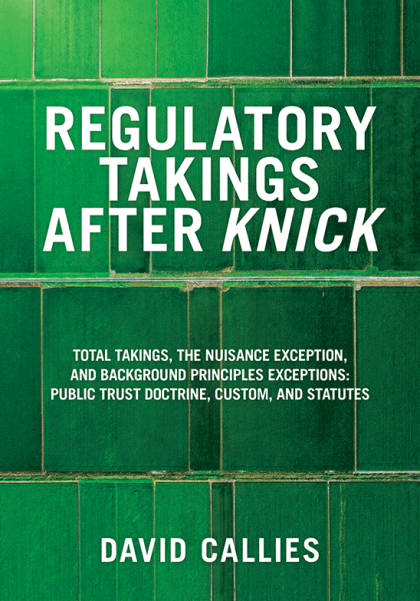
Callies_book
by David Lee Callies

Coming soon (August), a new book from lawprof David Callies on what might be our favorite subject, regulatory takings.

We had a chance to review the proofs, and we highly recommend this one for your bookshelf. We’ll bring you more once published. But for now, you can reserve your copy here.

Here’s the description:

Regulatory Takings after Knick summarizes the Supreme Court’s recent decision in Knick v. Township of Scott which does away with the state action prong of the Court’s former ripeness test and what it means for the law of regulatory taking of property. It emphasizes total takings after Lucas v. South Carolina Coastal Commission and the exceptions which permit government to so strictly regulate property as to permit no economically beneficial use of it.

The Supreme Court’s recent decision in Knick v. Township of Scott has been aptly described by some commentators


Continue Reading New Book Coming In August: Regulatory Takings After Knick by David Callies
A pipeline needed private property. Did it wait until it had actually taken the property before it started to build the pipeline? No. 

In Bayou Bridge Pipeline, LLC v. 38.00 Acres, No. CA 19-0565 (July 2020), the Louisiana Court of Appeal addressed a host of challenges:

  • A broad facial challenge to Louisiana’s expropriation system. The landowners asserted that allowing private entities to exercise the sovereign power violated due process, primarily because the delegation lacks concrete standards. The court rejected the argument, concluding that the state delegating the power to a common carrier pipeline and including a process that includes a predeprivation hearing to determine public use and necessity, is not a problem. Louisiana’s law “sets out appropriate standards to guide expropriating authorities and the courts, as well as providing for judicial review. Those standards are clearly set out in La.Const. art. 1, § 4, which requires that any taking


Continue Reading Louisiana Court Slaps Down Pipeline for Just Going Ahead And Building Before Actually Taking Property

Our Louisiana friends have a great word — lagniappe — that we’re not sure we understand precisely, but to us has always meant that little something extra. As Mark Twain wrote, “[i]t is the equivalent of the thirteenth roll in a ‘baker’s dozen.’ It is something thrown in, gratis, for good measure.” As far as we can tell, however, it’s meant to be something you give to others, not a little something extra you keep for yourself.

Maybe that message didn’t make its way up to Michigan, because until the Michigan Supreme Court’s ruling in Rafaelli, LLC v. Oakland, County, No. 156849 (July 17, 2020), local governments apparently were free to treat themselves to a little something extra when they foreclosed on property for the owner’s failure to keep up with their property tax payments. They would sell the property, pay themselves the taxes owed, and then pocket anything

Continue Reading Michigan: Gov’t Keeping The Change From Tax Delinquency Sale Is A Taking