
June 2020

As we noted here, property owners sued the New York governor asserting that one of his emergency measures to respond to the coronavirus crisis (a suspension of eviction proceedings) is a taking.

Yesterday, the District Court denied the plaintiffs’ motion for summary judgment, and entered summary judgment in favor of the governor. Order Denying Plaintiffs’ Motion for Summary Judgment and Granting Defendant’s Motion for Summary Judgment, Elmsford Apt. Assocs., LLC v. Cuomo, No. 20-cv-4062 (CM) (June 29, 2020).
No physical take (see Yee: you invited the tenants in, owners). And no regulatory taking either because — you guessed correctly — this is “temporary” and Tahoe-Sierra. When this is all done, no-harm, no-foul. And not a Lucas taking because the restrictions left the owners with some use and value, so this is a Penn Central analysis. And you can guess where the Penn Central analysis leads, no?

Continue Reading SDNY: No Taking For NY’s Eviction Moratorium (It’s Temporary, And You Invited Them In Landlords)


Here’s the recording of last month’s Federalist Society’s Environmental Law & Property Rights Practice Group teleforum, “Just Compensation: A Suggestion or a Requirement?

Can states unilaterally decide not to pay takings judgments? Some states think so. Louisiana and Florida have laws that say no takings judgment can be paid unless money is specially appropriated to do so—and then they never get around to appropriating the money to pay. These laws are currently being challenged in the Fifth Circuit and the Florida Supreme Court. Please join us for an interesting discussion of this litigation.

Featuring:

Robert McNamara, Senior Attorney, Institute for Justice

Daniel Woislaw, Attorney, Pacific Legal Foundation

Stream above, or download it here.Continue Reading What If Govt Is Obligated To Pay … But Doesn’t? Podcast: “Just Compensation: A Suggestion or a Requirement?”

Lech

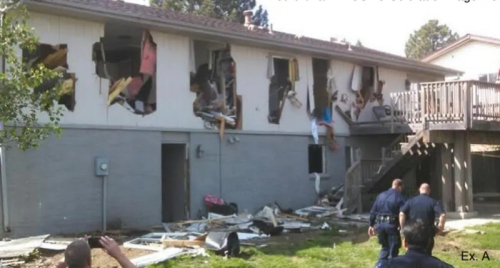
The Supreme Court today declined to review a Tenth Circuit decision that held a municipality could not be liable for a taking when its police officers pretty much destroyed a house in the course of dislodging a suspect who had holed up there. 

Along with our colleague Bill DeVinney, we filed an amicus brief in support of the homeowner, arguing that an invocation of “police power” isn’t the only question in these kind of cases, and the government’s assertion that it destroyed property for a police power purpose is but one of the factors a court considers when an owner asserts the destruction resulted in a taking. Police power may be a compelling factor militating against compensation. But it should never be the sole factor, as the Tenth Circuit concluded.

We had hoped that the Court would take notice of this case because after after the petition was filed, the

Continue Reading Cert Denied In Police Power Takings Case (Lech v. Greenwood Village)

Timothy Harris (Seattle U.) has posted his forthcoming article (Loyola L.A. L. Rev.) about takings and coronavirus shut downs. Well worth a read, and adds to the growing list of scholarly inquiry into the question, which includes Prof. Shai Stern’s “Pandemic Takings: Compensating for Public Health Emergency Regulation,” and our own “Evaluating Emergency Takings: Flattening The Economic Curve.

Here’s the abstract of Prof. Harris’ article:

The 2020 Coronavirus Pandemic and the ensuing shutdown of private businesses — to promote the public’s health and safety — demonstrated the wide reach of state and local governments’ police power. Many businesses closed and many went bankrupt as various government programs failed to keep their enterprises afloat.

These businesses were shut down to further the national interest in stemming a global pandemic. This is an archetypal example of regulating for the public health – preventing a direct threat that sickened

Continue Reading New Article: “The Coronavirus Pandemic Shutdown and Distributive Justice: Why Courts Should Refocus the Fifth Amendment Takings Analysis”

Here’s the latest in the remaining federal court challenge to Hawaii Governor David Ige’s coronavirus-related series of orders which, among other things, suspended a wide range of statutes, ordered activities deemed “nonessential” to stop or be limited, imposed a two-week self-quarantine on interisland, mainland, and international travelers, effectively shut down one of the main engines of the Hawaii economy—tourism, and compelled most residents to remain at home as much as possible and avoid large indoor gatherings.

The plaintiffs sought a temporary restraining order, and the court scheduled a hearing for Thursday, July 2, 2020. Apparently, the hearing was originally planned to be “virtual,” with the lawyers and parties participating by Zoom, while the public could listen in (audio only) via telephone.

But then yesterday, the Hawaii Attorney General asked the court for “an adjustment to the format” of the hearing, to allow the AG to appear in person. The

Continue Reading Hawaii AG: For The Hearing At Which I Will Argue That Indoor In-Person Gatherings Are Dangerous, Let’s Gather Indoors In-Person!

A private pipeline company obtained a certificate of public convenience from FERC. Under the Natural Gas Act, FERC may issue such certificates conditioned on the applicant meeting the Clean Water Act’s requirement of obtaining state environmental check off on the project. The pipeline needed an easement across Schuecker’s land, and began the condemnation process under New York law. It attached to its condemnation petition the conditional FERC certificate. 

Schuecker objected, asserting that the FERC certificate was no good, because the pipeline had not met the condition: it had not certified to FERC that it had received all state approvals (as required by the federal Natural Gas Act). Indeed, the New York Department of Environmental Conservation had denied the pipeline’s water quality certification. The pipeline responded that it was seeking reconsideration with FERC, and that the NYDEC could not deny water quality certification because it was too late to do so.

Continue Reading NY Takes Eminent Domain Law From Worse To Worse* – Conditional FERC Certificate Only Prohibits Construction, Not Eminent Domain

Here’s the recording of our webinar from earlier this week, in which we and fellow Honolulu lawyer Jeff Portnoy did our best to address some of the many questions that have arisen during the coronavirus shut-down.

Jeffrey Portnoy and Robert Thomas talked about what we can expect as the state and counties slowly lift their seemingly endless stay-at-home orders, which have discriminated between “essential” and “nonessential” workers, mandated “social distancing” and mask-wearing, and imposed 14-day quarantines on arriving airport passengers, both tourists and residents returning home.

During the hourlong event, Portnoy and Thomas considered whether businesses destroyed or devastated by the lockdowns have any legal recourse, and whether proposals being suggested to revive Hawaii’s devastated tourism industry, such as replacing the 14-day quarantines with various forms of testing and tracking, might violate constitutional privacy protections.

We’ve written up two articles with our thoughts on these issues:

The first

Continue Reading Video: “Lockdown, Testing and Tracking: Are They Really Legal?” (A Look At Hawaii’s COVID Response)

Important developments in the two lawsuits that are on file challenging Hawaii Governor David Ige’s emergency proclamation and myriad supplemental proclamations.

First, we were all set to post the briefs and summarize the arguments for tomorrow’s scheduled U.S. District Court hearing on a motion for preliminary injunction in the first case when earlier today, the plaintiffs in that case voluntarily dismissed the lawsuit without prejudice. As a result, the court vacated tomorrow’s scheduled hearing and ordered the case closed:

EO: In light of Plaintiffs’ Notice of Dismissal, Dkt. No. 26, the Court vacates the briefing requirements set forth in Dkt. No. 24 with respect to Defendants’ Motion to Consolidate (Dkt. No. 22), and vacates the June 26, 2020 hearing on Plaintiffs’ Motion for Preliminary Injunction (Dkt. No. 15). All pending motions are deemed withdrawn and/or moot, and the Clerk is directed to close this case. (JUDGE DERRICK K. WATSON)(tyk) (Entered:

Continue Reading One Left: Lawsuit Challenging Hawaii Gov’s COVID Orders Voluntarily Dismissed … And Other Developments

We’ve posted a lot of complaints lately (the lawsuit kind, not the “can I see the manager” kind), mostly coronavirus-related. All involving in one way or another a takings claim. See here, here, here, here, here, here, here, here, here, here, here, here and here, for a sampling.

This latest complaint does not challenge a government’s response to COVID, but instead might be even more “ripped from the headlines.” Read on!

As you may be aware, a neighborhood in Seattle, Washington has been blocked off and declared a no-go zone for certain folks. Most recently labeled “CHOP” (Capitol Hill Occupying Protest) after the first naming action went badly and someone realized that the acronym for “Capitol Hill Autonomous Zone” was CHAZ, “[p]eople can now freely walk in the area, which has been covered

Continue Reading Complaint: City’s Abandonment Of CHOP/CHAZ Neighborhood Is A Taking

Yesterday, in the second of two cases that we’ve been following (both of which are in the U.S. District Court for the District of Hawaii, and are challenging the Hawaii Governor’s coronavirus-related shutdown orders for a variety of reasons, see For Our Rights v. Ige (assigned to Judge Watson) and Carmichael v. Ige (assigned to Judge Otake)), the United States (via the U.S. Attorney and the Department of Justice) filed a Statement of Interest, arguing the shut-down orders violate the Privileges and Immunities Clause of the Constitution (article IV, section 2). You know, that’s the “and” clause, that doesn’t do much (but it does prohibit discrimination against out-of-state residents).

The Statement asserts that the Governor’s two-week self-quarantine requirement, which is imposed on all inbound travelers regardless of residency is “effective[ly] discriminati[on]” against nonresidents because yes, both tourists, nonresidents, and returning residents must shut themselves in after arrival, but

Continue Reading Federal Court To USA In Hawaii Quarantine Challenge: Explain Why You Filed P&I Right To Travel Amicus, When Plaintiffs Didn’t Raise P&I Right To Travel In The Complaint