
2019

We won’t go into the details of the Court of Federal Claims’ opinion and order in In re Upstream Addicks and Barker (Texas) Flood Control Reservoirs, No. 17-9001L (Dec. 17, 2019), since it is 46 single-spaced pages long. You can (and should) read the entire thing. But we shall highlight of a few of the highlights, since this is definitely a case to watch, especially as it progresses to the (inevitable) appeal to the Federal Circuit. 

This is the case in which Texas owners whose property upstream of two government created and maintained dams was intentionally flooded by the Corps of Engineers after Hurricane Harvey sued the feds for just compensation for a taking. The government sought dismissal, but after a 10-day trial, the CFC held the government is “liable for a taking on a flowage easement on the [thirteen test] properties.” Slip op. at 3. 

The court summarized

Continue Reading CFC: “Calculated” Hurricane Harvey Flooding Is A Taking – But Will Decision Survive Federal Circuit Review?

Quick quiz: a taking of private property for a public flood protection property is a “public use,” right?

Yes, but that wasn’t quite what the property owner had a problem with in a recent decision from the North Dakota Supreme Court, City of Fargo v. Wieland, No. 2019-153 (Dec. 12, 2019).

Rather, it was in the way the Resolution of Taking was worded. The owner asserted the wording was too vague, and allowed a “take now, decide what to do with the property later approach” that a California court had rejected in this case (and which a New Jersey court agreed with in this case). The ND court disagreed, concluding that the wording “flood protection project” and “real and meaningful flood protection” to be good enough to give the owner notice of what the condemnor was taking, and why. The court also affirmed that this issue was properly

Continue Reading ND SCT: It’s Enough That The Resolution Of Necessity Described The Public Use As “Flood Protection Project”

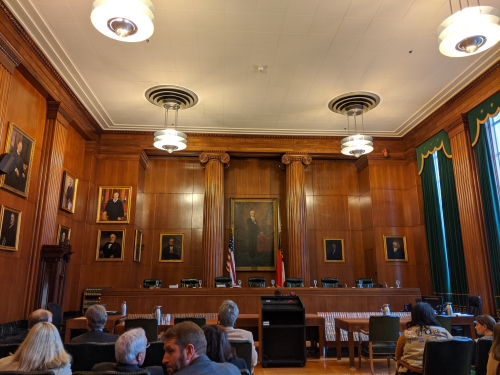
IMG_20191209_091814

This time last week, we were sitting in the North Carolina Supreme Court’s (very beautiful) courtroom, above, having just observed oral arguments in a case we’ve been following for quite a while, Chappell v. NCDOT, No. 51PA19 (docket here). 

This case is the follow up (after remand) of the N.C. Supreme Court’s landmark decision in Kirby v. North Carolina Dep’t of Transportation, No 56PA14-2 (June 10, 2016), in which the court held that the “Map Act,” a statute by which DOT designated vast swaths of property for future highway acquisition, was a taking because the Act prohibited development and use of designated properties in the interim. The court concluded “[t]hese restraints, coupled with their indefinite nature, constitute a taking of plaintiffs’ elemental property rights by eminent domain.” The court remanded the case for a parcel-by-parcel determination of just compensation. On remand, the trial court concluded

Continue Reading NC Supreme Court Considers Just Compensation For Formerly Indefinite–But Now Temporary–“Map Act” Takings
Check out Marianist Province of the United States v. City of Kirkwood, No. 18-3076 (Dec. 13, 2019), for the U.S. Court of Appeals’ handling of RLUIPA and (state law) takings claims stemming from the city not allowing a religious school to light up its baseball field. 

Today’s a busy day, so we won’t delve in detail into the opinion. But nicely, the Eighth Circuit’s website has a summary:

In school’s challenge to city’s zoning regulations in connection with the school’s lighting of its outdoor baseball diamond, the district court did not err in determining that the regulations concerning lighting and sound systems did not substantially burden the school’s religious exercise in violation of RLUIPA; the school’s inability to use its baseball field at night is a mere inconvenience and not a substantial burden because there are alternative times and locations available to it; school’s “as-applied” claim that the school

Continue Reading If You Build It, It Might Be A Zoning Violation: No Taking, No RLUIPA Violation When Zoning Limited Lights On Religious School’s Baseball Field

Here’s the latest opinion about land use from the Hawaii Supreme Court. Unite Here! Local 5 v. Dep’t of Planning & Permitting, No. SCAP-17-823 (Haw. Dec. 13, 2019).  Because our Damon Key partner Greg Kugle was the prevailing lawyer in the case, we won’t go into detail about the opinion, but leave it to you to delve into it.

It is about procedural due process and the opportunity to object in the administrative appeals process, permit conditions, and the like. Land users, check it out. 

Unite Here! Local 5 v. Dep’t of Planning & Permitting, No. SCAP-17-0000823 (Haw. Dec. 13, 2019) 

Continue Reading HAWSCT: When Agency Includes Conditions In Phase 1 Land Use Permit, But Later Removes The Conditions In Phase 2 Permit, Party Who Asked For Conditions Is Entitled To Notification

This one is not in the usual subject area of this blog, but we figured we’re allowed to stray off course a bit every now and then.

Here’s the motion we filed today, asking the Hawaii appellate courts to let us file an amicus brief in a case in which the League of Women Voters and Common Cause Hawaii is challenging the Legislature’s process of “gut-and-replace” whereby a bill that has progressed through one or both houses is gutted at the last minute, and the substance of the bill is wholesale replaced. This, the lawsuit alleged, violates the requirement in the Hawaii Constitution (article III, § 15) that a bill be read three times in each house. 

Here, the State claims that because the title of the bill remained the same “A Bill for an Act Relating to Public Safety,” it didn’t matter that the actual subject of the bill

Continue Reading Amicus Brief: Legislature’s “Gut-And-Replace” Procedure Violates Hawaii Constitution’s Three Readings Requirement

Here’s the latest on the judicial takings/rent control case which we’ve been following

This is the case where New York property owners assert that the N.Y. Court of Appeals’ decision which concluded that the luxury apartments (which were never formerly subject to rent control) are now governed by the Rent Stabilization Law. This, the petition argues, allows tenants (who hardly need the protections of rent control) to renew less-than-market rent in perpetuity. 

Some heavy hitters have weighed in on the side of the Petitioner, including takings maven Richard Epstein, who filed this amicus brief:

But another way of thinking about this case is to focus less on Petitioner’s property right in the physical building and more on its interest in the public benefits conferred under the RPTL and RSL—namely, Section 421-g benefits and luxury decontrol. New York law recognizes a “vested” property right in a public benefit

Continue Reading Takings Maven Prof Epstein Weighs In On Latest SCOTUS Judicial Takings Case: Owners Had A “Legitimate Claim Of Entitlement” To Rent Decontrol

Here’s the amicus brief we filed yesterday in a public use case we’ve been following that asks whether pretext and private benefit are irrelevant as long as the condemnor invokes a “classic” public use. In this case, the Colorado Supreme Court overturned the court of appeals’ conclusion that even though the purported purpose of the taking was to provide future possible public infrastructure, the overwhelming private benefit today meant the taking was not for public use. 

Here’s the cert petition

Southeastern Legal Foundation, Cato Institute, Owners’ Counsel, and NFIB Small Business Legal Center joined in the brief, which argues that the unusual circumstances (an obviously self-interested condemnor) lead to a reasonable suspicion that “a private purpose is afoot” (as Kelo put it), and thus the usual presumption of conceivable basis review is not warranted, and indeed, the courts should look at these type of takings with a particularly skeptical

Continue Reading New SCOTUS Amici Brief: Invoking A “Classic” Public Use Isn’t Enough When The Circumstances Reveal “A Private Purpose May Be Afoot”

Here’s one where you have to stop and pause and ask “why?” Because most of the time, you’d think that an offer to the property owner made by DOT that included more compensation than DOT’s own appraisal recognized would be a good thing.

Apparently not here: DOT’s appraiser opined that the owner incurred no severance damages from the partial take, and therefore did not include any in the appraisal. His letter appraised compensation for the property taken at $79k. But DOT offered the owner more, a total of $133k. Its initial offer identified $79k for the land, about $1k for “easement rights,” and the balance for “loss of various site improvements” (as the court phrased it. But “[n]otably, the initial offer letter did not identify severance damages as a line item for compensation.” 

When the parties could not agree on a voluntary acquisition, and in anticipation of condemnation, DOT went back

Continue Reading Owner Objects To Being Offered *More* Compensation: DOT’s Offer Invalid Because It Included Severance Damages The Appraisal Omitted