June 2019

Eminent domain lawyers know that even though the U.S. Supreme Court ruled against the property owner in Kelo, it acknowledged that there was a (slight?) hope in some cases where the condemnor’s stated public use or purposes is actually “pretext” to private benefit.

Pretext may be present in at least three situations: (1) when eminent domain is used to transfer the private property of one party to another private party where the magnitude of public benefits outweighs the private benefit; (2) when eminent domain is used for a one-to-one transfer of private property without a comprehensive, integrated, and carefully considered development plan; and (3) where a particular private party is identified before the taking. See Kelo v. City of New London, 545 U.S. 469, 478 & n.6 (2005). 

But in the 15 years since Kelo, the Court has never agreed to take up the question of how a property

Continue Reading Why Eminent Domain Lawyers Should Read The Supreme Court’s Census Case

Legalalertknick

We’ve already set out our general thoughts about the Supreme Court’s decision in Knick v. Township of Scott in a series of posts on the case. But we haven’t yet noted what the case might mean on the ground in Hawaii, our home turf. 

In a client alert we did: Hawaii’s property owners now have many more options for fighting back against oppressive government regulation of property than they did last week: 

  • You can go straight to federal court to claim that a county ordinance or regulation has violated your Fifth Amendment rights, if the regulation allows the public to enter your land, or severely restricts your uses of your property. You no longer need to go to state court at all. You still may choose to do so—and there may be good reasons why you may want to consider state court—but you cannot be forced to.
  • There may


Continue Reading What The US Supreme Court’s Property Rights Decision Means For Hawaii’s Property Owners

Here’s the recording of last week’s Federalist Society teleforum on the issue “Is ‘Possess Now, Pay Later’ Constitutional in Private Pipeline Takings?” 
 
Stream it or download it here:
 

Here’s the summary of the podcast:

The U.S. Supreme Court will soon consider the third of several petitions for certiorari asking it to review a question which has split the lower federal courts: whether district courts have the power under the Federal Rules of Civil Procedure to issue preliminary injunctions in takings under the Natural Gas Act which allow private pipeline condemnors to obtain immediate possession of property, even though Congress has withheld the federal “quick take” power in the NGA.

The Third, Fourth, Ninth, and Eleventh Circuits have concluded that simply because Congress did not delegate to private pipeline condemnors the quick take authority—the power to obtain immediate title and possession of condemned property upon a deposit

Continue Reading Podcast Now Available: Is “Possess Now, Pay Later” Constitutional in Private Pipeline Takings?

Here’s the cert petition in a case we’ve been following. 

In Guerin v. Fowler, 899 F,3d 1112 (9th Cir. 2018), a three-judge panel of the Ninth Circuit held that Washington state officials’ failure to return daily interest that was allegedly skimmed from the plaintiffs’ state-managed retirement accounts could be a taking. 

The panel rejected the State’s argument that because the Washington Court of Appeals held that Washington’s retirement statute didn’t require the payment of daily interest at all, the plaintiffs didn’t have “property” the state officials took when they kept the interest. If it isn’t “property” under state law, the State asserted, it isn’t “property” for purposes of the Takings Clause.

Not quite, the court concluded. Daily interest on principal is one of those “core” and “traditional” property rights that a state simply cannot disavow. In short, while state law usually defines property, there are certain sticks that transcend

Continue Reading New Takings Cert Petition – State Of Washington: There Isn’t A Property Right To Daily Interest If We Say There Isn’t One

Restatement cover page

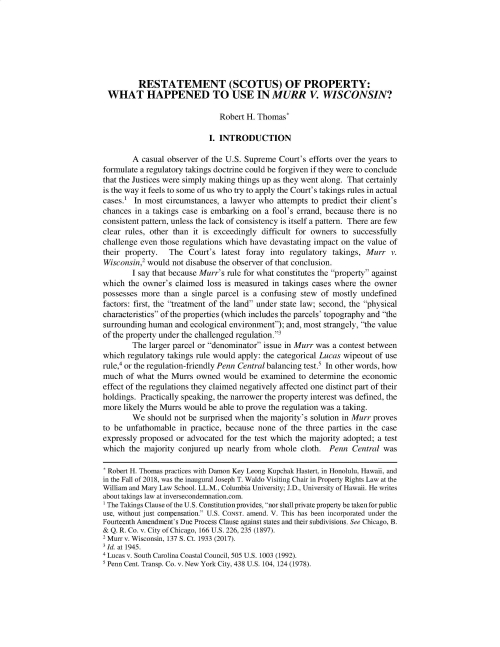
Here’s the article, recently published in the UMKC Law Review with thoughts on Murr v. Wisconsin, the case about the “denominator” issue in regulatory takings cases.

We won’t get into it in detail (if you are interested, you can read the article yourself), except to say that therein we offer views of what test the Court should have adopted to analyze whether the Murr family’s two parcels should be considered as one parcel for purposes of whether they were denied productive use of their property by Wisconsin’s environmental regulations. As you recall the Justice Kennedy authored Murr majority adopted a test with a mishmash of factors (what we waggishly labeled his “social justice warrior” test). The article argues that the Court should have instead applied the old “three unities” test from larger parcel questions in eminent domain. That test focuses on the owner’s joint use of the property. 

Continue Reading New Article: Restatement (SCOTUS) of Property – What Happened to Use in Murr v. Wisconsin?

20170918_171025_Richtone(HDR)

Yes, this is detail from the Supreme Court’s front door.

This is the first in what will be a short series of five posts with thoughts on the landmark decision in Knick. In this installment, a crash course in the extensive doctrinal background necessary to understand why the Knick Court did what it did. Here are the related posts:

* * * *

The opinions in last week’s ruling by a sharply-divided Supreme Court, Knick v. Township of Scott, No. 17-647 (June 21, 2019) employed a lot of very evocative language: “aborning,” “Catch-22,” “loot,” “shaky,” “sue me,” “overthrows,” “smashes,” “smithereens” “first crack,” “points for creativity.” But ultimately, the most important

Continue Reading Knick Analysis, Part I: After More Than 30 Years, Supreme Court Reopens The Federal Courthouse Door To Property Owners

This is the second in a series of five posts taking a look at last week’s landmark ruling by a sharply-divided Supreme Court, Knick v. Township of Scott, No. 17-647 (June 21, 2019). Here are the related posts:

In this post, we’ll take a look at the case which finally convinced the Supreme Court that it was time to revisit the Williamson County state-litigation ripeness rule, Knick v. Township of Scott, 862 F.3d 310 (3d Cir. 2017). What we call the Case of the Zombie Zoning Inspectors

* * * *

The Township of Scott, Pennsylvania, apparently

Continue Reading Knick Analysis, Part II: The Court Finds A Vehicle In A Zombie-Zoning Case

IMG_20190621_150358

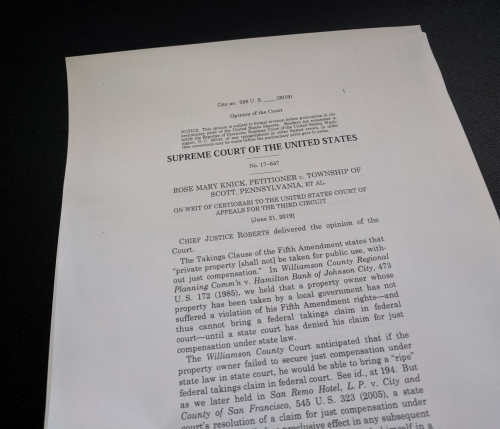
This is the third in a series of five posts taking a look at last week’s landmark ruling by a sharply-divided Supreme Court, Knick v. Township of Scott, No. 17-647 (June 21, 2019). Here are the related posts:

In this post, we’ll take a deeper dive into the three opinions: Chief Justice Roberts for the five-Justice majority (Roberts, Thomas, Alito, Gorsuch, Kavanagh), Justice Thomas’ short stand-alone concurring opinion, and Justice Kagan’s dissent (joined by Justices Ginsburg, Breyer, Sotomayor, and Kagan).  

* * * *

BLUFs

Here are the bottom lines up front, the lenses though which we think you should read each of

Continue Reading Knick Analysis, Part III: What It Means To “Take” Property Without Just Compensation – “A bank robber might give the loot back, but he still robbed the bank.”

Ill_be_back

This is the fourth in our series of five posts with thoughts on the landmark decision in Knick. In this installment, the dissent. Related posts:

* * * *

We cannot mask our disappointment with the dissenting opinion. We usually appreciate Justice Kagan’s opinions and measured approach, even while dissenting. And after the first oral arguments in October, we thought there was a chance, albeit slim, that she might see things Ms. Knick’s way.

But even though we were pretty sure she would rule for the government, we didn’t anticipate as vehement a defense of Williamson County‘s “no violation until you sue the government for

Continue Reading Knick Analysis, Part IV: Why Not Let Sleeping Dogs Lie? The Dissent And Stare Decisis

One does knick meme

This is the fifth and last in our series of posts with thoughts on the landmark decision in Knick. In this post, we’ll be puling out our crystal balls, and doing a bit of forecasting. Here are the related posts:

 * * * *

The execrable state-litigation ripeness requirement is overruled. Ding-dong, the wicked witch is dead. No longer will our only federal review of a federal constitutional issue be limited to petitions for cert at SCOTUS. We can “simply” go to federal court. 

So now what?

Continue Reading Knick Analysis, Part V: What’s Next?