April 2019

The Arizona Corporations Commission has authority to regulate the sale, lease, assigning, mortgage of a public utility’s assets, including when those assets are “otherwise dispose[d] of.” These transactions need the Commission’s approval. 

The city intended to exercise eminent domain to take the assets of a water utility. This sure looked like a “friendly” condemnation: the city and the utility entered into a letter of intent “documenting the City’s intent to condemn substantially all the assets” of the utility, and “negotiations between the City and [the utility] were intended to result in condemnation, not a sale.”

But the city and the utility did not seek Commission approval. A developer objected, asserting the municipality’s condemnation of the utility was covered by the “otherwise dispose of” language. The Commission agreed, concluding that it could regulate the condemnation, and ordered it to be halted until the Commission approved it. 

In City of Surprise v. Arizona

Continue Reading Arizona: Eminent Domain Isn’t Voluntary (Even A “Friendly” Condemnation)

We’re not quite sure what to make of this story (“The Raisin Situation“) in the New York Times, about the situation in Fresno, California, after the Horne case. You remember that one, don’t you? All about whether USDA’s seizure of raisins in order to maintain the price was a taking. 

The piece tackles a serious subject, the dwindling raisin market and the problems that have reverberated in Fresno (the raisin capital of the world), but like many stories about the raisin industry — Comedy Central did a report in which it described SCOTUS petitioner Marvin Horne as a “modern day Jesse James,” for example — this one is done in a tongue-in-cheek fashion (it appears in the “Style” section of the Times).

It reminds us of the 1980’s satirical miniseries “Fresno,” a comedic take on then then-popular nighttime soaps Dallas and Dynasty. 

But

Continue Reading The “2015 Supreme Court case that nearly leveled Fresno” – The Raisin Industry, Post-Horne

Nothing really can be done: the harsh reality is that CAFO’s (concentrated animal feeding operations) stink. But many state legislatures have concluded that farming and ranching are so important that the consequences (“externalities”) that naturally occur have to be accepted.

Right to Farm Acts, Indiana’s included, generally deprive neighboring property owners of their common law tort nuisance claims for the smell and noise, and other effects of having a nearby agricultural operation, often subject to certain conditions. One Indiana court summed up Right to Farm Acts as well as anyone when it noted, “so long as the human race consumes pork, someone must tolerate the smell.” Shatto v. McNulty, 509 N.E.2d 897, 900 (Ind. App. 1987). 

In Himsel v. Himsel, No. 18A-PL-645 (Apr. 22, 2019), that same court has now concluded that depriving neighboring landowners of their nuisance tort claims is not a taking. The opinion

Continue Reading Indiana’s Right To Farm Act Isn’t A Taking

Thanks to Professor Michael Wara’s Twitter feed, here is what might possibly be the first and only example of a comic strip devoted to inverse condemnation.

Yes, it is on an advocacy site (the International Brotherhood of Electrical Workers Local 1245), and it doesn’t really go into the details of the doctrine, but come on, what did you expect? Just sit back and enjoy.

Continue Reading California Inverse Condemnation And Wildfires: The Comic

Here’s the Brief in Opposition, in Like v. Transcontinental Gas Pipe Line Co., LLC, No. 18-1206 (Apr. 17, 2019), the case which we’ve been following (and in which we filed this amici brief). 

This is the case in which landowners are challenging the district court’s issuance of an injunction in a Natural Gas Act taking which allow a private condemnor to obtain immediate possession of the land being condemned even though the Natural Gas Act does not delegate to pipeline condemnors the quick-take power.

Here’s the Question Presented as framed by the pipeline: 

Whether the decision of the court below affirming the issuance of an injunction granting possession of specific rights of way on each of the Petitioners’ properties by the district court under the Natural Gas Act, after a two day hearing, and after the district court granted partial summary judgment and determined that Transco had

Continue Reading BIO In “Take-First-Pay-Later” Natural Gas Act Condemnation

0412191003c_HDR

Here are the links from today’s two sessions (the first, federal water issues impacting local land use; the second, Bringing and Defending a Takings Case):

The morning started off with a talk by former Detroit Mayor (and Michigan Supreme Court justice) Dennis Archer, about Poletown, eminent domain, and economic

Continue Reading Links And Materials From Today’s Land Use Institute Sessions, Baltimore

Here’s the amici brief of the Owners’ Counsel of AmericaNew Jersey, Virginia, and West Virginia property owners; Cato Institute, and NFIB Small Business Legal Center which urges the Supreme Court to grant cert in a case we’ve been following for a while.  

As regular readers understand, several federal courts of appeals recently have upheld giving prejudgment possession of property to a private pipeline condemnor once a district has ruled in favor of the pipeline that it qualifies under the three predicates in 15 U.S.C. § 717f(h). These courts conclude that summary judgment grants a pipeline a “substantive” right, and therefore there’s no reason to not give it possession now by granting a Rule 65 injunction. 

But a close read of the language of section 717f(h) shows it is only about whether a private pipeline company may institute an eminent domain lawsuit to take property. In

Continue Reading New SCOTUS Amici Brief In Pipeline Case: Courts Keep Using “Order of Condemnation.” We Do Not Think It Means What They Think It Means

We recommend you pick up the opinion of Maine’s Supreme Judicial Court in Ross v. Acadian Seaplants, Ltd., No. Was-17-142 (Mar. 28, 2019), because it deals with property rights in an area subject to the public trust. We think the court did a pretty good job of setting out the competing claims and the background of the oft-misunderstood public trust doctrine. 

The issue was whether the public (in this instance, Acadian Seaplants) has the right under the jus publicum to harvest living rockweed, a seaweed which anchors itself to “the rocky ledges that accent [Maine]’s coastline.” Slip op. at 1.

Specifically, we are asked to determine whether rockweed is private property that belongs to the adjoining upland landowner who owns the intertidal soil in fee simple, or property that is held in trust by the State through the jus publicum for the public to harvest.

Id.

Continue Reading The Ocean May Be Subject To The Public Trust, But Private Owners Own The Seaweed

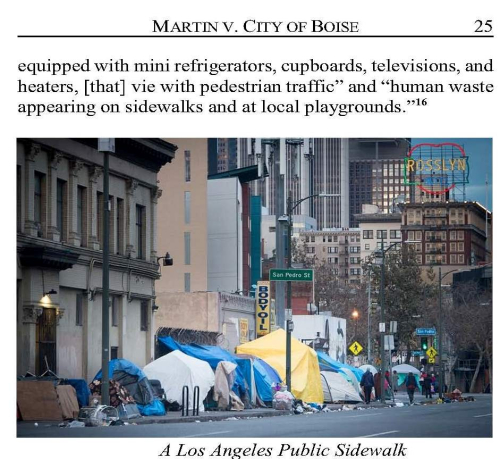
Photoskidrow

As we’ve noted before, the growing homeless and “urban camping” situation seems to be getting worse, and in our perception is reaching the point of being intractable. A trip down the sidewalk of any major city  — if you dare, particularly in the west — will confirm. And there are no easy answers, except maybe “get used to living with it.” Nor is there a consensus whether the law can do anything to remedy the problem.  

The Ninth Circuit’s latest foray into this area, this order denying rehearing and rehearing en banc of a panel opinion in a case out of Idaho, confirms. The case is a challenge to Boise’s ordinance under the Eighth Amendment’s prohibition on cruel and unusual punishments. The panel concluded that the city could not prosecute people for sleeping outside on public property because they have nowhere else to go. Until the

Continue Reading Ninth Circuit: Local Governments Cannot Enforce 24/7 Ban On Sleeping Or Camping On The Sidewalk If Nowhere Else To Go