February 2019

Later today (starting at 1pm ET), our colleague Edward Thomas is chairing an ABA-produced webinar on “Low Income Populations: Underrepresented Socially, Overrepresented as Victims of Natural Disasters: Using the Law to Solve a Serious Problem.”

As in other areas of life, when natural disasters strike, it is often the owners of modest means who are the hardest hit. Floods, wildfires, sea level rise, you name it. And Ed has been there: he’s a former FEMA guy, and currently the President of the Natural Hazard Mitigation Association who understands that property rights have to be respected in these situations. 
Find out more information about the program and register hereContinue Reading Webinar Today – Low Income Populations: Underrepresented Socially, Overrepresented as Victims of Natural Disasters

IMG_20180720_151841

Rather than sum up the issue and the Massachusetts Appeals Court’s** conclusion in Smyth v. Conservation Comm’n of Falmouth, No. 17-P-1189 (Feb. 19, 2019), here’s the first part of the opinion:

GREEN, C.J. A land owner brought this action in the Superior Court, claiming that local land use regulation effected a taking of her property, requiring just compensation under the Fifth Amendment to the United States Constitution and art. 10 of the Massachusetts Declaration of Rights. This appeal presents a question of first impression in Massachusetts: whether the land owner is entitled to have her regulatory taking claim decided by a jury. We conclude that the jury right does not attach to such a claim, and that the judge erred in denying the defendants’ motion to submit only the question of damages to a jury. We further conclude that the evidence presented at the trial did not, as matter

Continue Reading Mass App: Regulatory Takings Claims Don’t Get A Jury Trial

If you can make sense of the Montana Supreme Court’s analysis in Letica Land Co. v. Anaconda-Deer Lodge County, No. DA 18-0249 (Feb. 5, 2019), we are all ears, because we sure cannot.

The court concluded that the county’s actions in furtherance of its claim to own a road located on Letica’s property — including removing a dirt berm and encouraging the public to use the road — could not be a taking, only a tort. 

The county’s defense to the takings claim was “that a temporary physical invasion was done under claim of right and therefore did not amount to a taking of Letica’s private property.” Slip op. at 4-5.

The court agreed, relying on Langford v. United States, 101 U.S. 341 (1880) for the proposition that “if the government mistakenly asserts the right to use its own property, and the property in fact belongs to another

Continue Reading Say What? Gov’t Occupying Property Under Claim Of Right Is Only A Tort, Not A Taking

The South Carolina Constitution, like the Fifth Amendment and just about every other state constitution, prohibits takings of “private property” without just compensation. See S.C. Const. art. I, § 13(A).

But does that govern the situation where the owner of the property allegedly taken by a city and the State DOT by creating sinkholes is a county? In other words, is property owned by a county “private” property? (We’ve been down this road before, as noted in this post.)

In Georgetown County v. Davis & Floyd, Inc., No. 5627 (Feb. 13, 2019), the South Carolina Court of Appeals answered no. There, the County asserted an inverse condemnation claim against the City of Georgetown and SCDOT, alleging that “while engaged in a joint water drainage project, [they] altered the water table, causing sinkholes to form and damaging public buildings and real property owned by the County.” Slip

Continue Reading SC App: County-Owned Property Isn’t “Private Property,” So No Inverse Claim Against State DOT

17CA0595-PD

Here’s the latest in a case we’ve been following, involving what Colorado calls “bad faith” condemnations. 

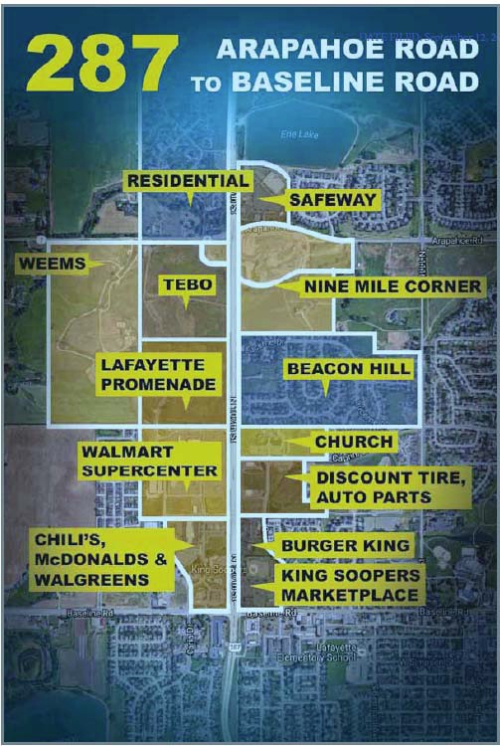
In this order, the Colorado Supreme Court has declined to review the Court of Appeals’ conclusion that a taking ostensibly to preserve open space and a buffer zone between two municipalities, was an invalid exercise of the eminent domain power because the true reason for the taking was to prevent the condemnee-municipality from luring a big-box retailer, King Sooper, to its territory and away from the condemnor’s. 

So even though the case has ended with a whimper and not a bang, this does mean that the Court of Appeals’ hard look at the actual motives of the condemnor — and not merely its stated purpose — is the way to do things. The court examined the factual record, and not just the stated reasons for the taking, and tested whether the condemnor’s

Continue Reading Colorado Supreme Court Denies Cert In “Improper Motive” Condemnation

SJEBKannouncement

Be sure to save the date on your calendar for the 16th Annual Brigham-Kanner Property Rights Conference, at the William and Mary Law School in Williamsburg, Virginia.

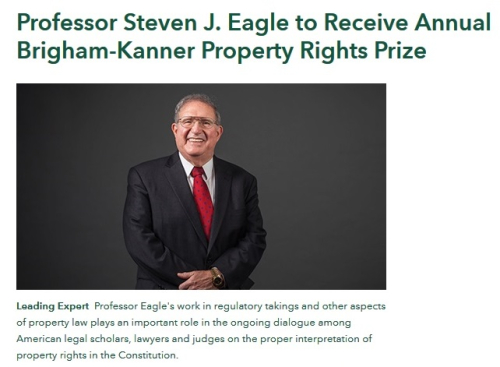
This year’s B-K Prize will be awarded to Professor Steven J. Eagle. Professor Eagle is a familiar presence to the property bar and the academy, and this award is well-earned. His treatise, Regulatory Takings, is a monumental work, and a book that needs to be on every property lawyer’s and scholar’s shelf. As the media release notes:

Michael M. Berger, an attorney at Manatt, Phelps & Phillips and the 2014 Brigham-Kanner Prize recipient, considers Eagle one of the finest property scholars of his generation.

“[Eagle] has devoted much of his life and his prodigious energy toward analyzing the constitutional nuances embedded in real estate law,” Berger said. “His deeply thought out analyses provide major contributions to the body of law examining and

Continue Reading Mark Your Calendars: October 3-4, 2019 – Brigham-Kanner Property Rights Conference And Prize Award To Prof Steven Eagle

JD Morris has the story at the San Francisco Chronicle, “California’s strict wildfire liability rule hangs over bankrupt PG&E.”

The story is about inverse condemnation of course, and how California law applies that doctrine in cases involving what look like natural disasters, most notably the state’s recent experiences with major wildfires.

We provided comments on whether an insurance fund might make some sense (because isn’t the mail goal of inverse liability to spread the economic burden of public benefits?). And the story also picks up on the recent 2-1 Ninth Circuit decision on how inverse claims which have not been reduced to judgment get treated in bankruptcy

The wildfire fund alternative Paulo identified could be evaluated by a new committee focused on wildfires and utilities that was authorized by Dodd’s bill, SB901. Gov. Gavin Newsom appointed his three members to the committee just last

Continue Reading SF Chronicle: “California’s strict wildfire liability rule hangs over bankrupt PG&E”

In the usual circumstance, we wouldn’t be terribly interested in an unpublished — and therefore not precedental — opinion. But the U.S. Court of Appeals’ opinion in Kerns v. Chesapeake Exploration, LLC, No. 18-3636 (Feb. 4, 2019) caught our attention because it involves “forced pooling,” which this site describes this way:

At its most basic, pooling is the joining together or combination of small tracts or portions of tracts to create sufficient acreage to receive a drilling permit under applicable state spacing rules and regulations, and for the purpose of sharing the production from the pooled unit among the pooled interest owners.

Often, pooling is done voluntarily. That is, interest owners agree to the benefits of the combined acreage. Most oil and gas leases contain provisions allowing the lessee to pool the acreage covered by the lease; sometimes this right is virtually unlimited.

At times, however, there are unleased

Continue Reading 6th Cir (unpub): “Forced Pooling” – Requiring Holdouts To Participate In Fracking – Isn’t A Taking

We suppose we should not be too surprised by the U.S. Court of Appeals for the Fourth Circuit’s panel opinion in Mountain Valley Pipeline, LLC v. 6-56 Acres, No. 18-1159 (Feb. 5, 2019), which concluded, like the Third, Sixth, and Eleventh Circuits did recently, that a private condemnor may obtain immediate possession of property that it may condemn, even though Congress did not delegate the quick take power to those private condemnors in the Natural Gas Act.

After oral argument, we had a faint hope that the panel might see things differently. See4th Cir Judge In Pipeline Arguments: “Condemnation is one of those monarchy things” – Is Immediate Possession Unconstitutional When Congress Has Not Delegated That Power To A Pipeline?

But alas no, it was not to be. All three judges concluded that this case is “on all fours” with the Fourth Circuit’s earlier

Continue Reading Fourth Circuit Panel Sticks With Sage: Natural Gas Act Condemnor Given Immediate Possession Even Though No Grant Of Quick Take Power In The Statute

A short update from the west coast: the California Supreme Court late last week denied discretionary review in the case in which a California utility was arguing that it cannot be liable under that state’s version of inverse condemnation because the utility, unlike a governmental entity, cannot automatically spread the cost of any judgment to all members of its constituency.

We posted the utility’s petition here (“Electric Company: We Can’t Be Liable For Inverse Condemnation For Cal Wildfires Unless We Can ‘Unilaterally Recoup Costs From The Benefited Public Through Taxation Or Rate Increases‘”).

There are other cases raising the same issue coming up the pipeline, so stay tuned for more. Continue Reading Cal Supreme Court Denies Review Of Wildfire Inverse Petition