October 2018

20181004_152311_HDR

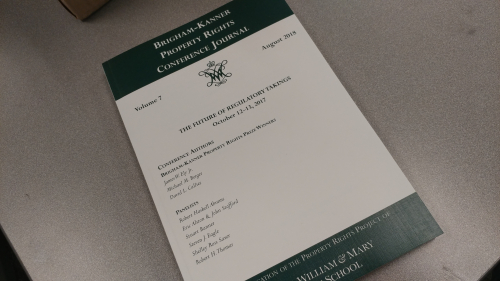
Every year, at the Brigham-Kanner Property Rights Conference, the conference publishes a law journal with the articles, essays, and remarks presented at last year’s conference. So it was this year, and Volume 7, with the theme of “The Future of Regulatory Takings,” is now available

We contributed an essay, “Back to the Future of Land Use Regulation,” which focuses on the rational basis test in land use law — where it came from and where it might be going — as well as some other current issues in property law such as the recent trend of raising general environmental concerns as property claims. Check it out if you are so inclined. 
Here’s the Introduction:

As always, I bring you greetings from the land of Midkiff, the land of Kaiser Aetna. The jurisdiction in which the legislature thought it was a good idea to try and

Continue Reading New Article: Back to the Future of Land Use Regulation – From Hadacheck To “New” Property

Pipelines are a hot topic. So much so that we’re devoting a couple of sessions at the upcoming ALI-CLE Eminent Domain and Land Valuation Litigation Conference to the subject (“Where You Haven’t Gone Before: New Approaches to Challenging the Take,” and “Compensation Pitfalls: How to Avoid Problems,” for example). 

And, with this recently-filed cert petition in a case we’ve been following, the issue just got hotter. 

In Berkley v. FERC, the U.S. Court of Appeals for the Fourth Circuit held that the federal Natural Gas Act allows the Federal Energy Regulatory Commission to delegate eminent domain authority to Mountain Valley, and that any challenges to that authority must be done via the NGA’s administrative review process.

We predicted a cert petition because it didn’t seem that the constitutional question of whether a taking is for public use could be relegated for resolution to the administrative

Continue Reading New Cert Petition: Can Congress Delegate To An Executive Agency Appeals Process The Power To Decide Whether A Taking Violates The Public Use Clause?

MRGO

Here’s the amici brief filed late last week on behalf of a lot of us (me included, check it out) in the MR-GO case we’ve been following closely ever since it was filed in the Court of Federal Claims.

That court concluded the Corps of Engineers built MR-GO (the Mississippi River-Gulf Outlet) shipping channel, essentially a shortcut to New Orleans from the Gulf of Mexico, but then, despite its own knowledge that its lack of channel maintenance over the years would amplify the “hurricane attack” (the Corps’ words, not ours) when the next big one hit, the Corps did not respond. Well, as we all know, Katrina smashed the Gulf Coast in 2005, and sure enough, MR-GO was like a hurricane bowling alley, allowing the storm surge to barrel up the channel, amplifying its effect. New Orleans’ Ninth Ward and St. Bernard Parish were the pins at the end of

Continue Reading Amici Brief: There’s No “Direct” vs. “Indirect,” Action vs. Inaction Distinction In Takings

What, you may ask, does the challenge by Hawaii’s counties to the proposed constitutional amendment which was on the ballot (until just a few minutes ago) have to do with the usual topics of this blog?

Not a whole lot (although we do cover property tax and election law issues occasionally), but as always, there’s a takings hook. Read to the end. 

The ballot measure proposed to amend the Hawaii Constitution’s property tax provision (article VIII) which currently delegates to the counties the exclusive power to levy property taxes. The measure, proposed by the legislature read:

Shall the legislature be authorized to establish, as provided by law, a surcharge on investment real property to be used to support public education? 

The counties, offended that the State would horn in on their property tax monopoly, challenged the ballot question as misleading. This would be a dilution of the counties’ property taxation power, not

Continue Reading HAWSCT Removes Property Tax … Oops, “Surcharge on Investment Real Property” – Measure From The Ballot

Here’s a case about eminent domain and pipelines, but which focuses more on the court’s jurisdiction than on the eminent domain aspects.

In Ameren Transmission Co. of Illinois v. Hutchings, No. 122973 (Oct. 18, 2018), the Illinois Supreme Court held that Illinois circuit courts — that state’s courts of general jurisdiction — do not have jurisdiction to consider property owners’ procedural due process defenses in an eminent domain action. Instead, if they had earlier challenged the certificate of public convenience in administrative proceedings and raised the due process argument there, their only avenue of judicial review was in the Illinois court of appeals. 

Here’s the short story: Ameren filed eminent domain actions in Illinois circuit court to condemn rights of way for an energy line. As a precursor to that, Ameren sought certificates of public convenience from the Illinois Commerce Commission. The Commission sent notice of the route to

Continue Reading Illinois Trial Courts Can Hear Eminent Domain Cases, But Not Defenses To Eminent Domain Cases

Would you pay, say $10 for an undeveloped Maui beachfront parcel that is zoned for hotel and residential purposes, but currently is not developable because the County in the past wanted to condemn the land and turn it into a public park (but then ran out of money)?

In furtherance of its acquisition plan, the County changed the parcel’s Community Plan (known as a “general plan” in most jurisdictions) designation to “park.” But it never amended the Hotel zoning, which allows lesser intensive uses such as single-family homes. But then the County didn’t have enough money — beachfront property, it turns out, was (and is) a lot more spendy than the government appraisers thought — so it never actually acquired the land. But having downplanned the parcel in order to take it, it never bothered uplanning it when it couldn’t: the County never reverted the CP designation to its former

Continue Reading New Amicus Brief In SCOTUS Hawaii Case: Takings Is About Denial Of *Use* Not Whether Property Has Value

Whatisthis

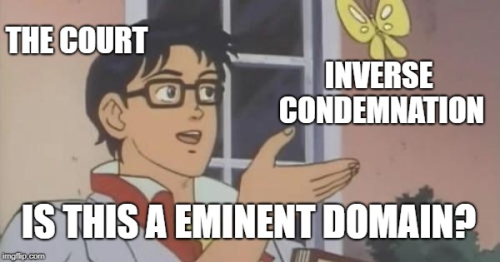
From Reno, Nevada colleague Steve Silva, comes this contribution to our growing collection of Knick/Williamson County-related memes.

Congratulations if you get this without having to do research. If so, you are a True Takings Nerd (and a nerd generally).

For those of you who are not quite getting it, here is the breakdown:


Continue Reading Friday Takings Fun: More Knick Memes

20181002_154246_HDR (1)

Last week, the 15th Annual Brigham-Kanner Property Rights Conference saw the gathering of legal scholars, judges, lawyers, and law students at the William and Mary Law School to award the B-K Property Rights Prize to Cardozo lawprof Stewart Sterk, followed by a day-long conference focusing on Professor Sterk’s work and the latest developments in property rights law.

Professor Sterk joins the pantheon of property law scholars (and a judge and a practitioner) who have been awarded the Prize. Pretty impressive:

WIN_20151002_13_15_51_Pro

As always, the program starts off with a candlelight dinner and award presentation in the historic Wren Building, definitely a highlight of the Conference. More about the Conference here

And there’s nothing like spending the following day addressing some of the most pressing issues in our area, along with the brightest minds in the business (below is the final panel of the day, with Professor John Echeverria

Continue Reading 2018 Brigham-Kanner Property Rights Conference Report: Emerging Issues

IMG_2075

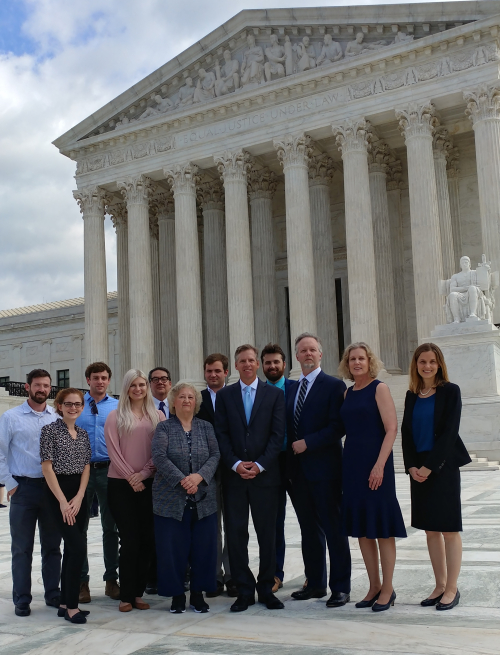
For the six-hour-plus roundtrip from Williamsburg to DC for last week’s SCOTUS oral arguments in Knick v. Township of Scott, the only assignment our class had — the ticket for the van ride, so to speak — was that each student was required to make two contributions to our day’s playlist. Otherwise, we’d be in for long stretches of possibly awkward small talk. 

The first, a good “road” song. Something to drive to. You know those kind of songs.

The second was a slightly tougher assignment: contribute at least one song that is somehow related to the nature of our class (Law 608: Eminent Domain and Property Rights Law). The contribution need not be directly related to our topic in that it was about eminent domain, property rights, takings, or the like. As long as there was some “hook,” and the contributor could make the connection

Continue Reading Law 608’s Infinite Playlist: Takings-Related And Road Trip Songs

20181003_114518_HDR

Seeking A Cause of Action

It has been just under a century since the U.S. Supreme Court first recognized (in the modern era, that is) the regulatory takings doctrine. You might think that the intervening decades would be enough time to allow the Justices, collectively, to have figured out what a cause of action looks like. You know, just enough to get by a motion to dismiss for failure to state a claim under Rule 12(b)(6).

Unfortunately, yesterday’s oral arguments in Knick v. Township of Scott, No. 17-647 (transcript here, and below), would not confirm that belief.

Our major impression from the argument is that no more than three Justices clearly understand the major difference between an affirmative exercise of the eminent domain power to take private property, and an inverse condemnation action in which a property owner asserts that the exercise of a power other than

Continue Reading Oranges And Tangerines – The Difference Between Eminent Domain And Inverse Condemnation: Deconstructing The Knick Oral Arguments