September 2018

Been meaning to post this one for a while, because it’s on a topic that is frequently on the mind of eminent domain lawyers, but isn’t often covered by the courts: liability for inequitable precondemnation activities.

In City of Albuquerque v. SMP Properties, LLC , No. A-1-CA-35261 (Sep. 26, 2018),  the New Mexico Court of Appeals 
City of Albuquerque v. SMP Properties, LLC, No. A-1-CA-35261 (N.M. App. Sep. 26, 2018)

Continue Reading NM App: Inequitable Precondemnation Activities

Louisiana

A very important public use case from the Louisiana Court of Appeals.

In Ryan v. Calcasieu Parish Police Jury, No. 17-00016 (Sep. 27, 2018), the court upheld a preliminary injunction issued by the trial court “barring the [Lake Charles Harbor and Terminal] District from expropriating a tract of [the Meyers’] property in Westlake Louisiana.” Slip op. at 1.

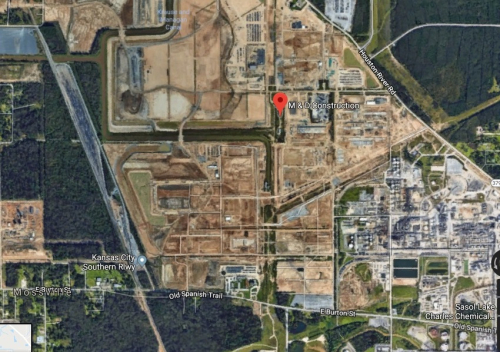
The map above shows the property (M & D Construction), and its proximity to what is known as the “Sasol Megaproject.” Barista’s note: it looks like the P.R. people didn’t get a hand in naming the project – when you name your chemical factory “the Megaproject,” you should probably not be surprised when there’s objection.

Sasol needs/wants Meyer’s five acres, and tried for several years to buy it. No deal. So the District adopted a resolution which provided “certain assurances with respect to the acquisition of the property needed” for the

Continue Reading La App: I Get By With A Little Help From My Friends – When Condemnor Testifies That “were it not for [the benefited private project], the District would not have looked at acquiring,” A Property Owner Can Enjoin A Taking

“Condemnation clauses” — provisions in leases that say if the leased premises is taken, then the lease automatically terminates — are pretty common. They also “codify” the common law, which provided the same thing. These provisions also commonly allocate if and how the lessor and the lessee would divide up any compensation award (often the tenant gets nothing).

The condemnation clause at issue in Utah Dep’t of Transportation v. Kmart Corp., No. 20160653 (Sep. 25, 2018) was just one of these. It provided:

In the event all of Tenant’s buildings constructed by Landlord shall be expropriated or the points of ingress and egress to the public roadways . . . be materially impaired by a public authority or quasi-public authority, this lease shall terminate as of the date Tenant shall be deprived thereof.

Slip op. at 3. Most critically, the clause also noted that the tenant (Kmart) would

Continue Reading Utah: “Condemnation Clause” In Lease Terminated Tenant’s Ability To Be Compensated

Our colleague and co-planning chair Joe Waldo was in town yesterday, so we walked through historic Williamsburg, Virginia (cradle of the Constitution and the Bill of Rights), to invite you to join us for the 36th Annual ALI-CLE Eminent Domain & Land Valuation Litigation Conference (January 24-26, 2019, in Palm Springs, California).

As we wrote in this post, the Conference will feature the nation’s best eminent domain faculty, presenting on the topics we love.

Register now here. Early registration and group discounts available. The 2018 Conference in Charleston sold out, so be sure to sign up now so you don’t miss out. Continue Reading Join Us For The 36th Annual ALI-CLE Eminent Domain & Land Valuation Litigation Conference In Palm Springs (Jan 24-26, 2019)

Here’s the latest in an issue we’ve been following closely. In the Natural Gas Act, Congress has not delegated to private pipeline companies the quick-take power. To get around that, to get immediate possession of properties which they are taking, pipeline companies use a procedural mechanism — a preliminary injunction under Fed. R. Civ. P. 65 — to get the same result. 

A preliminary injunction in these case looks like quick take, quacks like quick take (there’s a deposit, just like in quick take), and walks like quick take (the effect is the same). But it’s not really quick take because Congress has never actually approved of quick take in NGA takings. 

Of course, by the time a court gets to the actual merits of the validity of the taking — if it ever does — the pipeline is in place, and the whole thing a “done deal.” Fait accompli

Continue Reading 4th Cir Judge In Pipeline Arguments: “Condemnation is one of those monarchy things” – Is Immediate Possession Unconstitutional When Congress Has Not Delegated That Power To A Pipeline?

One more lesson on the speed of the interwebs: we were all set to take a deep dive into the California Court of Appeal’s opinion in an inverse condemnation case, Bottini v. City of San Diego, No. D071670 (Sep. 18, 2018), when our colleague Brad Kuhn analyzed the case at his California Eminent Domain Report blog. 

The title of Brad’s post, “Improper CEQA Determination Does Not Trigger Regulatory Taking,” tells you most of what you need to know. The short story is that the City asserted that Bottini’s planned demolition of a beach bungalow as part of a project to build a new house required assessment and analysis under California’s environmental reporting statute, CEQA (California Environmental Quality Act). Bottini disagreed, asserting the demolition was exempt from CEQA, and, by the way, the delay caused by the City’s wrongful assertion of CEQA authority was a temporary taking. 

Continue Reading Cal App: Landgate’s “Substantially Advance” Standard Isn’t The Takings Test (But The Property Owner Still Loses)

BK header

Come join us for one of the best conferences on property rights and property law at the 2018 Brigham-Kanner Property Rights Conference, October 4-5, 2018 at the William and Mary Law School in Williamsburg, Virginia.

Register here

We’ve attended and presented at the Conference in past years, including when it went international in Beijing and at the World Court in The Hague. This year it is back home, and will focus on the work of the 2018 B-K Prize winner, Professor Stewart Sterk of Cardozo Law School

The B-K Prize is awarded to a legal scholar, judge, or practicing lawyer who “has advanced the cause of property rights and has contributed to the overall awareness of the important role property rights occupy in the broader scheme of individual liberty.” The list of past prize winners is a pantheon of property law greats. 

We will be speaking

Continue Reading 2018 Brigham-Kanner Property Rights Conference: Williamsburg, Oct. 4-5, 2018

An interesting and thought-provoking new article from Professor Donald Kochan that is definitely worth your time: The [Takings] Keepings Clause: An Analysis of Framing Effects from Labeling Constitutional Rights, 45 Fla. State U. L. Rev. ___ (forthcoming 2018). 

As the title suggests, Professor Kochan doesn’t quite care for the phrase the “Takings Clause” when it comes to that part of the Fifth Amendment we like so much. Instead, he prefers “Keepings Clause” because that term better embodies the right protected, and does not focus on the governmental power being exercised. 

Best tidbit: the phrase “takings clause” isn’t of ancient origin. Indeed, it is pretty modern. (Count us among those who didn’t know that.) From the article’s Introduction:

It will probably surprise most people that the label “takings clause” is a moniker of modern invention. In fact, the provisions in the U.S. Constitution’s Fifth Amendment that identify the rights and obligations

Continue Reading New Article: The [Takings] Keepings Clause: An Analysis of Framing Effects from Labeling Constitutional Rights

MRGO

Here’s the cert petition we’ve been waiting to drop in a case we’ve been following closely

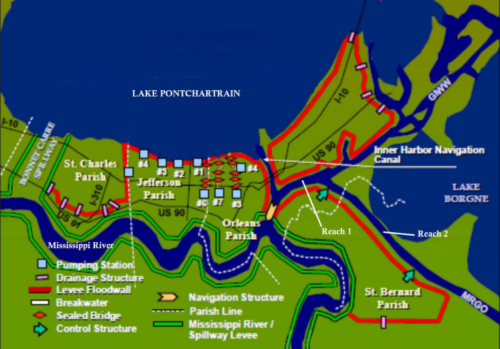
Last we checked in, the Federal Circuit (any guess on which judge?) held that the catastropic Katrina flooding — caused mostly by the federal government’s construction and maintenance of a navigation project, the Mississippi River Gulf-Outlet canal (known as MR-GO) — could only result in tort liability, for which the federal government has already been determined to be immune. MR-GO was an attempt to improve navigation, and it obviously wasn’t the sole cause of the flooding, but by all accounts (and the proof in the Court of Federal Claims) it ended up worsening dramatically and magnifying the effect of Katrina. The CFC concluded this was a taking, and awarded just compensation.

Now, St Bernard Parish has asked the Supreme Court to step in. Here are the Questions Presented:

In

Continue Reading New Cert Petition (MR-GO Katrina Case): Can Government *Inaction* Lead To A Taking?

Ah, the speed of the interwebs: we were all set to write something up about the California Court of Appeal’s recent opinion in Black v. City of Rancho Palos Verdes, No. B285135 (Sep. 6, 2018), when our friend and colleague Bryan Wenter beat us to it.

His post, “Court Rejects Residents’ Takings Lawsuits for Failure to Exhaust Administrative Remedies” pretty much tells the story. This same court a decade earlier concluded the City’s earlier version of a development moratorium was a Lucas taking. As Bryan writes,

Based on their interpretation of Monks II [that 2008 decision noted above], none of the landowners even filed an application for an exclusion from the moratorium. Instead, the landowners argued that Monks II absolved them of the need to exhaust administrative remedies or, alternatively, that exhausting administrative remedies would be futile.

Because the City might allow development if the owners

Continue Reading Cal App: No Taking For Development Moratorium Because Owners Had Not Asked For Development Permits