February 2018

Rogerspointmaine

In Bayberry Cove Children’s Land Trust v. Town of Steuben, No. Was-17-258 (Feb. 27, 2018), the Maine Supreme Judicial Court considered whether the Town’s exercise of eminent domain to take an interest to a road the public had apparently been using for decades (if not centuries) was for public use.

A 2013 survey, however, concluded that a part of the road “strayed outside the the bounds of the right of way as laid out by the Town in 1825, 1887 and 1944.” Slip op. at 3. The Trust, which owned the land on which that portion of the road was located, filed a quiet title action. In response, the voters of the Town, in a Town meeting (how very New England of them), rejected the Trust’s offer to pay the Town $150,000 in return for “discontinuing the road” (we presume that means discontinuing the public use of the

Continue Reading Maine: Condemnation To Wipe Out Quiet Title Action Is A Taking For Public Use

Here’s the cert petition, recently filed in a case we’ve been following from South Dakota

The statute at issue — the federal Uniform Relocation Assistance and Real Property Acquisition Act — isn’t one that gets a lot of attention, particularly at the Supreme Court. But it’s an area that is ripe for review. The issue in the case is whether a state may deny a property owner recovery of attorneys’ fees for a successful inverse condemnation claim resulting from a federally-funded SDDOT highway project.   

Here’s the Question Presented:

Congress, in 1970, established a uniform policy for compensation of legal costs as the result of unconstitutional takings of real estate. Congress required all federal agencies to pay a successful Plaintiff ’s legal costs when a citizen’s constitutional property rights were vindicated in an inverse condemnation action.

South Dakota refuses to comply with the policy Congress established. This Petition requests

Continue Reading New Cert Petition: Are The Relocation Act’s Attorneys’ Fee Provisions Merely Guidelines?

2018 LUI header Detroit-1

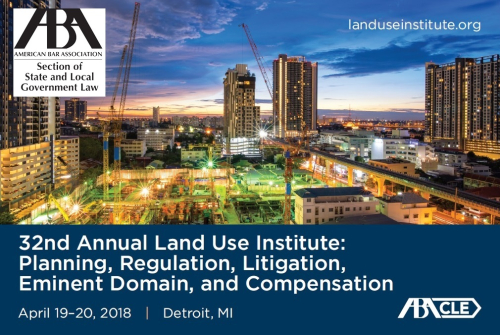
Mark your calendars, plan to come: Detroit, April 19-20, 2018. For what is perhaps the best deal in CLE (tuition as low as $400), the 32d Annual Land Use Institute, sponsored by our section of the ABA, the Section of State and Local Government Law.

The venue is the Detroit Mercy School of Law, and the conference hotel is the historic Westin Book Cadillac in downtown Detroit. The Land Use Institute is being held in conjunction with the Section’s Spring State and Local Law Conference. Register for one conference, and you are free to move between sessions (no additional registration fees).

Planning Chairs Frank Schnidman and Dean Patrica Salkin have assembled an excellent faculty and program for the two days. Topics include: “Nuts and Bolts of Land Use Practice: Vested Rights and Regulatory Takings,” “Public-Private Partnerships,” “Climate Change and Resilient Development,” “Client

Continue Reading 32nd Annual Land Use Institute: Detroit, April 19-20, 2018

Here’s one from the Hawaii Intermediate Court of Appeals, Cervelli v. Bufford, No. CAAP-13-896 (Feb. 23, 2018), in which the court considered whether homeowners who rented out rooms in their home to the public, but refused to do so to a lesbian couple, violated Hawaii’s public accommodation laws, or were sheltered from the statute by the Free Exercise Clause and other constitutional provisions.

In short, the court held they could be held liable, even though it is their home, first concluding that renting out a room in your home qualifies as offering a public accommodation, even though it is your residence. The owners advertise and offer rooms to the general public on their website and through third-party websites, rent to a large number of people (up to 200 nights per year), and pretty much takes all comers “aside from same-sex couples and smokers.” Slip op. at 11.

The potential

Continue Reading HAWICA: Vacation Rental Home Is “Public Accommodation,” And Can’t Discriminate Based On Sexual Orientation

Here’s the latest in a case we’ve been following since its inception, Brott v. United States, the case which asks the deceptively simple question of whether property owners who sue the federal government for a taking are entitled to both an Article III forum, and to have the issues determined by a jury.

The District court said no, as did the Sixth Circuit. The property owners’ cert petition asks this question:

Can the federal government take private property and deny the owner the ability to vindicate his constitutional right to be justly compensated in an Article III Court with trial by jury?

We filed an amicus brief in support, arguing that the “self-executing” nature of the Just Compensation Clause means that yes, property owner, you can bring a lawsuit for compensation if the government has taken your property: 

The government does not enjoy its usual sovereign

Continue Reading US BIO In Brott: No, The Fifth Amendment Isn’t Really “Self-Executing”

Here’s the cert petition, recently filed in a case we’ve been following as it has made its way from the Court of Federal Claims and through the Federal Circuit.

The underlying matter was litigated in the District Court and the Fifth Circuit. Those courts concluded that the plaintiff did not own mineral leases in Louisiana because under federal common law, it did not acquire any rights by prescription. The plaintiff then filed a Tucker Act claim in the in the CFC seeking compensation for a judicial taking on the theory that the Fifth Circuit’s ruling altered the plaintiff’s previously-established rights by changing the law.

The CFC accepted that fact as true, but concluded that the CFC has no jurisdiction to tell the Fifth Circuit it was wrong. The Federal Circuit affirmed, and here we are. 

Here’s the Questions Presented by the petition: 

In Stop the Beach

Continue Reading New Judicial Takings Cert Petition: Can A Federal Court Take Property By Changing The Law?

Here’s the cert petition, filed today by SCOTUS superstar Paul Clement in a case we’ve been following out of Northern California.

Here are the Questions Presented:

This case involves a stretch of private property along the California coast known as Martins Beach. The California Coastal Commission and the County of San Mateo want Martins Beach to be open to the public, but they do not want to pay to purchase the property, or even for an easement. Instead, they have taken the position that the owner of the property cannot exclude the public unless it first obtains a permit deemed necessary for any change, including a decrease, in the “intensity” of the public’s use of or access to the ocean under the California Coastal Act. In their view, because the previous owner of Martins Beach chose to allow members of the public to access the property upon payment of

Continue Reading New Cert Petition: Beach Access, Temporary And Permanent Takings, And Permits To Exercise The Right To Exclude

At the recent ALI-CLE Eminent Domain and Land Valuation Litigation Conference in Charleston, South Carolina, we held an after-hours preview of the upcoming feature film about the Kelo case, “Little Pink House.” (Based on Jeff Benedict’s book, which we reviewed here.)

The filmmakers graciously allowed us to preview it at the Conference, and we screened selected clips from the film (along with a few others from other eminent domain movies for comparison), and asked one of the lawyers depicted in the film (the Institute for Justice’s Dana Berliner) to comment: reality? Fiction? Somewhere in between? We’ll post a full review of the film soon, and let you know. 

Well, your chance to decide for yourself is coming soon. The producers have announced that the film has a release date, April 20, 2018. As the Hollywood Reporter noted:

The movie will be released in theaters

Continue Reading Coming Soon To A Theater Near You: “Little Pink House”

Here’s the latest in a case we’ve been following out of Louisiana, involving a local Port’s power to seize a Mississippi River docking facility downriver from New Orleans. The Port took the entire VDP facility, made no change in how the property was used, and eventually turned over operation of the facility to a “hand-picked” private operator. 

In St. Bernard Port, Harbor & Terminal District v. Violet Dock Port, Inc., No. 2017-C-0434 (Jan. 30, 2017), the Louisiana Supreme Court upheld the taking of VDP’s property by the Port so that the Port could run it itself. The owner challenged the power to take, as well as the compensation awarded. The Supreme Court held that the Port has the power to take the docking facility so that the Port could operate the facility, but on the issue of just compensation, the court agreed with the owner that it

Continue Reading Rehearing Sought In Major Public Use Case From Louisiana

Lo_wu_001

Mr. Song’s tale is harrowing: His property targeted for redevelopment. Offered compensation, but he believed that local regulations required payment of at least 45% more. When he attempted to negotiate, local officials said no deal. So he organized a protest at which he and his neighbors held signs that said things like “opposed to forced demolition.” They also “chanted slogans like ‘give me my fair compensation,’ ‘please do what is just,’ and ‘return to me what is mine.'”

For his troubles, he eventually was arrested, charged with “interfering with official duties.” (This tale, as you may have already deduced, takes place in the People’s Republic of China.)

During the three days Song was jailed, police tortured and beat him, and encouraged his cell mates to do the same. Song was forced to spend an entire night in a squatting position. The police also interrogated him about his alleged crime. When asked

Continue Reading Anti-Eminent Domain Protester Persecuted Because Of His Political Opinions