2018

We’re going to end 2018 with the latest in what we think was the most important issue of the past year (and which, we predict, will be the most important case in takings law for at least a decade when it likely gets decided in 2019), Knick v. Township of Scott, No. 17-647.

That case, as you well know, asks whether a property owner who alleges that a local government action has taken property but hasn’t paid the required just compensation is entitled to bring a lawsuit seeking just compensation under the Fifth and Fourteenth Amendments in a federal court.

Thirty years ago, in Williamson County, the Supreme Court said no. Or at least not until the owner has first pursued compensation via a state’s available procedures to recover compensation, assuming such procedures exist. Add to the mix the rules of preclusion and full faith and credit —

Continue Reading Wrapping Up 2018, And Previewing 2019’s Most Important Case: Final Briefs In Knick v. Township Of Scott

1126181629e_HDR

We’re almost there, but we still have room remaining. At the 2018 Conference in Charleston, we both sold out the registrations and the conference hotel, so we planned ahead for the upcoming 2019 Conference in Palm Springs at the Renaissance Palm Springs Resort

Register here. You will also be able to download the print brochure (above), or find out more details about the agenda and faculty on line. As always, we have assembled a great faculty — many of them new speakers — on the hottest topics in eminent domain and takings law: pipelines, jury presentations, challenging the take, an update on the most important decisions of 2018, pre-condemnation planning (from both the condemnor and property owner perspective), the border wall, and relocation. 

And of course, ethics and the “101” track for those new to the field, or experienced lawyers who would like a refresher on the

Continue Reading Space Remaining Is Limited – Register Now For ALI-CLE Eminent Domain And Land Valuation Litigation Conference (Palm Springs, Jan. 24-26, 2019)

Pitt lawprof Gerald S. Dickinson has written an interesting op-ed in the Washington Post, “The biggest problem for Trump’s border wall isn’t money. It’s getting the land.” The sublede poses an interesting thought: “Eminent domain fights could take years.”

Which raises the question, could it

Yes, it might, as Professor Dickinson notes. There’s the preliminaries, things like environmental and regulatory review. Negotiating with the property owners (if the feds either are required, or want, to go that route). There’s the special issue of the feds condemning lands occupied by tribes. 

But what about the biggest issue: are the feds going to use straight taking, or quick take (Declaration of Taking Act)? If the latter, any fights about compensation could get kicked down the road, and seizure of property — and construction — would not have to wait. 

We posted on this a while back (“

Continue Reading Op-Ed: Border Wall “Eminent Domain Fight Could Take Years.” Or Could It?

You might think from the caption of the Hawaii Supreme Court’s opinion in In re Contested Case Hearing on the Water Use Permit Application Originally Filed by Kukui (Molokai), Inc., No. SCOT-17-0000184 (Dec. 10, 2018), that, oh boy, we were about to get yet another pronunciation on Hawaii’s water law from the court.

Alas, not so. Search as you might, there’s nothing there that helps or hurts in the water law department. It’s only about administrative law. Specifically, when a party to an administrative proceeding has waived their right to demand a contested case (a trial-like proceeding in an administrative agency). 

Long backstory, but here’s the short version: when an applicant writes to the agency and states, “This letter is to inform you that Molokai Public Utilities (MPU) does not intend to continue to pursue this case on remand,” it’s not too surprising that the agency — and

Continue Reading HAWSCT’s Latest Water Case Isn’t About Water

Do you have “giver’s block” about an appropriate present this holiday season for that special dirt lawyer in your orbit? Well fear not, here are our modest suggestions for stocking stuffers.

Habit book cover

Start with this one, Howard Mansfield’s recently-published book “The Habit of Turning the World Upside Down.” As we discovered after reading the book and speaking with Mr. Mansfield a couple of weeks ago (here’s the podcast with our interview), his book is about property, property rights, and how these ideas are processed by the American psyche. But instead of the usual scholarly (and very often dry) treatment of these topics that we might expect – especially those of us in the legal and academic world – Mr. Mansfield takes a slightly different approach. He relates stories of how property fits in with the culture – the different and often competing narratives that are attached to the

Continue Reading Our 2018 Dirt Lawyer’s Holiday Gift Giving Guide

Today’s post is long, but, we think, worth the investment of your time.

Bankruptcy is the way to get rid of debt. Plaintiffs who have sued the debtor but who have not reduced the lawsuit to a judgment are unsecured creditors. Unsecured creditors for the most part, go to the end of the payment queue, and that usually means then get squat. 

In In re Stockton, No. 14-17269 (Dec. 10, 2018), a three-judge panel of the U.S. Court of Appeals for the Ninth Circuit addressed whether it makes a difference that the plaintiff is a property owner, and the lawsuit that has not been reduced to judgment is an inverse condemnation claim for a taking: can a city’s Chapter 9 bankruptcy reorganization plan shed the obligation to pay just compensation, or is an inverse condemnation claim protected by the Takings Clause from impairment? 

Over a strong (“adamant”) dissent, the

Continue Reading Ninth Circuit: Inverse Condemnation Plaintiff Must “Share The Pain” – City Can Shed Obligation To Pay Just Compensation In Bankruptcy, Which Is “Purely A Monetary Claim”

Here’s the Eleventh Circuit’s opinion in a case that adds to a circuit split (CA7 vs others) about whether a private condemnor, exercising the delegated federal power of eminent domain for a pipeline corridor under the Natural Gas Act, can obtain pre-judgment possession of the property, even though the NGA does not delegate the power to do so.

The Eleventh Circuit, like the Third and Fourth Circuits, concludes that the lack of delegation from Congress isn’t a problem, because, hey, Congress didn’t say that federal courts couldn’t exercise their “equitable” powers under Fed. R. Civ. P. 65, and issue injunctions to reach the same result.

We won’t go into the detail of the panel opinion (it pretty much tracks the other federal courts which have, for decades, been approaching this the wrong way). Nor shall we go into detail about why these courts are wrong, because we did so, in

Continue Reading CA11 Adds To Circuit Split: Private Pipeline Condemnor Can Get Immediate Possession, Even Though Natural Gas Act Doesn’t Delegate Quick Take Power

As we just detailed, the Eleventh Circuit joined the Third and Fourth (contra the Seventh) Circuits in concluding that a lack of Congressional delegation of quick take power to private pipeline condemnors in the Natural Gas Act does not stand in the way of a federal district court issuing an injunction to affect immediate pre-title transfer of property.

Read our amicus brief in the Third Circuit en banc process for why this is wrong.

Here is where the Sixth Circuit reveals its fundamental misunderstanding of eminent domain:

On appeal, Landowners do not dispute that Nexus holds a FERC certificate, that the 1.4-acre tract of land is necessary to build and maintain the pipeline, and that the parties have been unable to negotiate a voluntary easement by contract. This case appears to present a question not of whether Nexus has the statutory right to condemn Landowners’ property, but only of

Continue Reading CA6 Joins The Growing Circuit Split On Natural Gas Act Immediate Possession Injunctions

1207180945a_HDR

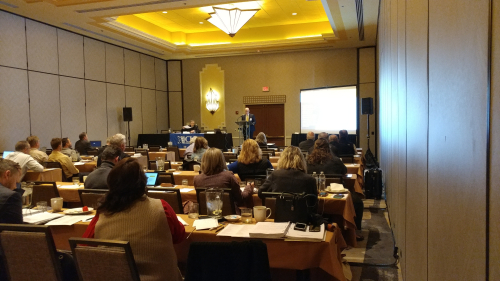
A very good and active crowd for today’s Eminent Domain Conference (CLE International) in Scottsdale, Arizona. It was good to visit with some old friends, and also to get to meet some new colleagues.

Our talk focused on national trends, and this year’s most interesting condemnation and takings cases. Here’s the links to the cases I mentioned that are not in the written materials:


Continue Reading Link’s From Today’s Eminent Domain Conference (Scottsdale)

Here’s the final brief for Ms. Knick, replying to the Township’s and the Solicitor General’s supplemental letter briefs.

It’s very short, so you should read it yourself. But here’s what we think is the highlight:

Williamson County is irreconcilable with the traditional view that a Takings Clause claim accrues (and is actionable in federal court) the moment government injures property without securing compensation. The Solicitor General ultimately concurs. SG Suppl. Brief at 6. Williamson County is also irreconcilable with the original understanding of Section 1983 as a law opening federal courts to unconstitutional takings suits, Monell v. Dep’t of Soc. Servs. of City of New York, 436 U.S. 658, 687, 687 n.47 (1978), and with exhaustion of remedies doctrine.

Br. at 4. 

Ms. Knick’s argument focuses — correctly, we think — on Kirby Forest Industries, Inc. v. United States, 467 U.S. 1 (1984), pointing out that “[s]ignificantly, a suit

Continue Reading Knick’s Supplemental Reply Brief: Injury To Property Triggers Right To Come To Federal Court