March 2017

We think we can find a takings angle in nearly anything. See here (net neutrality) here (the Supreme Court’s Obamacare decision), and here (a visit to Los Alamos, NM) for past examples. 

So when reviewing last week’s U.S. District Court (D. Hawaii) order granting a nationwide TRO prohibiting enforcement of President Trump’s executive order on immigration (something, we admit, has nothing to do with our usual topics — we were armoring up for the inevitable cocktail party questions), we came across the court’s reliance on several cases which allowed it to “go behind” the purported purpose of the EO, to get to the “real” reason it was adopted: religious animus. See Order at 32 (citing Church of the Lukumi Babalu Aye, Inc. v. City of Hialeah, 508 U.S. 520, 534 (1993); Village of Arlington Heights v. Metro. Hous. Dev. Corp., 429 U.S. 252, 266–68 (1977)).

We knew we had

Continue Reading The Eminent Domain Angle In The Hawaii Federal Court’s Immigration EO Ruling

As takings mavens are no doubt already aware, next Monday, the 8-Justice Supreme Court will hear arguments in Murr v. Wisconsin, the regulatory takings case which asks whether the county can avoid application of the Lucas wipeout standard on one parcel by taking advantage of the fact that the plaintiffs also own the adjacent parcel. Thus, the county argues, both parcels should be combined to determine how the regulation has impacted the property. 

Others have done a better job at previewing the issues than we could hope to (see SCOTUSblog, the National Constitution Center, and the Federalist Society), so we won’t do a big summary here, but will limit ourselves to pointing out what we think will be the key areas of contention. Go read the voluminous briefing as well. And with the Court one-Justice-down for this case, we’re certainly not going to even venture

Continue Reading SCOTUS Argument Preview: Does Fee Simple Absolute Mean Anything? The “Larger Parcel” Issue In Regulatory Takings

2012-02-06_11-19-58_634

Here’s a case you should be following which involves both public use and just comp issues, now before the Louisiana Supreme Court.

The case is an appeal in an expropriation case from a quick-take of a Mississippi River docking facility downriver from New Orleans. The Port took the entire VDP facility, made no change in how the property was used, and eventually turned over operation of the facility to a “hand-picked” private operator.

In St. Bernard Port, Harbor & Terminal District v. Violet Dock Port, Inc., LLC, No. 2016-CA-0096 (La. Ct. App. Dec. 14, 2016), the Louisiana Court of Appeals, over a strong dissent, rejected the owner’s arguments that the Port could not take the property for economic development, the taking was for private benefit, and the argument that the Port was really taking the property in order to obtain VDP’s contracts with the Navy. The court also

Continue Reading Eminent Domain Case To Watch: Violet Dock Port (Louisiana S Ct)

Here’s what we’re reading this Monday:

  • Preview of SCOTUS oral arguments in Murr v. Wisconsin. This is the “larger parcel” case which will be heard next Monday, March 20. The Cato Institute is having a session on it at its DC facility, “Rethinking Regulatory Takings.” If you can’t be there in-person, it will be live streamed. More here. We’ll have our own preview later this week. 
  • Our colleagues at the Massachusetts Land Use Monitor comes this report (“Regulatory Taking, Anyone?“) about a recent jury verdict which concluded that denial of a variance resulted in a loss of all beneficial use of property. And you know what that means, don’t you? 
  • Professor Ilya Somin writes about the “Potential pitfalls of building Trump’s Great Wall of eminent domain” in the Washington Post
  • Professor Gerald S. Dickinson adds his thoughts on the Wall:


Continue Reading Monday Links: Murr SCOTUS Preview, Mass. Reg Takings Verdict, Great Wall Of America, Train Takings

Montana

In Deschner v. State of Montana Dep’t of Highways, No. DA 15-693 (Feb. 28, 2017) the Montana Supreme Court agreed with the plaintiffs, who argued on appeal that the trial court had improperly instructed the jury about the requirements of inverse condemnation law. But the court affirmed the jury’s verdict of no inverse liability, because the jury had concluded that the Department wasn’t negligent, and hadn’t caused the damage to the home.  

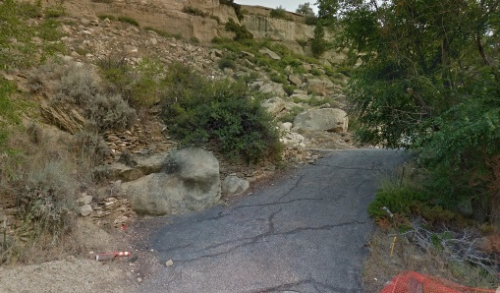
The Department maintained a highway on a bluff that apparently is some kind of attraction. Deschner’s home was at the bottom of the bluff, and one day, a two million pound sandstone slab crashed down on the home and destroyed it. As the photo above shows, the home was a total loss. The owners brought suit, alleging both inverse condemnation and negligence. The jury eventually ruled for the Department on both claims.

The homeowners

Continue Reading Montana: Inverse Condemnation Jury Instructions Were Bad, But No-Harm, No-Foul
West Virginia Dep’t of  Transportation v. Newton, No. 16-0325 (Mar. 7, 2017) was the second time that case had come before the West Virginia Supreme Court. As we noted here (“DOT Should Not Have Mined Privately Owned Limestone Without Owner’s Permission“), the court held that the the Department of Highways should have instituted eminent domain proceedings before it started removing Ms. Newton’s limestone from her land. After she prevailed in her mandamus action, WVDOH did so. 

As a result of the condemnation action, Newton was awarded nearly $1 million in compensation, and $250k in attorneys’ fees for the mandamus and condemnation actions under the Uniform Relocation Act, which is incorporated into West Virginia law. The URA provides for fee shifting when an owner is forced to initiate a claim for compensation.

WVDOH appealed, arguing that hey, we condemned Newton’s property (after she won her mandamus action), so

Continue Reading W Va: Relocation Act Attorneys’ Fees Required Where Owner Sues To Compel Condemnation

Can there be a more “Florida” name for a municipality than “Sunny Isles Beach?” Opinion may differ of course, but we think this one may take the prize.

That diversion aside, here’s today’s case. In City of Sunny Isles Beach v. Cavalry Corp., No. 3D15-1420 (Jan. 25, 2017), the Florida District Court of Appeal affirmed an eminent domain judgment and an award of just compensation, concluding that the trial court was within its discretion when it allowed the landowner to present evidence of “conceptual” site plans to establish the property’s highest and best use.

The city took property for a bridge, and “[f]or all the years since the current owner acquired title to the property and before, there has been no effort by an owner to develop the canal property.” Slip op. at 3. But at trial, the owner “contended at trial, based upon conceptual site plans prepared by one of its

Continue Reading Fla App: Highest And Best Use Doesn’t Require Owner Have More Than “Conceptual Plans”

Here’s the cert petition we filed today in an eminent domain case out of Mississippi. 

Rather than go on about what the case is about, here are the Questions Presented:

An inverse condemnation jury determined the Mississippi Transportation Commission (MTC) ceased using a highway-purpose easement granted to it in 1952 by Petitioner’s predecessor-in-title for a specific bridge, “Toll Project No. 1,” the U.S. Highway 90 crossing of Bay St. Louis. In 2005, Hurricane Katrina destroyed the bridge. MTC removed Toll Project No. 1 and built an entirely new bridge in a different location, and converted the majority of Petitioner’s land into a public recreational park. This discontinued the specific use authorized by the easement, and Petitioner should have immediately recovered unencumbered possession. The jury determined MTC’s new uses were not highway purposes within the 1952 easement, and MTC had taken Petitioner’s property. The court, however, instructed the jury to calculate

Continue Reading New SCOTUS Just Comp Cert Petition: Can Jury Value Property As If Burdened By Extinguished Easement?