
October 2016

The title to this Think Tech Hawaii video says it all.

Grassroot Institute Hawaii’s Dr. Kelii Akina hosts the Goldwater Institute’s Timothy and Christina Sandefur for a talk on the status of property rights, and what’s being done about it.

[Barista’s note:we’ve been on the road the past week after the Brigham-Kanner Property Rights Conference, and not really able to post. But we’ll get back to it soon, with a further report on the Conference as well as some good cases that have come down in the interim.]Continue Reading How Secure Are Private Property Rights In Hawaii? Find Out Here.

Here are the remarks we were to have presented today, the second day of the 2016 Brigham-Kanner Property Rights Conference, being held in The Hague, Netherlands at the International Court of Justice. The panel subject was “Property Rights in Intangible Assets.” We were unable to deliver them due to the panel running of of time, one of the dangers of being the last speaker in a lineup of four. [Protip: if ever you’re on a speaking panel, you might want to think about slotting yourself ahead of the others; some pay no regard to those behind them in the queue, exceed their allotted time significantly (even after being notified that their time is up), and don’t even bother to acknowledge their lack of respect for others.] But no matter, here we go.

Defining and Protecting Property Rights in Intangible Assets:
New Frontiers, Uncharted Waters

As you might already be able

Continue Reading Brigham-Kanner Property Rights Conference, The Hague: Property Rights In Intangible Assets

IMG_20161020_141639

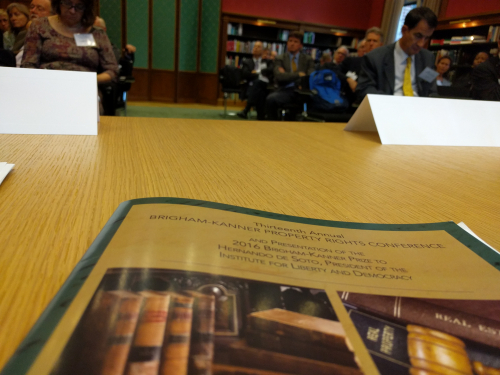
Several years ago, William & Mary Law School’s Brigham-Kanner Property Rights Conference departed its usual Williamsburg, Virginia venue and held the event in Beijing. Holding the conference there allowed U.S. legal scholars and property law practitioners to share ideas and compare our ways with our PRC counterparts. The event was a great success.
IMG_20161020_091110 (3)

Now, W&M has followed up with another international venue for the Conference: the World Court (Peace Palace), in The Hague, Netherlands.

The Conference kicked off last night with a reception honoring this year’s Brigham-Kanner Prize winner, Peruvian economist Hernando de Soto, who opened the Conference this morning with a summary of his work and theories. One of the most intriguing is that the “Arab Spring” was a cry for property and economic rights.Count us as convinced. 

IMG_20161019_203955

The panels began their presentations today. Ours focused on how property rights contribute (or not) to developing nations. My

Continue Reading In Peace And In War: 2016 Brigham-Kanner Property Rights Conference At The World Court

6a00d83451707369e201b7c89b1d5e970b-500wi

The complete agenda, faculty list, and other information (including registration and early and group discounts) for the 2017 ALI-CLE Eminent Domain and Land Valuation Litigation Conference is now up and ready

The conference will be held January 26-28, 2017, at the Westin San Diego. Please consider joining us for the premier national conference on all things related to eminent domain, takings, and property law. You will learn a lot, meet your colleagues from around the country, earn a ton of CLE credits, and have some fun too. 

Continue Reading ALI-CLE 2017 Eminent Domain And Land Valuation Litigation Agenda, Faculty List, And Registration Now Live

Recall that in the wake of the overwhelmingly negative reaction to the U.S. Supreme Court’s decision in Kelo v. New London, at least one of the Connecticut Supreme Court justices whose previous ruling was upheld, expressed his regrets. Others have made similar remarks. 

Well, here may be a chance for the Connecticut Supreme Court to right the ship, so to speak. Later this month, the court will be hearing oral arguments in a case asking whether a state agency’s power to take “land, buildings, equipment or facilities” includes bus companies’ exclusive state-granted rights to operate bus routes. The bus companies have what amounts to a monopoly under state-granted certificates.

While this case doesn’t squarely present the same issue as in Kelo (that may be coming later, in other cases which are making their way up the Connecticut chain), it does represent a chance to see whether the Connecticut Supreme

Continue Reading Sorry Not Sorry? Connecticut Supreme Court Has A Chance To Make Amends For Kelo

Here are two cases about a topic that’s been getting a lot of traction lately in legal circles: how to deal with the so-called sharing economy. You know, things like Uber, Lyft, Air BnB, and … DogVacay. [Sidebar: that last one reminds of us Jack Handey’s faux sponsor of SNL‘s “Unfrozen Caveman Lawyer” series, “Dog Assassin” (“When you can’t bear to put him to sleep, maybe it’s time to call … Dog Assassin.”)].

This is such a developing area right now that our section of the ABA (State and Local Government Law) has formed a Sharing Economy Committee to try to discover what the rules are and should be. Ping me if you want to be a part of this group — all are welcome

Uber, Air BnB, and DogVacay aren’t taxis, or hotels, or dog walking services, they say. But they

Continue Reading Peak Posner At The 7th Circuit: Cab Companies Were Chumps To Rely On A Govt Monopoly To Protect Them From Competition

Here’s the amici brief we’re filing in a case which we told you about earlier, involving the way attorneys’ fees get calculated when a statute allows fee shifting. 

This is the afterglow of a rails-to-trails takings case, in which the property owners are entitled under the Uniform Relocation Act to attorneys’ fees. We like. 

What we didn’t like was the way the trial court arbitrarily cut the property owners’ fee request, without ever explaining why. The court simply made an across-the-board percentage reduction from the “lodestar” (a reasonable hourly rate times a reasonable time per task). And the Federal Circuit affirmed. 

So the property owners sought cert review, and now we’ve filed a brief in support. Our brief focuses on the first Question Presented: “Whether trial courts have discretion to make across-the-board percentage adjustments to the lodestar fee and, if so, what “specific proof” or “explanation” must the

Continue Reading SCOTUS Amicus Brief: Court Can’t Arbitrarily Reduce A Lawyer’s “Stock In Trade”

We all know that the Supreme Court’s 5-4 decision in Kelo is lousy. See “Kelo at 10: Still Stinks, And A Decade Has Not Lessened The Odor.”

Or at least most of us know that. But other than crying in our beer, or trying to get the case overruled (efforts continue!), what is there to do, given that the decision remains “good law?”

Well, here’s some suggestions from our Owners’ Counsel of America and ABA State and Local colleague Dwight Merriam, to soon be published in the Connecticut Law Review, “Time to Make Lemonade from the Lemons of the Kelo Case,” 48 Conn. L. Rev. ___ (forthcoming 2016). 

Intrigued? Here’s the abstract:

The decision in Kelo v. New London only addressed the constitutionality of the eminent domain process used to take Susette Kelo’s home. Given the four corners of the case

Continue Reading New Law Review Article: “Time to Make Lemonade from the Lemons of the Kelo Case”

We were getting ready to dig into the California Court of  Appeal’s opinion in 616 Croft Ave., LLC v. City of West Hollywood, No. B266660 (Sep. 23, 2016), when our ABA State and Local Government Law colleague Bryan Wenter wrote up the case on his firm’s land use blog, saving us the trouble.

The opinion is, in his words, “the first reported appellate decision to rely upon the broad holding of the California Supreme Court’s blockbuster 2015 affordable housing case, California Building Industry Assn. v. City of San Jose, and it boldly highlight the far reaching implications of that ruling.” As Bryan writes, “it also underscores the ongoing need for the United States Supreme Court to finally address whether the heightened scrutiny of the Nollan, Dolan, and Koontz Fifth Amendment takings cases applies to legislatively imposed permit conditions.”

Go read Bryan’s summary and excellent analysis

Continue Reading Cal App: In-Lieu Housing Fee Isn’t An “Exaction,” And Isn’t A Taking