February 2016

You can really breathe in San Jose
They’ve got a lot of space
There’ll be a place where I can stay.
I was born and raised in San Jose
I’m going back to find some peace of mind in San Jose

Today, in this order after a series of rescheduled considerations that had seen the U.S. Supreme Court repeatedly delay the conference, the Court declined to review the California Supreme Court’s decision in California Building Industry Association v. City of San Jose.
That’s the case in which the California Supreme Court upheld the city’s “affordable housing” requirement against a challenge which asserted that it was an exaction and thus should have been subject to the heightened scrutiny of the unconstitutional conditions doctrine of Nollan, Dolan, and Koontz. The California court disagreed, holding that because the ordinance did not require a developer to give up land, or

Continue Reading Cert Denied In Cal Affordable Housing “Exaction” Case

Here’s what we’re reading today, two pieces on seemingly unrelated topics:

We found these posts to be good companion pieces because in the first, Professor Kanner points out that the nomination and confirmation process is political because the business of judging is political (“So with a judicial atmosphere like that, not only in takings law but in other fields as well, we should not be surprised when citizens eventually decide that what comes out of the marble palace in Washington, is actually more like a

Continue Reading Thursday Reading – The Politics Of Judicial Nominations, Electing Judges: Two Sides Of The Same Coin?

Colorado’s Constitution prohibits the use of proceeds from the state lottery, which are used to fund the “Great Outdoor Colorado Program” Trust Fund from being “used to acquire real property by condemnation through the power of eminent domain.” Colo. Const. art. XXVII, § 9. 

The Town of Silverthorne used trust fund money on a recreational trail project, a part of which required the condemnation of Lutz’s land. Lutz objected to the taking, arguing that the Town lacked the power to take because the constitution “barred the Town’s exercise of eminent domain power to acquire the easement rights over the landowners’ property.” 

In Town of Silverthorne v. Lutz, No. 2015COA17 (Feb. 11, 2016), the Colorado Court of Appeals disagreed, concluding that the constitutional prohibition only extended to using trust fund money to “acquire” land by eminent domain, and since the Town was not using the money to actually pay compensation, but was

Continue Reading Colo App: Town Can Use Lottery Money For Trail Project, Despite Constitutional Prohibition On Using Funds To “Acquire” Property By Eminent Domain

Worth couldn’t get to his “Section 30 property” except from Evans’ land, or from his own land after fording the 102 River.

So Worth sued Evans in a private condemnation (essentially seeking an easement by necessity). Evans filed a petition alleging that Worth could not use the eminent domain power because Worth had reasonable access to his land by way of crossing the 102 River. “Although the parties agreed there is no public or existing private access to the property, Evans claims Worth could acquire private access to the property across the 102 River by making some minor modifications to the area.”

Too hard, countered Worth. The modifications necessary to make the river crossable “is neither possible nor financially reasonable.”

Unfortunately for Worth, the trial court agreed with Evans. Evans testified that he built a “vented low water crossing” back in 2004 for $15,000. “All you have to

Continue Reading The Water Isn’t That Wide: Parcel Isn’t “Land Locked” For Private Condemnation If You Can Build A River Crossing

Let’s say that you didn’t know much about regulatory takings, or municipal employment and Fair Labor Standards law (in our case, the latter would most certainly be correct). And let’s say you were asked to predict how the plaintiff would fare with a claim that the city’s regulatory regime for taxicabs was so oppressive that it resulted in taxi drivers effectively working for less than minimum wage, and thus the city must make up the difference, on either of two theories: (1) the regulatory scheme is a taking, or (2) taxi drivers are city employees and the city must pay the difference between minimum wage and the amounts actually earned.Any guesses whether she succeeds?

We don’t think it would be too hard to predict that the plaintiff got nowhere, on either theory.

In Callahan v. City of Chicago, No. 15-1318 (Feb. 17, 2016), the U.S. Court of Appeals for the

Continue Reading 7th Circuit: Bring Your Regulatory Takings Claims In Federal Court (At Least Those That Come Out Of Illinois)

Appropos of nothing really, but we’re going to end this work week by recounting for you something we heard during testimony yesterday at a government agency hearing. You land use types will recognize this one, but we think this took the “unilateral agreement” fiction to new heights:

“We couldn’t reach agreement with [the other party] so we couldn’t do a bilateral agreement, so instead we did a unilateral agreement.”

Got it.Continue Reading A Unilateral Agreement

Kirbyncsctarguments2-2016

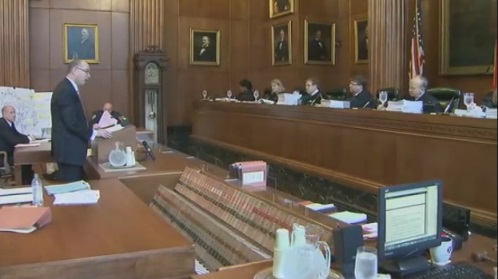
All of the drama playing out in the North Carolina Supreme Court yesterday as the court heard oral arguments in its review of Kirby v North Carolina Dep’t of Transportation, No. COA14-184 (Feb. 17, 2015) came down — as they often do in these things — to a single question from the bench, and an advocate’s response. At about the 8:40 mark on the the video, this colloquy took place:

Q [Justice Newby]: How would you characterize the benefit, or the purpose of the Map Act. Isn’t it to set in place the value of the property … by restricting improvements or subdivision to keep the ultimate cost of the project at a particular level?

A [NCDOT counsel]: Well that is certainly one aspect or element of the rationale behind the Map Act. The public purpose and benefit can be broadly described as coordinating future road projects with current

Continue Reading NC Supreme Court Hears Arguments In Important Takings Case

Miss-I95-intersection

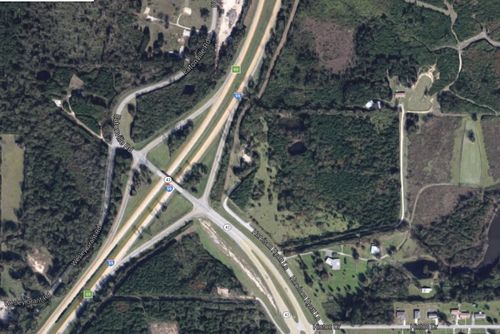
A pretty straightforward one from the Mississippi Supreme Court. Mississippi Transportation Comm’n v. United Assets, LLC, No. 2014-SA-01181-SCT (Feb. 11, 2016), involved a partial taking by MDOT at the intersection of I-59 and Highway 42.

The state’s appraiser concluded that commercial development was the highest and best use of the land and settled on the sales comparison approach, explaining “that, when taking the sales comparison approach, the appraiser arrives at a value using sales of real estate similar to the subject property, making adjustments as needed for differences between each sale and the subject property.” Slip op. at 3. After concluding that the remainder parcel’s HBU was also commercial development, he opined that just compensation for the taken land was $826,035.

Perhaps not surprisingly, the property owner’s witnesses disagreed. First its appraisers, a real estate agent, and one of its members testified that the remainder parcel could not be

Continue Reading Mississippi: Like Everywhere Else, In Eminent Domain You Snooze, You Lose – Condemnor Didn’t Object To Appraiser’s Failure To Rely On Market Data

At the recent ALI-CLE Eminent Domain and Land Valuation conference in Austin, Texas, I had the opportunity to interview Ted Balaker, Producer of the upcoming feature film about the Kelo v. New London case, Little Pink House, who took time out of his busy schedule to come to Austin and join us. 

Based on Jeff Benedict’s 2009 book, Little Pink House: A True Story of Defiance and Courage, the film stars Catherine Keener (Capote) as Susette Kelo and Jeanne Tripplehorn (The Firm, Basic Instinct) as the head of the New London Redevelopment agency.

Ted gave us an inside look at the film (which has completed principal filming), brought some photos from the set, and gave us a preview of what the film will cover. 

This is not the entire interview — you’ll have to have registered for the ALI-CLE program

Continue Reading Podcast: Interview With Ted Balaker, Producer Of The Upcoming Kelo Movie “Little Pink House”

Update: Rick Rayl has this post (“Eminent Domain Takes Center Stage in Republican Presidential Race“) at the California Eminent Domain Report.

+++++++++

With one exception — a repost of our review of the docfilm You’ve Been Trumped (“If You Are Even Thinking Of Voting For Trump…“), we’ve gone out of our way to avoid getting sucked into the debate on which GOP presidential candidate has the worse record on the abuse of the eminent domain power.

Others have analyzed it better (see, e.g., “Trump Does Not Understand Eminent Domain Law” from Gideon Kanner; “Donald Trump’s lightweight defense of taking property for private development” by Ilya Somin, for example), and there is little that we can add to those expert takedowns.

But we couldn’t resist posting the video above, a Ted Cruz campaign ad attacking The Donald on eminent domain:

Continue Reading Has The Eminent Domain Meme Finally Jumped The Shark?