August 2014

A reminder: the 11th annual Brigham-Kanner Property Rights Conference is coming up on October 30-31, 2014, at the William and Mary Law School in Williamsburg, Virginia. As we noted earlier, Michael Berger will receive the Brigham-Kanner Prize, so this one is special – he’s the first practitioner to receive the Prize.

More here, from W&M, including agenda and registration information. Here’s the flyer.

We’re going – hope to see you there. 

11th Annual Brigham-Kanner Property Rights Conference – Oct 30-31, 2014 – Michael Berger

Continue Reading October 30-31, 2014: Brigham-Kanner Property Rights Conference @ William & Mary Law

Today must be election contest day at the Hawaii Supreme Court. We say that because the court today disposed of all three election contests which were filed stemming from the postponed Puna precincts primary and other primary election problems.

Earlier, we posted the court’s order dismissing for lack of subject-matter jurisdiction the original jurisidiction action filed by several voters from Puna and the ACLU Hawaii, which asked the court to allow them to vote because they were prevented by the tropical storm which whacked the Big Island on primary day. Now we have decisions on the merits in the other two election contests which were filed by the deadline.

In Waikiki v. Nago, No. SCEC-14-0001072 (Aug. 28, 2014), the court issued findings of fact and conclusions of law, and held that an election contest which complained about the state’s Chief Election Officer temporarily misplacing 800 Maui County votes

Continue Reading The Other Two Election Contests To The Postponed Puna Precincts Primary Also Dismissed

Here’s the Order Granting Motion to Dismiss, just filed in Lathers v. Abercrombie, No. SCOT-14-0001069 (Aug. 28, 2014).

That’s the original jurisidiction action filed by several voters from Puna and the ACLU Hawaii, which asked the court to allow them to vote because they were prevented by the tropical storm which whacked the Big Island on primary day. 

The State defendants sought dismissal, and the court agreed that it lacked subject matter jurisdiction:

Plaintiffs concede that their complaint is “not a typical ‘election contest’” within the meaning of HRS §§ 11-172 (2009) or 11-173.5 (2009) and that they do not meet the statutory requirements for an election contest. Further, the court does not have jurisdiction under the statutory and constitutional provisions cited in the Complaint and First Amended Complaint to grant the relief requested. Therefore,

IT IS HEREBY ORDERED that the motions to dismiss are granted. The

Continue Reading HAWSCT Dismisses Postponed Puna Precincts Primary Challenge

Here’s our latest article, from the upcoming edition of The Practical Real Estate Lawyer, via ALI-CLE.

Despite its grand title, “A Full and Perfect Equivalent for Just Compensation: The Historical Context and Practice,” its just a short piece that asks whether just compensation is the next big thing, identifies three issues in just compensation in eminent domain that may be on the horizon, and urges the Supreme Court to provide some guidance on this issue.   

Continue Reading New Article: “A Full and Perfect Equivalent for Just Compensation: The Historical Context and Practice”

EM Hauulaeminent_domain_abuse

Remember that case which we posted about earlier, in which the City and County of Honolulu condemned an undeveloped lot in rural Oahu for a fire station, but has been met with staunch resistance by the property owners? Not only did we post on the case, but it made national waves, also.

The City filed an eminent domain action in state court, and obtained a writ of immediate possession. After that, the City removed the eminent domain protest signs the owners had maintained on the property. The owners objected, filing a complaint in U.S. District Court alleging that the City went on the property and posted a “removal notice” under the City’s newly-adopted “Bill 54,” an ordinance allowing the City to seize property “stored” on public property provided it “tags” it 24 hours in advance, and that the removal was retaliation for the signs’ content.

The complaint alleges that the

Continue Reading Hawaii Federal Court: “Quick-Take” In Eminent Domain May Not Give Condemnor Exclusive Possession

Update: an astute reader notes that “election contests” in the Hawaii Supreme Court actually have their own separate designation in the case numbering system, “EC.” Thus, a election challenge is labeled as “SCEC-xxxxxxx.” Which means that, for whatever reason, the ACLU’s case which we posted on below and earlier was not labeled as an election challenge at all, but as an “Other.” We don’t think that the case designation or numbering has any substantive effect, mind you, but do find it interesting that the complaint calls the action an “election challenge” yet it’s neither labeled as such, nor was the jurisdiction of the court invoked under the election challenge statute. A big mahalo for the input. 

+++++++++++++++++++++

You can tell what kind of case is before what Hawaii appellate court by the case designation at the top of the fist page flysheet. First two letters are the court, second

Continue Reading Great SCOT! Actually, No “SCOT” According To State: ACLU Complaint About Postponed Puna Primary Not An “Election Contest”

Yesterday at 4:30 p.m. was the statutory deadline for instituting an “election contest” in the Hawaii Supreme Court to challenge last Friday’s postponed Puna precincts primary (say that quickly five times).

As those of you who have been following along know, the state’s Chief Election Officer determined that voting would remain open in two Big Island precincts due to the impacts of Tropical Storm Iselle on primary day. He could have ordered a delay of up to 21 days and the use of mail-in ballots, but after some waffling, determined that the two-precinct election would be held one week later, with in-person voting. All of this while the reports of the impact of the storm just seemed to get worse each day as the residents of Puna dug themselves out, and the true scope of the damage made its way to the media.

National eyes were watching, because the

Continue Reading “Not A Typical Election Contest” Filed Over Postponed Puna Primary

Here’s an opinion from the California Court of Appeal, issued last month but unpublished, which was recently ordered published by the court. It’s a lengthy (38 pages) and somewhat detailed opinion, but for those of you who do eminent domain, it’s a worthy read because it covers many bases, and covers them well.

First, the bottom line of San Diego Gas & Elec.Co. v. Schmidt, No. D062671 (July 21, 2014, published Aug. 13, 2014). Condemnor’s just compensation deposit: $712,200. The jury’s award: $8,034,000. That’s over an eleven-fold difference. Lowball Watch alert! 

The case involved the taking of an easement for power lines, and the issues revolved around the highest and best use of the property (the jury agreed with the owner that mining was the highest and best use, and rejected SDG&E’s claim that residential development or habitat mitigation was the highest and best use), the method of valuation

Continue Reading Cal App: Highest And Best Use Isn’t Limited To Current Uses

2010-03-24 15.24.40
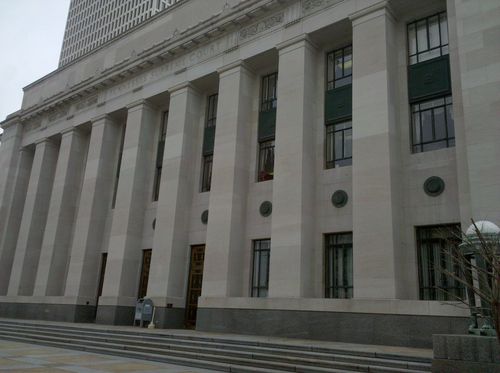
Tennessee Supreme Court, Nashville

In Phillips v. Montgomery County, No. M2012-00737-SC-R11-CV (Aug. 18, 2014), the Tennessee Supreme Court held that a property owner could recover under the state’s inverse condemnation statute, Tenn. Code Ann. § 29-16-123, for a regulatory taking:

We hold that, like the Takings Clause of the United States Constitution, article I, section 21 of the Tennessee Constitution encompasses regulatory takings and that the Property Owners’ complaint is sufficient to allege a state constitutional regulatory taking claim, for which they may seek compensation under Tennessee’s inverse condemnation statute, Tennessee Code Annotated section 29-16-123.

Slip op. at 12.

That’s all well and good, and we applaud the court for doing so. But wait a minute, you say, that statute and this issue sure sound familiar.

Indeed they do. This is the same statute which the U.S. Supreme Court, in Williamson County Regional Planning Comm’n v. Hamilton Bank

Continue Reading Tennessee Finally Recognizes Regulatory Takings Cause Of Action – A Quarter Century After The US Supreme Court Wrongly Assumed It Did

Pasadena, California, in addition to loving roses, apparently loves trees.

The city owns 60,000 street trees, and as the City Arborist testified in City of Pasadena v. Superior Court, No. B255800 (Aug. 14, 2014), “the City catalogued these trees in a database, that he ‘headed an urban tree maintenance program,’ and that ‘[t]he City strives to enhance the quality of life through the promotion, protection, and balanced management of … trees.'” Slip op. at 9.

One day, however, one of those trees fell on the home insured by Mercury Casualty Company. 

Mercury paid the homeowner, then looked to the City for damages in subrogation, asserting nuisance and inverse condemnation. Under California law, inverse condemnation liability arises when property is injured by a public project or improvement in which the defendant substantially planned, approved, constructed, or operated. As the court noted:

The sole issue here is whether the

Continue Reading Cal App: City-Owned Tree Might Be A “Public Improvement” Supporting Inverse Condemnation Claim