August 2012

DK_Film_banner_re3

There’s still time for you to attend one (or more) of the screenings in our upcoming law film series. In conjunction with the Doris Duke Theatre at the Honolulu Museum of Art, we’re screening five films about lawyers and the law:

  • The Castle (for that eminent domain connection, naturally) (September 4)
  • Counsellor at Law (a forgotten John Barrymore classic about a private lawyer in New York) (September 5)
  • Anatomy of a Murder (James Stewart, George C. Scott, Lee Remick, and Ben Gazzara. Plus a Duke Ellington score) (September 6)

Each film will be introduced by a Damon Key colleague, who will lead a discussion of the issues raised following the

Continue Reading Still Time To Join Us For The Lawyer Film Series At The Honolulu Museum Of Art

Here’s the latest inverse condemnation opinion from the Wisconsin Supreme Court in a case involving overflights from an adjacent airport. The case arose when property owners asserted that an extension of the runway by 1500 feet was a taking. The trial court dismissed the property owners’ inverse condemnation claims, but the court of appeal reversed and revived their claims.The airport authority sought review by the Wisconsin Supreme Court, which affirmed.

The decision was summarized by the Schober & Mitchell blog:

The Court took into consideration the fact that Wisconsin Statutes Section 114.03 and 114.04 gave property owners certain rights with respect to airspace over their properties. It determined referring to federal case law that the proper standard to be applied in determining whether a taking occurs in airplane overflight cases is whether the government action results in aircraft flying low enough and with such frequency as to have a

Continue Reading Airspace In Wisconsin Is Property – Overflights May Be A Taking

The Cato Institute, the National Federation of Independent Business, the Center for Constitutional Jurisprudence, and the Reason Foundation have filed an amicus brief in Horne v. United States, No. 12-123 (cert. petition filed July 25, 2012).

This is the case in which the petitioners argue that they are entitled to raise the Takings Clause as a defense to the government’s assertion that they are raisin “handlers,” and thus required to turn over a huge percentage of their raisin crop to the government without compensation. We posted the cert petition here.

As the Cato@Liberty blog details:

Property owners shouldn’t be made to suffer a needless, Rube Goldberg-style litigation process to vindicate their constitutional rights. Yet that is exactly what the U.S. Department of Agriculture seeks to impose on independent raisin farmers Marvin and Laura Horne when they protested the enforcement of a USDA “marketing order” that demanded that the

Continue Reading Cato’s Amicus Brief In California Raisin Takings Case

Check this out. A report from the Maui News that “Environmental court would be perfect fit here – judge.” Apparently, there is an effort to get the Judiciary or the Legislature to form another court with specialized jurisdiction, either formally like the Family Courts, or more likely on a less formalized basis like the “Drug Courts” that the circuit courts convene.

And who is recommending the formation of such a court? Why a judge from just such a court in Memphis, Tennessee:

“I’ve learned over the years that if you get them by the wallet, their hearts and minds follow,” Potter said to about 100 people at the Maui Arts & Cultural Center.

Potter said that an environmental court here is a perfect fit – and long overdue. There’s just so much to protect and balance in this delicate paradise, he said.

“The environment is everything here. It’s

Continue Reading Does Hawaii Need An “Environmental Court?” – Doesn’t It Already Have One?

An interesting new complaint filed in U.S. District Court in Hawaii, asserting claims for substantive due process, violation of the zoning enabling act, and the Kauai County Charter.

A owner of property that has been designated for resort development for 35 years is asserting that the adoption by the County’s voters of a charter amendment severely limiting the number of visitor accommodation units (no more than one new unit, and other restrictions), was an attempt to restrict the number of visitors and part-time residents. The complaint asserts that the County has no legitimate interest in restricting tourists or part time residents, and that the charter amendment is a zoning regulation that cannot be adopted by the voters (recall that in Hawaii, zoning ordinances may not be adopted by initiative – thanks to a case we argued many years ago – see here and here).

We’ll keep track of this

Continue Reading New Complaint Challenging Kauai’s Limit On Visitor Units

Here’s the federal government’s merits brief in Arkansas Game & Fish Comm’n v. United States, No. 11-597 (cert. granted Apr. 2, 2012), the case in which the Federal Circuit held that flooding caused by the Corps of Engineers was only temporary, and did not result in a compensable taking merely because it eventually stopped, and “at most created tort liablity.” The dissenting judge concluded that temporary flooding was no different in kind than more permanent flooding that occurs in other inverse condemnation cases, and regularly results in awards of compensation. The Federal Circuit’s opinion is here.

As you might expect, the brief phrases the Question Presented somewhat differently than the property owner/petitioner’s brief:

The Court of Federal Claims found that during several years in the 1990s, temporary and irregular changes in water releases from a flood-control dam operated by the United States Army Corps of Engineers marginally

Continue Reading Fed Govt’s Brief: “Temporary And Irregular Inundation Of Wetlands” (Read: Flooding) Is Not A Taking

In a short opinion in Sierra Club v. Castle & Cooke Homes Hawaii, Inc., No. CAAP-11-0000625 (Aug. 24, 2012), the Hawaii Intermediate Court of Appeals held that the Hawaii Senate’s failure to confirm a sitting Land Use Commissioner for a second term did not disqualify him under Haw. Rev. Stat. § 26-34(a):

Kanuha was not disqualified under HRS § 26-34(a) as he had not been a commissioner appointed consecutively to more than two terms as a member of the LUC not had his membership on LUC exceeded eight consecutive years. Not obtaining Senate consent to a second term did not disqualify Kanuha from service as a holdover after the expiration of his first term. This was not a disqualification under the plain language of HRS § 26-34(a). The circuit court erred in holding that Kanuha was not a valid holdover for failure to obtain Senate confirmation for

Continue Reading HAWICA: Holdover Land Use Commissioner Not Disqualified

This just in: as we predicted after oral arguments (see HAWSCT Oral Argument Recap – Who Defines The “Project” For Archaeological Review? and The Real “Descendants” Plays Out In The Hawaii Supreme Court – Honolulu’s $4+ Billion Rail Project In Grave Danger), in a unanimous opinion, Hawaii Supreme Court has slapped down the City of Honolulu’s archaelological inventory survey, holding:

In sum, the SHPD failed to comply with HRS chapter 6E and its implementing rules when it concurred in the rail project prior to the completion of the required archaeological inventory survey for the entire project. The City similarly failed to comply with HRS chapter 6E and its implementing rules by granting a special management area permit for the rail project and by commencing construction prior to the completion of the historic preservation review process.

Slip op. at 6. The court vacated the trial court’s decision, and sent

Continue Reading Hawaii Supreme Court Smacks Rail EIS – City Needed To Evaluate Burials For “Entire Project” Before Starting To Build

According to the Washington Post, a Texas county judge has concluded that TransCanada is a common carrier, and therefore may exercise eminent domain to take property for its Keystone XL pipeline.

In an unusual twist (but one which we fully expect to see more of as smartphones become ubiquitous), the court apparently informed the parties of his decision by an email or text from his iPhone:

Dear Counsel,
 
My rulings as follows:
 
Transcanada’s MSJ is GRANTED
Transcanada’s NEMSJ is GRANTED
Crawford’s Plea to the Jurisdiction is DENIED
 
Mr. Freeman would you please forward orders consistent with my ruling for my signature?
 
Sent from my iPhone

At least he didn’t include an LOL or 🙁 to add further insult to the injury. Continue Reading Judge Not BFF To Landowner, Grants MSJ To Condemnor Via iPhone. SRSLY.

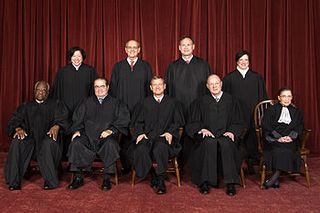
350px-Supreme_Court_US_2010

According to a recent poll, 2/3 of Americans could not name a single Supreme Court justice. This news was predictably met with calls for remedial civics lessons … The horror!

But we say: so what if your average citizen can’t identify Justice Kagan, or Justice Kennedy, or the Chief Justice.

Isn’t that why you hire lawyers? It’s our job —  not the average citizen’s — to know who staffs the relevant courts, from the high-and-mighty on the Supreme Court on down to our local municipal judges, and how to pitch our clients’ cases to them.

Besides, there isn’t a lot your average citizen can do about the Supremes and their decisions once they are on the Court — they enjoy life tenure, the Court’s public hearings are not telecast on C-SPAN or the internet, and unlike many of their state counterparts, they don’t campaign (at least in the traditional

Continue Reading No One Knows The Names Of Supreme Court Justices. Who Cares?