January 2011

U. Hawaii law student Stewart A. Yerton has published a comment in the most recent issue of the Asian-Pacific Law and Policy Journal, “Procedural Standing and the Hawaii Superferry Decision” How a Surfer, a Paddler, and an Orchid Farmer Aligned Hawaii’s Standing Doctrine with Federal Principles.”

From the Introduction:

This paper will examine the background law and the procedures, strategies, and arguments the Superferry plaintiffs employed in order to attain standing, as well as the arguments the defendants used in an attempt to keep the plaintiffs out of court. Part II will outline federal and state environmental standing doctrine, paying specific attention to cases most relevant to Superferry. The section will conclude with a brief statement of Superferry’s factual background. Part III will analyze four subjects: (1) how the plaintiffs’ lawyers convinced the court to navigate precedent and firmly establish procedural standing in Hawaii, (2) the

Continue Reading Worth Reading: Law Review Comment On Hawaii’s “Procedural Standing” Theory And The Superferry Case

Check this out. The Hawaii Legislature is considering a bill requiring the State and the counties to take private roads, waterways, and water courses “upon request” of an adjacent landowner:

(a) Upon request by the owner of land adjacent to a privately owned highway, waterway, or watercourse, the State shall initiate condemnation proceedings for a public purpose pursuant to section 101-2, unless the State makes a written determination that a county is the more appropriate jurisdiction to initiate condemnation proceedings on the private property. For the purposes of this section “private property” means a privately owned highway, waterway, or water course.

(b) If the State declines to exercise its power of eminent domain to condemn the private property pursuant to subsection (a), then the county in which the private property is located shall initiate condemnation proceedings pursuant to section 101-14.

(c) In fixing the compensation to be paid for condemnation

Continue Reading Hawaii Legislature Considering A Bill Requiring State Or Counties To Take Private Roads Upon Request By Adjacent Landowner

512n15x1gdl_ss500_

Hat tip: the Clancy Brothers‘ “They’re Moving Father’s Grave to Build a Sewer” (via Gideon Kanner). As we noted in our earlier post, life has imitated art: Chicago is seeking to take cemetery and move the graves in order to expand O’Hare airport.

As reported here (“High court ducks battle between O’Hare, cemetery), the saga now appears to have ended. The Illinois Supreme Court has denied review of the court of appeals’ September 2010 decision allowing the condemnation.

The court of appeals concluded that the claims of the living relatives of the residents of St. Johannes Cemetery were adjudicated in federal court when the district court dismissed their complaint for failure to state a claim and the Seventh Circuit affirmed. Thus, their subsequent claims in state court were res judicata (that means “claim preclusion” to you young ‘uns).

Here, all claims, both federal and state, clearly

Continue Reading “Now, What’s The Use Of Having A Religion, If When You’re Dead Your Troubles Never Cease…”

In Cobb v. City of Stockton, No. C062328 (Jan. 26, 2011), the California Court of Appeal (3d District) concluded that the property owner’s claim for inverse condemnation for a physical invasion of his property was not barred by California’s five-year statute of limitations, even though the City took possession nine years earlier.

In 1998, the City initiated an action in eminent domain to take a portion of the Cobb’s property for a road. The City deposited its estimation of just compensation into court after which the court placed the City in prejudgment possession of the land. The City built the road, and the property owner withdrew the deposit. In 2007, nine years after it was filed, the court dismissed the condemnation action because it was not brought to trial within five years as required by California law.

A few months later, Cobb instituted an inverse condemnation action. The City

Continue Reading Cal Ct App: Inverse Condemnation Statute Of Limitations For Physical Taking Begins When Invasion Becomes Wrongful

Update: Rebecca Copeland has posted a short summary of Justice Alito’s remarks on her Record on Appeal blog here.

++++++++++++++++++++++++++++++++++++++++++++++++++++++++++++++++

Justice_Alito_Justice_Acoba Join us later today at 4:30 p.m. HST (6:30 p.m. PST, 9:30 p.m. EST) for the live blog of U.S. Supreme Court Associate Justice Samuel Alito’s remarks to the Hawaii Bar, “Top Things You May Not Know About the U.S. Supreme Court.” Justice Alito is in town for the University of Hawaii Law School’s “jurist in residence” program.

Rebecca Copeland will be leading the live blog. Our Damon Key colleagues summarized several Alito opinions on their blogs: Mark Murakami’s summary is here, and Tred Eyerly’s (focusing on Alito’s opinions relating to insurance law issued while he was a Circuit Judge) is here.

Continue Reading Live Blog Of Justice Alito’s Remarks To The Hawaii Bar: “Top Things You May Not Know About the U.S. Supreme Court”

Just received this email.

+++++++++++++++++++++++++++++++++++++++++++++++++++++++++

To members of the HSBA:

Governor Neil Abercrombie has announced today his first judicial nomination, subject to Senate confirmation:

Sabrina Shizue McKenna as Associate Justice on the Hawai‘i Supreme Court.

Comments on this nominee are sought in order to allow the HSBA Board to provide an informed recommendation to the Senate confirmation committee.  If you desire to do so, please submit your comments on the nominee as soon as possible, but no later than 12 noon, Thursday, February 3, 2011.  Please be as specific as possible in your comments and confine them to the following criteria used by the HSBA Board in reviewing a nominee:

Integrity and Diligence
Legal Knowledge and Ability
Professional Experience
Judicial Temperament
Financial Responsibility
Public Service
Health
Ability to fulfill the responsibilities and duties of the position

You may submit your comments by replying to this email [info@hsba.org] which is returned to

Continue Reading HSBA Requests Comments On HAWSCT Associate Justice Nominee Sabrina S. McKenna

Update: Circuit Judge Sabrina McKenna has been appointed by Governor Abercrombie as an Associate Justice of the Hawaii Supreme Court.

* * * *

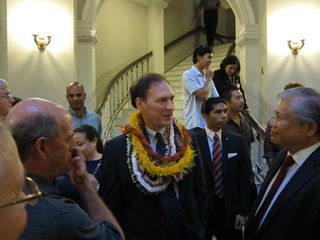
At noon Hawaii Standard Time on Tuesday, January 25, 2011, we’ll be live blogging Hawaii Governor Neil Abercrombie’s announcement of his choice to be the next Associate Justice of the Hawaii Supreme Court. This seat was vacated by Justice Mark Recktenwald when he was appointed as the Chief Justice by Governor Lingle.

Our Damon Key colleague Rebecca Copeland will be in the room covering the announcement.

This is Governor Abercrombie’s first appointment to the court. Breaking from past tradition, he has not publicly announced the list of candidates transmitted to him from the Judicial Selection Commission, so this really will be a surprise announcement. See Ian Lind’s critique here.

Under Hawaii law, the appointment is subject to confirmation by the Hawaii Senate. As we recently

Continue Reading January 25, 2011: Live Blog Of Announcement Of HAWSCT Associate Justice Nominee

Regulatingparadise For those of you who do not yet have your copy of University of Hawaii lawprof David L. Callies‘ recent book Regulating Paradise – Land Use Controls In Hawaii, here’s your chance to get it signed by the author himself.

This Saturday, January 29, 2011 from 2:00 to 3:00 p.m., Professor Callies will be selling and signing at the Barnes & Noble at Ala Moana Center.

As we wrote in our initial review of the book, it’s a must-have for every dirt lawyer’s bookshelf. It is the one essential book if you want to understand Hawaii land use law, so it also belongs on the shelf of every Hawaii landowner, government regulator, environmentalist, and politician. At $22, it is a real bargain. Continue Reading Book Signing: Regulating Paradise – Land Use Controls In Hawaii (2d ed. 2010)

As noted by my blogging colleagues, U.S. Supreme Court Associate Justice Samuel Alito is  coming to Honolulu next week to participate in the U.H. Law School’s “jurist in residence” program, and to address the Bar. (Mark Murakami summarized several of Justice Alito’s more important opinions here, and Tred Eyerly summarizes his opinions that relate to insurance law issued while he was a Circuit Judge here.)

Justice Alito will be speaking about “Top Things You May Not Know About the U.S. Supreme Court” on Wednesday, January 26, 2011 at 4:30 p.m. at the Hawaii Supreme Court courtroom.

Justice Alito’s most “Hawaii-centric” opinion was in Hawaii v. Office of Hawaiian Affairs, 129 S. Ct. 1436 (2009), where he authored the opinion for a unanimous Court. In that case, the Court held that the United States held “absolute fee simple” title to Hawaii’s ceded lands, and

Continue Reading Justice Alito Is Coming To Town – Time To Re-Read His “Ceded Lands” Opinion

As we noted in this post, last week the Hawaii Intermediate Court of Appeals heard arguments in Pavsek v. Sandvold, No. 29179. In that case, the court is considering whether a complainer can circumvent the City’s enforcement procedures and the administrative appeal process by instituting an original jurisdiction lawsuit claiming that a homeowner is renting her property in violation of the City’s prohibition on rentals of less than thirty days.

We didn’t live blog the argument or analyze the issues because our firm represents one of the appellees (my Damon Key partner Gregory Kugle argued the case).

Here’s the streaming audio:  

ICAOA_011211_29179

Or you can download it here (caution, it’s a 85mb mp3).

Well worth a listen.
Continue Reading Oral Argument Recording In HAWICA Case: Can Complainer Avoid The Administrative Process By An Original Jurisdiction Lawsuit?