
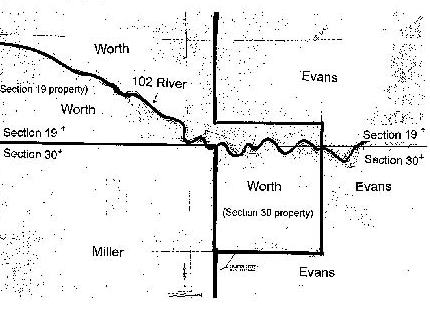
Worth couldn’t get to his “Section 30 property” except from Evans’ land, or from his own land after fording the 102 River.
So Worth sued Evans in a private condemnation (essentially seeking an easement by necessity). Evans filed a petition alleging that Worth could not use the eminent domain power because Worth had reasonable access to his land by way of crossing the 102 River. “Although the parties agreed there is no public or existing private access to the property, Evans claims Worth could acquire private access to the property across the 102 River by making some minor modifications to the area.”
Too hard, countered Worth. The modifications necessary to make the river crossable “is neither possible nor financially reasonable.”
Unfortunately for Worth, the trial court agreed with Evans. Evans testified that he built a “vented low water crossing” back in 2004 for $15,000. “All you have to do is make a crossing, then it’s good to go.”
The Iowa Court of Appeals affirmed. In Evans v. Worth, No. 14-2099 (Feb. 10, 2016), the court concluded that building a vented low water crossing was feasible, and thus Evans’ property wasn’t the only way for Worth’s property to gain access:
Worth testified the forty-acre parcel at issue was worth $8000 per acre. And by accessing it, Worth would be able to earn income on the property by putting it into crop production. Considering the cost of constructing a way across the natural obstruction, and considering the value of the land benefited by the crossing, we conclude the cost is far from disproportionate to the value of the land. Consequently, we conclude Worth’s property is not land locked because reasonable access can be gained by constructing a crossing at a reasonable cost under the test of proportionality. We therefore affirm the district court’s ruling granting Evans’s petition and enjoining Worth from proceeding with condemnation of an access across Evans’s land.
Slip op. at 10.
Evans v. Worth, No. 14-2099 (Iowa App. Feb. 10, 2016)