
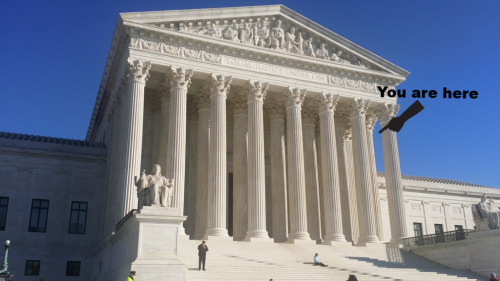
In case you were on Mars yesterday, you are aware that putative frat boy Brett Kavanaugh is up for a seat at the most exclusive club in law land, Alpha Alpha Alpha, otherwise known as the U.S. Supreme Court.
We said pretty much all we’re going to say about what Judge Kavanaugh becoming Justice Kavanaugh might mean for the stuff we’re interested in in this post, “What Might A Justice Kavanaugh Mean For Takings, Land Use, And Other Issues?” We certainly can’t add much more to the deep, probing insights the confirmation hearing has provided so far.
But we also noticed that we haven’t actually gone back through the decade-plus of his opinions from the D.C. Circuit or our blog archives to see if any decision in which he participated provided a clue on how he might lean on the property-related question of the day. Especially the one that could come up this week during the confirmation circus: how might he treat eminent domain and 2005’s infamous Kelo v. City of New London decision?
Well, nothing on point (as our Associates frequently respond when we task them with finding case law to support our theories). Not really surprising. The D.C. Circuit doesn’t get much of this stuff. Eminent domain and takings law involves most often state and local authorities, and the bulk of the D.C. Circuit’s docket is taken up with federal government issues. Besides, as we know, federal courts don’t do much takings law generally, due in large part to Williamson County, which punts most of these cases to state courts (at least for now). But we did find one case in which he sat on the panel, and it presented a Williamson County issue. And — at least procedurally — a Public Use issue.
As we noted in “Public Use Challenges Not Subject to Williamson County Ripeness,” a post about the D.C. Circuit’s panel opinion in Rumber v. District of Columbia, 487 F.2d 941 (D.C. Cir. 2007), the issue before Judge Kavanaugh was whether a landowner challenging the public use of a taking needs to utilize state compensation procedures before seeking relief in federal court. Short answer: no. (Yes, this is our old friend, the Skyland Shopping Mall case (or, more precisely, cases ).)
Judge Kavanaugh did not write the opinion, but merely joined in Judge Rogers’ writing, which held:
We find the reasoning of the majority of the circuits persuasive because the Fifth Amendment Takings Clause protects two distinct rights and Williamson County does not explicitly require exhaustion for all Fifth Amendment claims. We, therefore, hold that the ripeness requirements of Williamson County do not apply to public use claims under the Fifth Amendment. Because appellants challenged the Skyland Acts as a “taking [ ] for a private use and not for a public use,” Compl. ¶ 114; see also id. ¶¶ 106, 109, we reverse the dismissal of the complaint with respect to the public use claim.
Not a lot to hang your hat on if you’re trying to predict which way he’s going to lean in the future based solely on his past output, to be sure. But man, it is something.
And isn’t it interesting that the first property case he’d consider were he confirmed and seated by the time the Court’s term opens next month is a case asking the Court to overrule a part of Williamson County?